
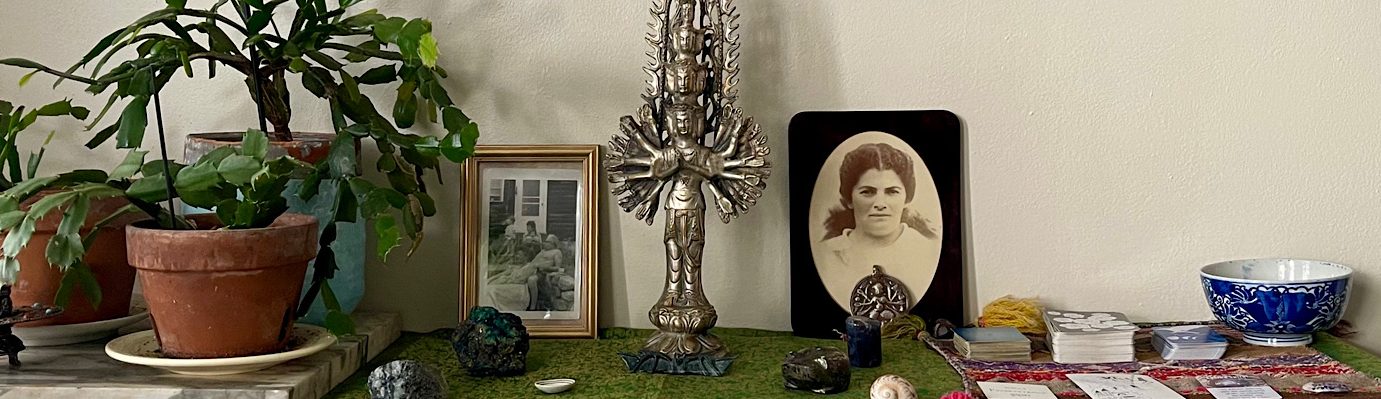
“How I Got Into Yoga”
Filed Under Art and Culture, Asana, Pranayama, and Yoga Practice, Community and Family, Food for the Mind (Yoga Philosophy, etc) | Leave a Comment
I enjoyed reading Amy Ippoliti’s blog entry on her first yoga class. My story is here (sorry, it takes two clicks), for those of you have not yet read it. What is your story? Does thinking about it help you reflect on how yoga has shifted your life?
Another Storm Passes Without Any Rain Falling Inside the Beltway
Filed Under Art and Culture, Asana, Pranayama, and Yoga Practice, Community and Family, Food for the Body, Food for the Mind (Yoga Philosophy, etc), Gardening | 1 Comment
What’s a gardener and concerned for the trees and the health of the planet citizen to do? I’ve got enough water in the rain barrel to water the vegetables and herbs once or twice, but what impact does that really have? At work, people were grumbling because it was cloudy. They seemed shocked when I advised them that we are an inch under normal rainfall for August and have a fairly significant deficit for the summer despite the July rains.
Wouldn’t it be great if we could move some of the flood waters that have fallen only a couple hundred miles away to irrigate our fields without disrupting our eco-system? Part of me just wants not to know about the consequences of global climate change, but it is hard not to notice that all the weather patterns I used to know and understand do not seem to apply quite the same way anymore. What do we do when the systems and practices we have in place for our ease, comfort, well-being, and understood day-to-day peace of mind are disrupted?
Yoga will not fix the big outer problems, but it can provide us with the steadiness and ease needed to stay present and be flexible in the face of crisis, upheaval, or disease. It can also provide insight into how we can live in better alignment. In the meantime, I am practicing gratitude. I know how blessed I am that, so far, the wild upheavals I read about in the news have not kept me from all the food and comfort that a person could possibly want. And I pay attention, because to be ignorant ultimately never serves ourselves or others.
What a Good Murder Mystery Can Teach Us About Sadhana
Filed Under Art and Culture, Asana, Pranayama, and Yoga Practice, Food for the Mind (Yoga Philosophy, etc), Meditation | Leave a Comment
Surely that’s what life was all about? Opening doors and peering through them–perhaps even finding the rose gardens there… (Colin Dexter, The Dead of Jericho)
The good murder mysteries — the ones that teach much about human nature and do not dwell graphically on gore and violence — can teach us much about the power of sadhana (yoga practice). The best mysteries are ones in which the protagonist teaches us by his or her investigation into the mystery that with careful, steady discipline, the application of well-developed technique and study, consistent effort, and an openness to trust intuition tempered by discrimination, we can reveal to ourselves the truth of the matter. The truth revealed is not just the identity, means, and motive of the murderer (mystery solved), but the knowledge of the extraordinariness of human being in all of its manifestations, both good and evil.
Breathing Exercises to Aid Sleep
Filed Under Asana, Pranayama, and Yoga Practice | Leave a Comment
A regular brought a friend to this week’s group house practice. When I asked whether there was anything about her health or practice I should know to enhance her experience in the class, she advised me that she had been having trouble sleeping for the past few months in response to an event in her life. I did not ask about the event, but offered some of my favorite practices when I am not easily falling asleep:
1. gentle ujayi breathing with the exhale twice the length of the inhale. We were sitting up, but this is great to do in vipariti karani (legs up the wall pose).
2. chandra bhedana (the moon breath). This is similar to nadi shodana (alternate nostril breathing) except that for every breath, the inhale is through the left (ida or chandra nostril and the exhale through the right (pinga or surya) nostril.
3. This one I learned from work place yoga teacher Kathy Rowley with whom I took lunch time classes at the Department of Labor for a couple of years. I am not sure I remember it exactly the way she taught it, but it works:
Start lying on one side. Take sixteen deep breaths, keeping count of the breaths, with the exhales longer than the inhales. Quietly roll to your other side and take another sixteen breaths. Continue switching sides, slowly and without disturbing growing sleepiness, each set of two doubling the number of breaths you take. After 16 on both sides, then 32 on both sides, then 64, and so on (though so on is unlikely). Let the breaths get slower and deeper and when you get to the point where it does not seem right to switch sides, then you let yourself sink into deep relaxed sleep.
A Key to a Steady Home Practice (Letting Go of Preconceived Notions)
Filed Under Asana, Pranayama, and Yoga Practice, Meditation, Photos | Leave a Comment
One of the things most likely to keep us from having a steady home practice (whether asana or meditation or both) is being unable to live up to our own expectations or preconceived notions of what is a proper or good home practice. If we think that we need to do a certain amount for an established length of time or that we have to feel fit enough to do a particular range or poses than inevitably we will be challenged in practicing regularly in a busy life.
It is good to have a set time and place for our practice and to try and practice for a length of time that will foster the growth and balance in ourselves that we seek from our practice. To stay steady, though, we have to be flexible with our expectations. When we are sick or injured or exhausted, it will be appropriate to do restoratives or a gentle practice rather than a more vigorous one, even if we are accustomed to doing more advanced asana. If we are pressed for time, even if we like to spend 45 minutes to an hour in the morning, perhaps we will do 25 minutes. If we usually meditate in a special place in the house, but we have to leave for the airport at 6am, we can find a quiet moment to breathe for three minutes before we leave the house and then meditate on the plane.
This morning, for example, I knew that the only opportunity to have a walk would be early morning because the electricians are coming for more work towards installing the solar panels. Having a walk on days I am working at home is critical for my ability to sit at my desk and concentrate. Instead of doing my usual 45-60 minutes of practice, which gives me time for some asana and pranayama before sitting for meditation followed by savasana, I chose to sit for 25 minutes and then go for a walk. I will practice more this evening when I am off work.
Once we give ourselves permission to be flexible about how much to practice and what, then it will be easier to stick to practicing. I think it is far more important to practice several times a week than to have a practice that is thorough and “by the book” but is only done sporadically. What are your challenges in developing a steady practice? If you have a steady practice, what has helped you stick to it? Have your expectations about what a practice should be interfered with your practicing?
“Inspiration Cards”
Filed Under Asana, Pranayama, and Yoga Practice, Food for the Mind (Yoga Philosophy, etc), Meditation | Leave a Comment
I adore having a library and will rarely say no to a philosophy text or a book about anatomy, therapeutics, or yoga methodology. I am less interested in “self help” types of books or gadgets. Every once and a while though, I come across something that truly supports my practice and my teaching. When I first went to Inner Harmony to study with John Friend in mid-2003, there was an altar in the corner of the practice room, just at the entrance. On the altar was a set of cards (a little smaller than 2″x2″). Each card had a word in English, the devanagari, and the sanskrit of the word transliterated into our alphabet. Following the lead of others who had been to Inner Harmony for previous retreats, at the beginning of the day, I would select a card and think about how the word on the card might inform my practice and intention.
At that time, I was first starting to use Anusara’s “heart-oriented posturing language,” using a theme for class that was designed to lead the students into a deeper place in their hearts through their asana practice, and I found that the cards were an excellent source of inspiration.
Even though I first bought the cards in 2003 to serve as a basic class preparation aid, I have continued to use them regularly for my own practice and contemplation. Often, the word that appears resonates with something that is of immediate concern. The day after Becky (my beloved cat who lived to be 21) left her body last year, I went to the set of cards, which I’d not used in a couple of months. The card that I selected at random (like picking a card from a deck when someone is showing you card tricks) was moksha — liberation, and in classic yoga, literally liberation from the body. I was moved to tears.
This summer, with myself and my students, we have been working on manifesting intention. As I’ve blogged about previously, I invited us to think about an intention. Whether an intention is something basic with the body or mind or something more universal, whenever we seek to manifest an intention, ultimately it is because we want to be more blissful, more open, and more at peace with ourselves and others. The question becomes how do we use our practice both to discover an intention and to seek to make it manifest. To help me with the contemplation of this question, I have gone again to the cards as a source of inspiration. This week, the card that turned itself up was racanatmakata — creativity. “Perfect,” I thought, when I saw the word. Creativity is a human reflection of the wild, pulsing, diverse and ever-extraordinary dance of all being. When we open to our creative impulse to allow things to unfold, we can witness the fullest range of possibilities and the variety of paths to manifestation.
Belated Happy Birthday
Filed Under Asana, Pranayama, and Yoga Practice, Community and Family | Leave a Comment
When I took class tonight with Kate Miller at Willow Street, she reminded us that yesterday was the 13th anniversary of Anusara yoga’s officially being Anusara yoga. How delightful to celebrate with each other this yoga that invites us to play, to dance, to celebrate each other and ourselves.
Waking Up in the Dark (a Hint of Autumn)
Filed Under Asana, Pranayama, and Yoga Practice, Gardening | Leave a Comment
This week I have really noticed the light changing. When I start my morning meditation, the day is just dawning, not full daylight. The cat is not waking me up an hour before the electronic wake-up call, but is rather showing up just before it goes off (he is acting in sync with my routine rather than with the birds’). Even though the days are still hot, there are hints of autumn in the smell of the leaves and certain breezes. The first of the late summer fruits and vegetables are starting to come.
Are you noticing the subtle shifts? Has it changed what you want to practice and how you are feeling when you practice?
What Does It Mean to Be Yogic? (and “The New York Times Article”)
Filed Under Asana, Pranayama, and Yoga Practice, Community and Family, Food for the Mind (Yoga Philosophy, etc), Meditation | 5 Comments
This weekend, a friend whose marriage of decades is precipitating towards dissolution, said to me, “I am having trouble reconciling being yogic and still needing to do what I need to do in connection with divorce. How do I deal with that?” I told her about a yoga principle I learned at the first Inner Harmony Retreat I attended with John Friend in the summer of 2003. He had asked a student a question that yielded as the answer the four yoga principles of ardha (physical and material well-being), kama (relationship, including intimate and love relationships), dharma (life path or work), and moksha (liberation or freedom). The fellow student answering the question, who was also my teacher, gave the classic yoga explanation that we try to do the first three elements in alignment so that we can then transcend and go beyond them to become free (enlightened). John replied that was the traditionally correct answer in dualist, classical yoga, but that from the tantric perspective of a person living in the world as a yogi, we look apply the principles differently. By living in a way that we have taken care of our physical and material well-being, have happy and loving relationships, and work with delight and passion that we will be embodying a life of the spirit; we will then be living and embodying freedom (jivanmukti). That encapsulation of tantric yoga resonated deeply and is a significant part of why I have chosen a path of tantric yoga rather than one that preaches renouncing the body and mind (which I think is impossible for one staying in the world).
My friend’s question seemed especially significant to me in light of the dialogue that has ensued following the publication of the New York Times article on John Friend, John’s blog in response, and the Elephant Journal interview. The essence of the article and the reactions, to me, seem to be about the intersection of our “outer” notions of societal success–fame and fortune–and yoga and whether the two can be reconciled. The New York Times article is obviously intended to be sensational and to create controversy; that is what makes a journalist who gets fame and fortune. But the alleged tension highlighted in the article is indicative of a bigger societal confusion of how and whether we can be spiritual or religious beings and also have human needs and wants. Ours is a society that hungers for panaceas and palliatives. In “discovering” yoga and its benefits in the late 20th century, far too many have put onto it expectations that have no basis in what is yoga and how it is supposed to aid us.
There is no word in yoga philosophy or in India for “yogic.” The word “yogic” is a western creation of relatively recent vintage. Webster’s dictionary does not have it as a separate word, but just has it at the end of the definition of “yoga” as “adj, often capitalized.” What do we mean by being “yogic?” It seems that we have gotten this notion that if we practice yoga seriously or teach it, that means we must be perfectly pure and good. We will need only light and air to nourish our bodies (and maybe a little local raw food in season); we will have neither needs nor desires; we will be so suffused with peace, compassion, and equanimity, that we never feel or show anger or grief, even in the face of injustice, violence, pain, or outrageous behavior. We expect that somehow we will be a perfect monk while still living with family and going to work.
We expect this not only of ourselves, but even more so of our teachers. In essence, we somehow expect yoga to release us from the realities of being human. To have such expectations inevitably will lead to disappointment in ourselves and our teachers (for being unable to reach this impossible ideal) or in the practice (both for not yielding this ideal and for, in our delusion, creating this expectation in the first place). My meditation and philosophy teacher Paul Muller-Ortega would say that to have such expectations is “adolescent” spirituality. When we practice “adult” spirituality, we take responsibility for ourselves and our own practice. We expect our teachers to offer us the teachings, but we honor and recognize them as human beings.
To practice yoga sincerely while still living in the world should make us more humane to ourselves and to all around us, not beyond being human. This is the true essence of Anusara yoga. To be richly and freely and wonderfully human and feel great love and compassion for that, even as we balance the realities of life with attempts to live in greater alignment. I am incredibly grateful for the teachings and the community that John Friend has created and the offering to study and get as deeply into the yoga as makes sense for me. Whether there are things I might do differently in the realm of ardha, kama, or dharma if I were “the yoga mogul” is of little moment because to find moksha we all strive to do our best in our own way (and one thing I know of John is that he always strives to do his best).
Hope Springs Eternal
Filed Under Asana, Pranayama, and Yoga Practice, Meditation, Photos | 1 Comment
Uma and Sully know that if they keep coming to their food bowl at some point it will be full. So too, I am firm in my belief that if I keep coming to my mat and my meditation cushion, I will experience the fullness of being, even though I do not experience it every time I show up. Without showing up, though, I would never get to sip the exquisite nectar of consciousness.
keep looking »