Asana, Pranayama, and Yoga Practice | Community and Family | Food for the Mind (Yoga Philosophy, etc) | Photos | Quaker
Be Here Now (Var.)
April 19, marching from the Washington Monument to the White House
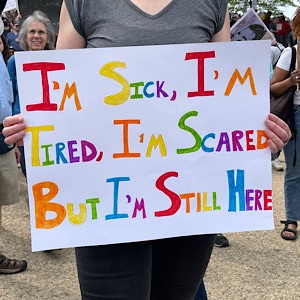
April 19, marching from the Washington Monument to the White House
As those of you who are regular readers may recall, I have been working to use solar energy to provide most of my electric power. The solar installation was complete in late August, and the public utility responsible for changing the meter to reflect the input of my solar energy to the grid advised on September 3rd that the meter would be changed within three to five weeks. Week five came and went. Week six, I wrote to the utility and asked why nothing had been done. My tone was appropriate, and I did not let it upset me, but still I felt the need to take action. I was advised that the metering people would be contacted, and it would be done or I would hear back within the week. Week six passed with not a word. Now it was week seven. I wrote again asking why I hadn’t gotten a response. The answer was that I deserved to be frustrated and should complain to the public service commission.
I filed a complaint; after all, I was directed to do so by the very entity against which I had the complaint, but was advised by the public service commission that it could take 30 days to respond to my complaint. Meanwhile, my house was continuing to be powered by mountaintop coal mining and nuclear power. This wouldn’t do. I contacted my solar contractor and asked for assistance. The solar contractor had connections with the commission. This morning I received a very apologetic call from a supervisor at the electric company. The meter was installed later in the day (although I still need for the electric company to “authorize” “my use” of the meter–not going to try and understand that one). The authorization is supposed to be processed tomorrow.
Here’s where the apparent disconnect between responding “from the highest” and not being a doormat came into play in my mind. The reason I got an immediate response was not the delay, but my documenting the foolishness of having been advised that the next step was to file a complaint instead of having been told the actions that the employee was taking to try and address my concerns. I work for the government. I know that is something that is wholly unacceptable, and my having used the inappropriate response to my inquiry to make sure I got a result will likely result in unpleasant repercussions for the employee.
This situation triggered a memory of an airport episode in the days when I was still flying around the country as a litigator. When nearly everyone else at the airport was traveling for the holidays (it was December 22nd), I was flying out of National Airport to Hartford to take a deposition the next day. I was waiting in a long line to check-in (this was long before the days of e-ticketing), and the airline announced the flight was canceled and that they would be putting all of us on a bus to Dulles airport on a flight that left two or three hours later (it was already the end of the work day). I was a bit cranky, I am sure. I asked in a way that everyone could hear, keeping in mind I had a ticket that could be changed, whether there were flights on any other airlines going to Hartford from National that night. Gosh, apparently, no one had thought of that or was hoping that no passengers would ask for such a response since it would have a cost for the airline. Within a half hour, several of us were re-booked on a flight with another airline leaving from National. No bus. Hardly any delay. A college-aged woman who ended up with the benefit of the re-booking looked at me with her eyes shining, “are you are lawyer?” she asked. I’ve always thought I might have been responsible for changing her life by having not stood for being treated badly, who knows whether it ultimately was for good or ill.
I often hear people saying that speaking up, taking action, refusing to suffer inappropriate, unjust, or unnecessary conduct is “bad.” What is the difference between being passive and responding from the highest? Where do we draw the line?

Peace and light, E — Posted with WordPress for BlackBerry.
Snowdrops have been showing up for more than a week, but crocuses? They seem a little incongruous with the bitter winds and as much a reminder of global warming as of spring. I feel a bit confused seeing them, though delighted.
It has been a good winter. I have learned to appreciate the cold and dark, which gives us time to enjoy the pleasures of home and introspection. Now, I am looking forward to spring, the effusive colors, the warmth, the ability to get back out into the garden.
This time of year, with the radical contrasts of cold winds and flowers does highlight the play of opposites, the very pulsation of existence — in yoga terms, the spanda. This time in society seems to have a similar play of bitterness and sweetness. Staying steady with our yoga practice and our community, we can delight in what we see and what we have, even as we may be worried and working for change. That too, is part of the play (lila). To invite in a steady warmth and support from our practice and our community, even as we see difficulties and challenges, want things to be different, and know that our work may not necessarily bring about the change we seek.
I went on Saturday evening after teaching two classes and a workshop. I arrived at the 5:20 show of Harry Potter just as the opening credits were rolling, having intentionally missed the ads and the trailers (17 minutes of them by my clock). After the movie was over, and I was walking to catch the bus home, I overheard a young woman loudly giving a blow by blow to a friend about the ways the movie was unfaithful to the book.
I was raised to think the book was always better. I read all of the Mary Poppins books (yes, there are several), first seeing Mary Poppins in college. In the books, Mary Poppins has quite an edge; she is not the saccherine being of the movie. I’d read Charlie and the Chocolate Factory years before I saw the first movie. The book is fantastic. The movie is its own art. The list could go on.
I’ve taken these days — thank goodness I never did realize the ubiquitous adolescent dream of being a movie critic — to just enjoying movies about books for their own sake, without undue comparison. (It does help, sometimes, though, to be familiar with the books on which the movie is based, for example: Cheri).
If it had not been for the yoga practice, I do not know whether I could have reached a stage where I could watch the movie without comparing it to the book after my Woody Allenesque how to watch a movie upbringing. To be open and fully accepting of what comes takes many forms. This is just a very small and rather unimportant one. Having come with no expectation of the movie being faithful to the book, though, gave me a much greater possibility of enjoying it for the bit of summer afternoon entertainment it was.
As part of my walk in the neighborhood, I joined a March on the Capitol advocating for health care for all/Medicare for all. What does it mean to have mercy or to be merciful? I am quite certain inaction is inconsistent with mercy.