Signs Around Town
Also—found exhortation and be here now variation. I consider this a reminder that loving your neighbor is a practice. As is how, when, and where to use commas.
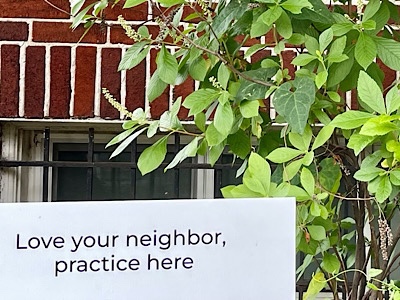
Also—found exhortation and be here now variation. I consider this a reminder that loving your neighbor is a practice. As is how, when, and where to use commas.
My friend Dan just posted an insightful piece about the sweetly humbling (without diminishing) perspective on the single life or the whole collective human being in the context of the whole universe. It resonated with the passage I had read for group practice last Wednesday from Ramesh Menon’s rendering of the Shiva Puranas, which talks about all the units of time from a nimesha, a human moment, to the life of the highest Siva principle–an immensity of infinite time that is incomprehensible at a human consciousness level.
I just received a yoga email advertising classes and workshops that quoted a well-respected teacher as saying not to listen to your mind and to listen only to your heart. I respectfully disagree.
I do believe that if we listen (listening in the deepest and broadest sense) only to our mind, we lose connection with body and emotion, which can lead to ill health and unhappiness. I also believe that individual consciousness is more than mind and includes bodily and emotional awareness as well as brain function and that one of the salutary aspects of yoga practices is to expand our capacity to be aware beyond thought and mere processing of sense perception.
But to listen only to our heart is to be empty-headed, to be without discrimination (viveka), and also presumes that we can process and act on what is in our heart of hearts without using our minds. To dismiss our mind as somehow not being a source for deep listening also defies the tantric yoga notion that all is an essential part of being, of consciousness, of the source of inner bliss (Satcitananda–being, consciousness, bliss). Why would we have minds if we weren’t meant to use them?
Want to be a fully engaged yogi who lives in the world? Go ahead: cultivate, educate, enlighten, and use your mind. Just do it with an open heart and ever expanding sensitivity and awareness of all your being and all that is around you!
I am curious about the concept of guru, and as usual, when I am curious about something some large part of my exploration is through books. As my latest entry in books about gurus, I’ve just finished reading Rachel Manija Brown’s “All the Fishes Come Home to Roost,” memoir about her years as an American child in an Indian ashram.
The tale a wonderful example of how humor and curiosity can help us survive human challenges and discomfort and how story telling itself can be an act of healing. Finishing the book at the start of guru purnima reminds me of how many of my teachers have been books.