Food for the Mind (Yoga Philosophy, etc)

Contemplations on readings and yoga philosophy.

  • | | |

    The Capitoline Venus (and Sruti)

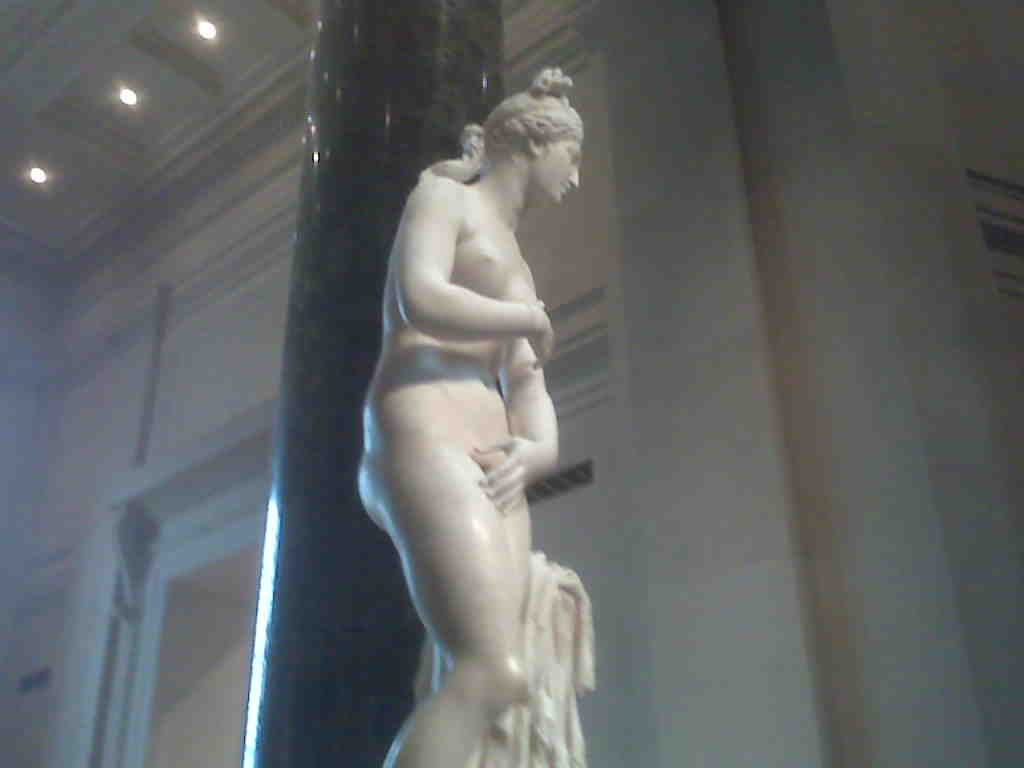
    The Capitoline Venus arrived in DC last week from Rome–the first time this circa 200 CE sculpture has been out of Rome in nearly 200 years. What makes it especially beautiful is the apparent softness of flesh of the cool, carved marble, the seeming etherealness of the ancient solid stone.

    Looking at the Venus made me think about how carving in stone can help us understand the concept of sruti. The hindu scriptures generally are classified as either sruti (revealed) or smriti (remembered) and until recent centuries were passed on through oral tradition. Those scriptures that are sruti are said to have been revealed by a divine source to the original listener. They were already there as part of the wholeness of the universe and then manifested to a particular enlightened being in a way that could be witnessed and passed on. The essence of the text was always already present, but not tangible, until it was revealed in the mind of a listener, who then passed it on.

    Carving in marble takes both the emergence of idea and form in the mind/imagination of the artist and the revealing of that idea from the original stone by the craft of the artist. The sculptor has studied and practiced art and is always open to the emerging into consciousness of a particular image or idea, just as the great yogis continuously meditated and studied, open to what might be revealed.

    As the sculptor may find the block of marble first or have the idea and then go looking for the right stone to express the idea, the yogi pulses between experiencing spirit and enhancing the experience through practice. It is not just an act of imagination that builds and creates something out of nothing. To some extent, the form of the final sculpture is already there in the stone. The work of the artist is to remove that part of the stone that is obscuring the witnessing and expression of the exquisite shape revealed from within by the educated and painstaking act of making art.

    Peace and light, E — Posted with WordPress for BlackBerry.

  • | | |

    Christina Sell Writes About Teaching at Willow Street and Suzie Hurley

    I had the good fortune to be able to study with Christina Sell last weekend at Willow Street.  Christina writes here about the Willow Street community.  Her gracious words reveal the light in her own teaching and personal expression.  I look forward to studying with Christina again.

    And Christine–ditto on everything you write about Suzie and her extraordinary capacity to expand community.

  • | | | |

    Two Ways of Looking at Things (and Women: Count Your Apertures)

    My studies today (it is a very rare day that I do not read some of a yoga text or commentary) included a mention of the body’s nine openings. The yoga treatises ubiquitously mention the “nine openings” of the body through which prana enters or leaves (is dissipated). Certain practices are designed to open the tenth, which is an energetic opening that corresponds to the fontenelle at the crown of a baby’s head.

    A few month’s ago, my astute friend Jane, who has given birth and nursed, pointed out that a woman has 12, not nine openings.

    What is a woman to do in response to this apparent disconnect or male exclusivity? Reject out of hand the teachings as only being misogynistic and of limited utility because they originated for male physiology and not female? Interpret the teachings and correlative practices as being based on the anatomical and energetic openings common to both sexes? Deeply explore the practices relating to this teaching and discover whether there are subtle ways to modify and reinterpret and apply the teachings and practices to address the lack of reference to and recognition of the three crucial additional openings that are fundamental to a woman’s being?

    Guess which of these I am most likely to advocate and practice.

    Peace and light, E — Posted with WordPress for BlackBerry.

  • | | | | |

    It Does Not Get Much Better (and Satcitananda)

    The key concept of yoga–satcitananda can be elusive, like all abstract concepts in the yoga philosophy and in other philosophies or areas of study. We are given metaphors and analogies in the texts to help us recognize when, through our practice, we experience in our self the manifestation of what had just been theory (book knowledge).

    It is hard to describe, for example, what it truly means to be fully present and aware in the moment and thus suffused with bliss
    (satcitananda).

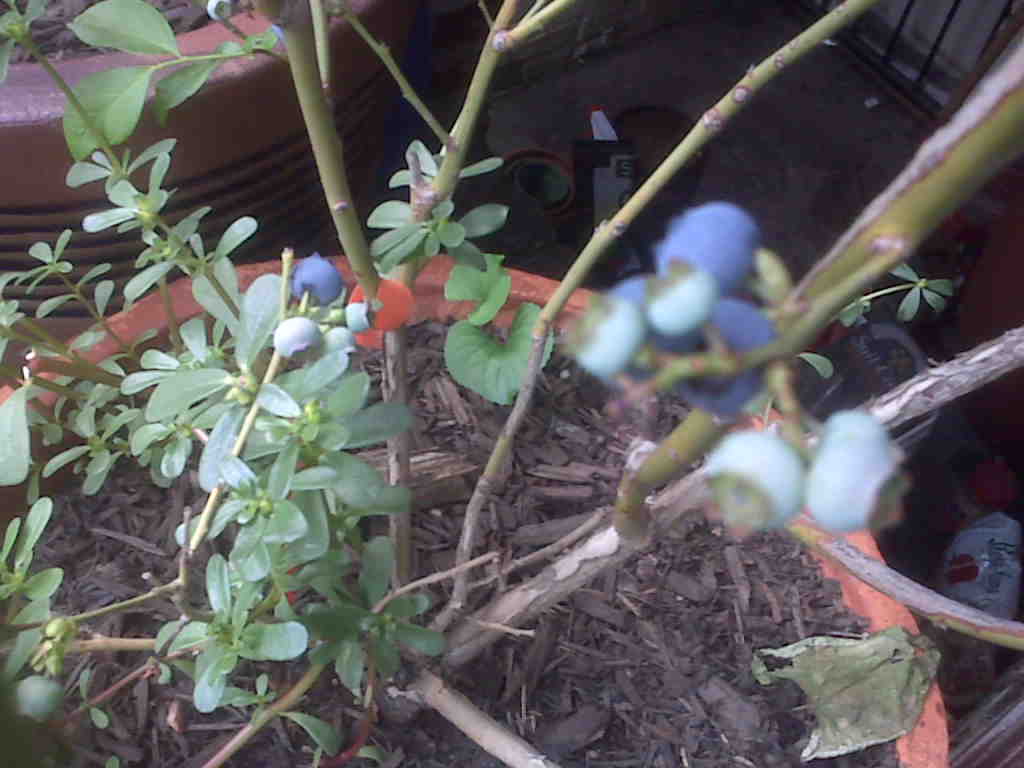
    There was a moment, standing in the hot sun, when I tasted a sun-warmed, perfectly ripe blueberry that I thought, this is a moment many of my students might imagine to be able to extrapolate the abstract concept of satcitananda.

    Notice also the volunteer purslane at the base of the blueberry bush. Weeding and harvesting greens for salad and stir fry can be coextensive. Don’t poison or discard your purslane (or your dandelions). Pick it and eat it; purslane is a great plant source of omega fatty acids.

    Peace and light, E — Posted with WordPress for BlackBerry.

  • | | | | | |

    June Greetings (Web Version of June E-Newsletter)

    Dear Friends,

    One of the yoga practices in Patanjali’s Yoga Sutras is sauca, which means cleanliness or purity.  It does have a basic aspect of physical cleanliness, which has lead me this year to do an especially vigorous spring cleaning.  I think following the principle of saucra also applies to the clarity of our intention for the practice of yoga:  are we seeking to experience and act from a place of deep connection to spirit (or good or oneness or divine or whatever you name it)?  In practicing sauca, I think the most basic question is whether we have dust on the mirror that reflects the good in ourselves obscuring our vision, whether there are blockages to the energy flowing to bring us to optimal physical and emotional health, or whether anything is getting in the way of our manifesting our intention?

    When it has been too hot to go into the garden over the past month, I have been reorganizing and sorting through old papers.  As a once every five or ten years spring cleaning, it is lasting longer than usual.  I tend to be good about keeping on top of these things, but there are crevises of old records of my life that seem to just get stuck back into a folder to be decided on some other time.  This afternoon I came across intimate letters from a friend who, not long after we went our separate what had become cross-continental ways with regret on both sides, discovered he had brain cancer.  There were a few notes not in envelopes.  I reread those, but did not open the envelopes.  Back into the miscellaneous file until the next time.  The same with the print-outs of emails to and from Peru right after 9/11.  It wasn’t avoidance.  Over time and distance, regret and grief have faded.  I did not have the need or the time to read them now.  They went back into the file because I am curious what will be my reaction to these documents when I am 87 should I be around in this body then.  I find that when I see them after again more years have passed, I can see how much the yoga (asana and meditation) as a steady practice over time has shifted how I relate to my past, to all the decisions better or worse that brought me here today.  I am more at peace with the various detours and convolutions for the teachings and the good at the time, even if they do not appear to have been squarely or most efficiently on the path.

    Just as most of us have pieces of paper or things that for some reason get saved, but spend most of their time in a drawer or a file cabinet or a closet, we have thoughts and emotions around past experiences that can emerge into memory at what can seem to be the oddest of times.  With a strong meditation practice, it can sometimes feel like we are cleaning out the closets of our mind.  With a therapeutically focused asana practice, it can seem as though we have found old energetic entanglements, and it may feel that it would have been easier never to have practiced at all.  If we stay steady and keep coming to class and our own practice, we witness how much change can be wrought.  When we remember to bring our clear intention to the yoga mat, the meditation cushion, the garden and the kitchen, the laundry, work and commuting and everything we do, then we in an ever more refined and deepening way open to grace, the fundamental AnusaraR principle.

    I am happy to let you know that I am now E-RYT 500.  My spring cleaning on the physical level motivated me to do the paperwork with Yoga Alliance.  My carrying the designation E-RYT 500 means that teachers taking my classes and workshops can get Yoga Alliance continuing education credits, in addition to Anusara study hours.

    I am looking forward to studying with Christina Sell at Willow Street Yoga next weekend.  Come join fellow yogis for what promises to be a joyously challenging weekend of classes.  The following weekend, I head up to Vermont for the Anusara Grand Gathering.  If you are going, let me know and we can try to connect.

    Special June Location Information for William Penn House Classes:  June 14 and 28, William Penn House will be completely taken over by conference groups.  Class will be held at the house location.  RSVP’s are required.  For those who have been regulars, but who have been full up with other things in life than class, it is a sweet way to get back.

    Hope to see you soon.

    Peace and light,

    Elizabeth
  • |

    Abhinavagupta (X-Rated or Not?)

    As I get deeper into studying tantric philosophy I have taken the time to pause and reflect on how that philosophy originated and grew and who were the people offering and practicing the teachings.  The tantric teachings I have received and offer are completely chaste.  Put “tantra” into your favorite search engine, though, and you will see that people tend to think it is about intimate physical connection (my first euphemism).  What is tantra?  Is it one or the other?  Is it something one can have without the other?

    To help me think through and contemplate the issue, I read David Gordon White’s The Alchemical Body. I followed this with Lilian Silburn’s Kundalinia–Energy of the Depths.”  What seems fairly evident–if you want the details, I invite you to read the books yourself (and also on sri vidya, Douglas Renfrew Brooks’ The Secret of the Three Cities)–is that despite the inclusion of those not twice born and women in the rituals, the community of tantrikas was no less sexist than more traditional society.  The role of women in the secret rituals, as I have read it described, is one that would be wholly unacceptable to me in terms of equality, gender neutrality, and respect for women as human beings and not as archtypes and means to an end for male practitioners.

    I did not get into the depths of knowing the historical details before I had been strongly drawn to the metaphysics of Kashmir Shaivism, which has been an integral part of my yoga studies.  As I think about how a feminist, pacifist can find the universal teachings while still acknowledging the historical and social context in other texts such as the Bhagavad Gita and the Bible, it seemed given tantra’s rap in today’s society, I should see what my answer is for the tantric teachings as well.  In thinking about the issue, I contemplated how I see the teachings in and out of the historical context (as you can see from the link to Swami Lakshmanjoo, the philosophical teachings are presented today without a hint the secret rituals).

    I also asked the following, among other questions:  How important is it for the student to take the teacher for the whole of the teachings and his or her human strengths and weaknesses?  Is it ok to just really believe in one aspect of the teachings?  Can we pick and choose what to learn and still be faithful to the lineage? Can we love and respect someone fully even if we disagree with his or her way or life and/or way of participating in society?  Is extraordinary grace and genius enough to make what might otherwise trouble or even appall us seem irrelevant? Is it easier to come to terms with this issue for those teachers from different time periods or cultures and thus for whom our own choices or “modern thinking” might not have been available?

    I think that the Wikipedia entry for Abhinavagupta, which mentions that the community would have engaged in secret (my spam-avoidance euphemism) ritual, but avers that “[w]e can only speculate about whether he was physically chaste, and either answer to this question is not very meaningful in the context of his life and teachings” gets it half right.  It seems to me that it would be meaningful when looking at his life, but not of import in the modern receipt of the teachings.  I think, for me, the very resonance of the philosophy and the practices with which I am familiar are not less meaningful for the historical concomitance of the hidden practices.