A Contemplation on the “Yama” “Saucha”
Sometimes when I find myself thinking I could use some new clothing, it is just that I have been busy with other things and it ha been longer than usual since I last did laundry.
Sometimes when I find myself thinking I could use some new clothing, it is just that I have been busy with other things and it ha been longer than usual since I last did laundry.
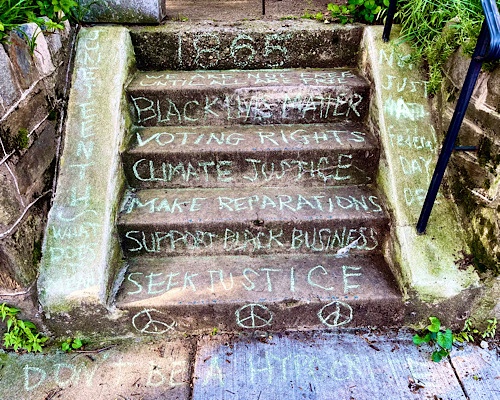
Asteya in Sanskrit means non-stealing and is the third yama of the yamas and niyamas set forth in Patanjali’s Yoga Sutras as a critical part of the path of yoga. White people giving themselves a holiday created by Black people for themselves without both taking action against current injustice and inequity is a classic example of what would be stealing.
Could you give extra support to a Black business today? Donate to a Black-run organization working to fight for civil rights or voting rights or equal access to health care, education, and support services or against police brutality? Give mutual aid? Write to your elected officials about said issues?
We don’t have to do everything every day, but it is not ok to do nothing.
This was the first weekend in some time where I did not have any commitments. I knew I’d have to get some errands and correspondence done, but I’d thought it might be nice to find an asana class on Saturday morning. I ultimately decided to go to the opening class at the new Yoga Shala studio in Shaw . I really enjoyed the class, the studio itself has a good vibe, and they are looking to integrate into the neighborhood, sharing the block with Bread for the City. I expect to return. After class, I took a long walk and a good nap and then made a nourishing meal and went to bed early.
On Sunday, I noticed in my “promotion” emails, that Dharma Mittra was leading a day of classes at the convention center; Yoga District had arranged for him to come. I’ve never felt a calling to study with him, but I like Yoga District’s community focus, Dharma Mittra is an iconic figure in Western Yoga, and there he was and there I was and I’ve recently had a few different students ask me about the Dharma yoga classes in town, so I took the master class and stayed for yoga nidra. It was a deep three hours with an enthusiastic group of practitioners. I found some of the darshan of interest, though Dharma Mittra speaks too much of God and is [insert politically correct way to say sexist; he’s 78 and originally from a macho culture]] to resonate with my beliefs, and I prefer more focus on alignment with the physical postures. I liked very much that he says the first principle of yoga is compassion and that one must maintain the state/practice of compassion throughout all the other practices or they do not have any import.
It was good to reinvigorate my practices and my intentions for all that I can offer.
And it was really a treat top watch Dharma Mittra demonstrate poses.


Peace and light, E — Posted with WordPress for BlackBerry.
Ahimsa, which is the first of the yamas in Patanjali’s Yoga Sutras, and thus is the first practice or principle of the eight-limbed path, is usually translated as non-violence or non-harming. Over my years of practice and study, I have read and heard many versions–some general, some personal beliefs–as to what it means to practice nonviolence as part of a path of yoga. As I watch the way people around me are behaving and reacting to the heat and drought, I thought about how, for me, the practice ahimsa is as much about seeking to be in alignment with the movements and shifts around us that we cannot change as about refraining from specific acts of violence (though that is obviously a basic element).
In terms of aligning with the world arounds us and the cycles of our own body-mind, when we are sensitive to what will best serve our own self while having the least impact on the environment, we are practicing ahimsa, in other words, “opening to grace.” How does practicing ahimsa by behaving mindfully incorporate many aspects of the Anusara first principle of opening to grace? Opening to grace, as a practice principle, invites us to be open, sensitive, spacious, and radically affirm what is so that we can expand, shift, and serve ourselves and others in the best way possible under the circumstance. To be open in this way, try not to rage at the heat–or whatever is your weather. Soften, listen, and mindfully discover how you can live at your fullest, kindest, and most generous with what you cannot change.
When the temperature soars above 95F for days in a row, it is an act of violence to rage against it or to consume outrageous amounts of fossil fuels to cool our businesses and homes enough to wear warm clothes, sleep under blankets, cook and eat hot foods, or do an athletic asana practice or workout (lest we feel that we are not fulfilling some externally motivated personal notion of fitness–having external notions of how we should look, act govern us without accepting the actual situation is its own form of violence against ourselves) that we would not do if we could not artificially cool our environment.
Perhaps I have no call to speak on this: my central air conditioning is on, though I’ve been keeping it between 78-82F and I have been moving, dressing, and eating in a way that honors the fact that those temperatures are as cool as it is going to be until the heat wave breaks. Some might argue that using any air conditioning or even an electric fan or a refrigerator is doing excessive harm to the environment. That may in fact be true, but asking for more than we can do just makes things seem impossible, and then we are less likely to make any shift at all.
Peace and light, E — Posted with WordPress for BlackBerry.