Art and Culture | Asana, Pranayama, and Yoga Practice | Community and Family | Food for the Mind (Yoga Philosophy, etc)
Found Quotations


Being Consciousness Bliss
Be aware of what needs your attention, including moments of beauty.

[Caption] Photo shows a sticker with a red circle with a line across it and a cartoon image of 45; a sticker that says “stop police brutality” and a sticker that says “No Vote, No Tax–No Taxation Without Federation Representation.
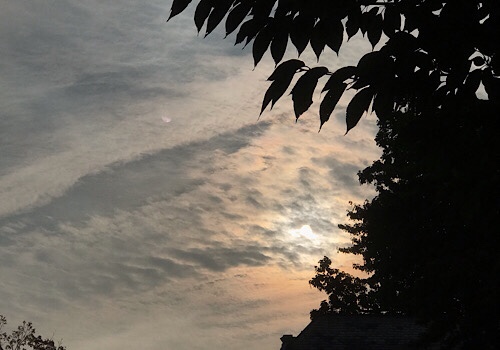
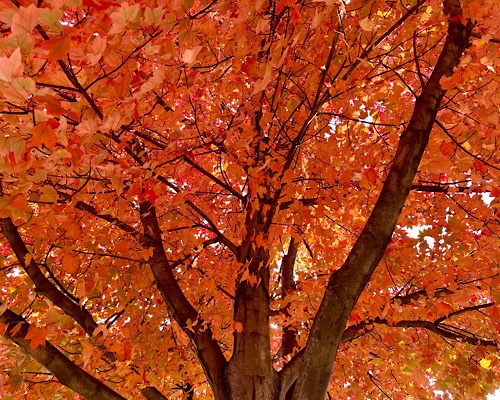
I was having an anxiety provoking type of morning. When I walked out to address one of the things that needed to be addressed, the trees reminded me to pay attention to beauty, while I was doing what needs to be done.
It is a constant dialogue that arises for me with others in my various communities about the place of political discussion in a spiritual community. Is there a place for examining the state of the world, calling for action, and trying to change things when we believe (or are seeking to understand) everything as being at its essence infused with the light? I just happened to read this parable today, after being advised that spiritual and political dialogue have no place being conjoined (today, it was about the budget and the war; it could just as easily have been about how to address from a place of spirit the complexities of how to shift and respond to the Gulf oil spill):
“RAMAKRISHNA: … [W]ater remains water, whether it stands still or breaks into waves. Divine Reality remains exactly the same when one is silent and one speaks. Relax your mind a moment and consider this parable. A guru teaches his disciple that every being and event is simply God. The ardent disciple, while walking home meditating on this truth, encounters a mad elephant. The elephant-driver, who has completely lost control of the animal, shouts to all who are in the way, warning them to run. But the stubborn disciple refuses to deviate from his path. He continues his contemplative exercise, regarding himself as God and the elephant as God. The crazed beast picks up this foolish man with its trunk and dashes him to the earth. The guru, famous for his healing powers, is called to revive the unconscious victim. After certain prayers are recited and holy water is sprinkled, the young man regains consciousness. He is surprised to find his guru gazing at him. When asked why he did not run from such evident danger, he replies: ‘Why should I run? My guru, you teach that all beings and events are God. I have implicit faith in your inspired words.’ The venerable master then addresses his immature disciple: ‘But my child, why did you fail to heed the inspired words of the elephant-driver, who is also God?'”
Lex Hixon, Great Swan: Meetings with Ramakrishna (Shambala Publications 1992)