Similar Posts
Aphids (and limitations)
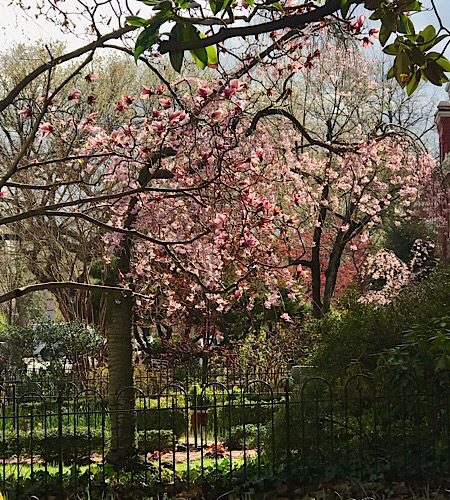
Even though we had real, hard frosts this winter, there are already aphids on my roses. I went out this morning and picked the aphids off of the new buds — yes, my roses are budding. It was too cold to stay out long, but I did a little weeding and planted a couple of pots of pansies.
I was thinking about how I garden in my tiny space — using my fingers to take the aphids off of each rose bud, pulling up individual weeds between new plants in containers, choosing to let some volunteers come up between bricks because it expands my planting area. How different it would be if I even had a small yard by suburban standards. It would not be possible to attend to all the detail that I see, unless I were to spend every waking hour in the garden. If I had an acre, it would take three full-time gardeners to attend without tools and sprays the small things I touch by hand.
It seems we make our world as big or as small as we want it. My tiny garden is as much a universe for me as a gardener as would be an acre garden — though of course I cannot grow sprawling things like melons and potatoes and fruit trees.
But the fullness of how much I see and experience, how much calls out for love and attention, how much I am enriched by tending and observing what is there, is not diminished by what I do not have. Rather, I am called to expand to the greatest what I have within my limits. This is true, too, in our yoga and meditation practice, and our lives. We can choose to live expansively no matter what our limits or we can choose to feel bound and diminished by our limits. The garden, this morning, helped me remind myself of that choice. It helped me turn towards possibilities for growth instead of towards constriction.
Sadhana
After a full work day and a Board meeting at William Penn House, I joined those at the Supreme Court affirming their engagement, crying out their resolve, their outrage, their grief, their hope.

United States Supreme Court, July 9, 2018 (chanting, “hey, hey, ho, ho, the patriarchy has got to go…”
Gardening, Cleaning, Cooking (and Vinyasa Krama and Kali)
Vinyasa krama is the art of sequencing. How a yoga practice or flow is sequenced can determine whether it is uplifting or inward going, exhilarating or calming. When we are trained and attentive, we start to know the most optimal order to open our bodies and our focus to align with the time of day, the season, the weather, our mood, and our health. This incredible art helps us be positioned and aligned in a way that we feel free in time and space, rather than being constrained by time and space.
This morning while I was out in the garden, I was thinking a lot about vinyasa krama and the goddess Kali — goddess of, among other things, time and change, and thus, of sequencing. I woke very early, brought to consciousness by the long light of the solstice even through closed curtains. As I went about my morning, rinsing the sprouts while heating the water for my morning coffee; cutting back the greens and herbs before starting breakfast; doing the major pruning and clean-up before doing more decorative garden work; finishing cooking before taking out the recycling; applying a facial mask before starting to vacuum; never walking up or down the stairs empty-handed; waiting to gather the bills until after I was clean and waiting for friends to arrive, etc., I realized how important sequencing is to the richness of my days. By knowing the best way to order tasks for my needs, my day is simultaneously productive, unhurried, and enjoyable.
By the time my friends arrived around noon, I had meditated, taken care of the garden, gathered food for my own breakfast and to share with friends, talked to neighbors, cleaned the house and myself, done a little asana, written in my journal, and sorted the mail. Had I not known from long experience and conscious attention how to sequence all the different elements, knowing which ones went together, which took longest, which ones if done earlier or later would create double clean up, etc, I would have been tired and the tasks unfinished. Instead, after brunch, I came home to a tended garden, a freshly made bed, and time to enjoy a quiet evening.
These sequencing principles also apply for me on major projects at work. If ordered one way, the work is exponentially harder, the deadline a fearsome thing; if ordered another way, everything comes together mostly as it should when it should. When I order my work with attention (this assumes others cooperate with this endeavor), I have time to do a good, careful job and still take breaks, eat well, and leave the office in time to take or teach yoga class.
Whether you are doing your home yoga practice or cooking or working, choose to sequence the elements of your practice, your activities, or your day, with attentiveness, reverence, love, and respect, and Kali will support you and not show you her most fearsome face.