| | | |

Asteya and Juneteenth

Asteya in Sanskrit means non-stealing and is the third yama of the yamas and niyamas set forth in Patanjali’s Yoga Sutras as a critical part of the path of yoga. White people giving themselves a holiday created by Black people for themselves without both taking action against current injustice and inequity is a classic example of what would be stealing.

Could you give extra support to a Black business today? Donate to a Black-run organization working to fight for civil rights or voting rights or equal access to health care, education, and support services or against police brutality? Give mutual aid? Write to your elected officials about said issues?

We don’t have to do everything every day, but it is not ok to do nothing.
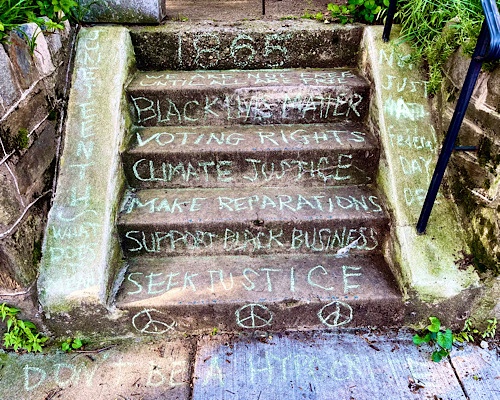
Chalk drawing on stairs says:  1865, we are not free until all are free; Black Lives Matter, voting rights, climate justice, make reparations, support Black business, seek justice, don’t be a hypocrite, Juneteenth—not just a Federal holiday

Similar Posts

  • | | | |

    Balance of Stability and Freedom

    Last night, we were talking about the parameters of cultivating a steady and fruitful meditation practice, and Paul Muller-Ortega suggested that it was about the balance of stability and flexibility. He had learned the principle from a different source, but I have contemplated and explored the principle in depth from teachings I have received from John Friend.

    A critical aspect of the Anusara alignment principles is to find the perfect balance of stability and freedom. We need stability to stay fully and safely in each pose. We need freedom to achieve the fullest and most delightful expression of the pose.

    We find the stability both by making certain that we have established our foundation (which is an aspect of the first principle of opening to grace). By then using the three aspects of muscular energy–hugging the muscles to the bone, drawing into the midline, and drawing energy from the periphery to the focal point, we make possible an expansion of our edge, whatever that might be. Having a solid, aligned foundation and affirming our very core with these actions, gives us security and balance. We also want to reach out, to be playful, to expand to our fullest, which we do using the expansive, outreaching organic energy — from focal point to the periphery, from the midline to our outer edges, from the very marrow of our bones through bone, muscle, skin, and beyond.

    If we over-emphasize (including natural inclination) stability, then we can get stuck. If we just let ourselves be free, then we end up all over the place. When these elements are perfectly balanced, we can safely find our deepest freedom of expression.

    When I teach this principle as the focus of a class, I always invite my students to think of how important the balance of stability and freedom is for every aspect of our lives.

    The discussion last night put this principle in the context of the regularity and steadiness of our practice, with the recognition that to stick with our practice, we will sometimes need to vary the time or amount of our practice, or what elements are included in the practice.

    To get the fullest benefits of a practice (this applies to any practice and not just to meditation), we need to show up consistently and to practice in accordance with how we have been taught. To stay steady, though, we need to give ourselves the permission or freedom not to show up, or within appropriate parameters, to modify the practice when life gets in the way of what we think would be the ideal practice. If we think we have to do things at the exact time and place every day in a perfectly precise way, we become rigid. On the other hand, if we are loosey-goosey about it, then we do not have much of a practice and will not realize the benefits that we could get.

    Where in your practice or life would more stability and steadiness give a field for greater freedom and happiness? Where could you give yourself a little more flexibility so that you feel that steadiness brings the possibility of joy, rather than tying you down?

    Peace and light, E — Posted with WordPress for BlackBerry.

  • | | |

    The News

    The photos of the aftermath of the earthquake are horrific. I cannot really imagine what it must be like. I found myself today thinking about how it is that I trust that the images are real even though those who offer us “entertainment” give us similar pictures through the same media. How do we stay keenly open to truth and sympathy when our receipt of truth and fiction comes through the same channels? My heart goes out to all those suffering.

    Peace and light, E — Posted with WordPress for BlackBerry.

  • | |

    Article About Anusara Yoga and Aging

    Congratulations and thanks for my friends and fellow Anusara yoga instructors, Kathy Carroll and Ellen Saltonstall for publishing, Effects of Anusara Yoga on Older Students From Their Perspective (Topics in Geriatric Rehabilitation • Volume 27, Number 2, 94–103 • Copyright © 2011 Wolters Kluwer Health | Lippincott Williams & Wilkins).  They are both great teachers and warm spirits.  Check out one of their classes when you have a chance.

    A big thanks, too, for the regulars at the William Penn House class who graciously allowed themselves to be photographed.


Leave a Reply

Your email address will not be published. Required fields are marked *

This site uses Akismet to reduce spam. Learn how your comment data is processed.