| | | |

Fences, Freedom, and Viveka

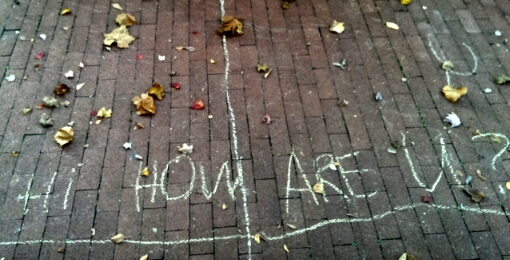
Refining how and to what we say “yes” and “no” in the world is one of the purposes of the yoga practices.  The dedicated yogin seeks ever-growing discernment (viveka) of his or her own limits for the purpose of living ever more expansively and in fact more freely than is possible for those who fight against or ignore limits.

If we stick up or hold onto fences and defenses where they are not needed, we miss the opportunity to connect.  Conversely, if we fail to honor the extraordinary combination of limits that makes us our exquisitely individual self and shapes our embodied connection to the world around us, we will be less free in ourselves and in the world and with each other, which leads to suffering.

fence

Similar Posts

  • | | |

    State of the Garden

    I think during World War II, backyard gardens supplied something on the order of 40 percent (don’t quote me on this) of the nation’s produce. Were we to do that, how much it might contribute to alleviating any shortages–with so much of our food from beyond closing borders.

    How might it help shift our growing climate imbalance and social inequality and the hideous chaos it unleashes? Wouldn’t growing some of your own food be a healthy strategy?

    The generous harvest from today’s garden all came up from prior year plantings. I may joke about how many variations of greens and grains and pulses I can come up with, but the greens are from my back garden, bursting with nutrients, and everything else is a long storage pantry item (including in recent years, dried beans, for having grown enough of them). Most anything else is a luxury. I can go a long time between trips to the grocery store and still have well-flavored, healthy, and inexpensive meals.

  • |

    on the train

    I am on Amtrak heading to the Anusara teachers’ gathering in
    Morrisville, NC. The train is surprisingly crowded and not surprisingly a whole different vibe than the train to NY.

    By day we will be practing and gathering in a hall at a Hindu temple. The grounds are reported to be beautiful and welcoming. By night, those of us who don’t have local friends will be staying at hotels off the highway with cable TV that usually serve the visitors to the big university ball games and events. We’ll then all be driving back and forth to the venue and out to eat.

    I find it of mild interest that I spend more time in cars and more time in a place with TV when I travel to study yoga than at any other time during the year.

  • | | |

    The Search Continues (based on some dreaming)

    In 2000 or 2001, shortly before I started practicing Anusara yoga, a teacher who regularly played music in class, played for us a recording of Alice Coltrane singing a tantric chant to Siva and the Goddess Bhuvaneshvari.  I only heard the chant once while we were in savasana — corpse pose/final relaxation.  Although I only heard the chant once, for several months afterwards, I found myself having a recurring dream that I was wondering in a neighborhood that looked like the one where I grew up and went to high school and chanting the full chant.  At the time I merely found it curious that I seemed to have learned the sanskrit just by hearing the chant one time.  I have since learned that the recording may have been done right near my high school; that is where the Coltrane’s had a recording studio.  I also learned that the chant was a tantric chant.  At the time, my teachers were coming from a classical yoga perspective.  Did I actually learn the chant by osmosis?  Was having the very vibration of the chanting near where I lived and studied the catalyst for me, as a receptive being, discovering a path of tantric yoga?

    I have found other recordings of the chant.  One is Atman’s “Dancing to the Goddess” on the Eternal Dance CD, which is an electronica version.  The other is Ragani’s “Om Mata” on the Best of Both Worlds, which is a very nice kirtan/pop version.  I have several of Alice Coltrane’s recordings, which are great jazz, if you aren’t familiar with Alice Coltrane as a fabulous musician in her own right.  Recently I searched again on the internet to see if the bootleg had become available.  There was nothing on YouTube (though some good Alice Coltrane things to watch).    I bought Alice Coltrane’s “Radha-Krsna Mana Sankirtana,” which was originally recorded in 1977 (when I was in high school) and reissued in 2005, as I thought that was a promising source.  It has some good things on it, but no luck finding the recording I wanted to hear.

    The chant goes like this:

    Samba sadasiva, samba sadasiva, samba sadasiva, samba shambo.

    Om mata, om mata, om sri mata, jagade mata.

    Om bhuvaneshvari, sri bhuvaneshvari, hari parashakti, devi bhuvaneshvari.

    It is a chant to the benevolent, auspicious one within, the radiant goddess, the creatrix of the world.  Bhuvaneshvari is one of the ten wisdom goddesses.

    Please advise if you have access to the Alice Coltrane or another recording of this beautiful chant.

Leave a Reply

Your email address will not be published. Required fields are marked *

This site uses Akismet to reduce spam. Learn how your comment data is processed.