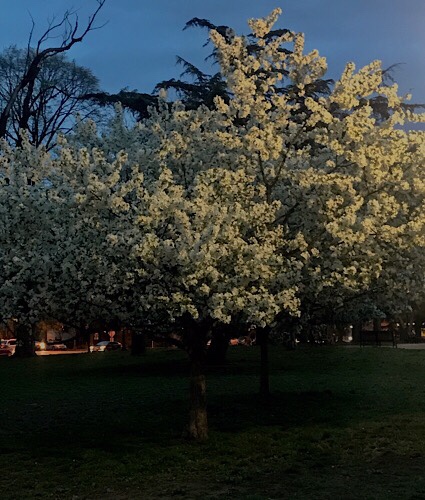
Illuminated Blossoms
MoveOn just posted this Howard Zinn quote on Facebook: “Civil disobedience is not our problem. Our problem is civil obedience. Our problem is that people all over the world have obeyed the dictates of leaders…and millions have been killed because of this obedience…Our problem is that people are obedient all over the world in the face of poverty and starvation and stupidity, and war, and cruelty. Our problem is that people are obedient while the jails are full of petty thieves… (and) the grand thieves are running the country. That’s our problem.”
It spoke my mind and resonated with what I wrote about yesterday with regard to how to be open to yoga’s invitation to practice humility without ceding power to authoritarian structures. This quote is spurring me to think aboutPatanjali’s eight-limbed path of yoga, and particularly the niyama (observance) of ishvara pranadhana (surrender). I don’t see why a true, radical yogini could not simultaneously surrender to the mysterious outrageousness of being while still being appropriately disobedient to authoritarian structure. But maybe that is because I was raised a Quaker; there’s quite a bit of overlap between some of the tantric yoga principles and the teachings of Quakers.
Monument to Andy (but, I ask, does he really need one?)

Peace and light, E — Posted with WordPress for BlackBerry.
In 2000 or 2001, shortly before I started practicing Anusara yoga, a teacher who regularly played music in class, played for us a recording of Alice Coltrane singing a tantric chant to Siva and the Goddess Bhuvaneshvari. I only heard the chant once while we were in savasana — corpse pose/final relaxation. Although I only heard the chant once, for several months afterwards, I found myself having a recurring dream that I was wondering in a neighborhood that looked like the one where I grew up and went to high school and chanting the full chant. At the time I merely found it curious that I seemed to have learned the sanskrit just by hearing the chant one time. I have since learned that the recording may have been done right near my high school; that is where the Coltrane’s had a recording studio. I also learned that the chant was a tantric chant. At the time, my teachers were coming from a classical yoga perspective. Did I actually learn the chant by osmosis? Was having the very vibration of the chanting near where I lived and studied the catalyst for me, as a receptive being, discovering a path of tantric yoga?
I have found other recordings of the chant. One is Atman’s “Dancing to the Goddess” on the Eternal Dance CD, which is an electronica version. The other is Ragani’s “Om Mata” on the Best of Both Worlds, which is a very nice kirtan/pop version. I have several of Alice Coltrane’s recordings, which are great jazz, if you aren’t familiar with Alice Coltrane as a fabulous musician in her own right. Recently I searched again on the internet to see if the bootleg had become available. There was nothing on YouTube (though some good Alice Coltrane things to watch). I bought Alice Coltrane’s “Radha-Krsna Mana Sankirtana,” which was originally recorded in 1977 (when I was in high school) and reissued in 2005, as I thought that was a promising source. It has some good things on it, but no luck finding the recording I wanted to hear.
The chant goes like this:
Samba sadasiva, samba sadasiva, samba sadasiva, samba shambo.
Om mata, om mata, om sri mata, jagade mata.
Om bhuvaneshvari, sri bhuvaneshvari, hari parashakti, devi bhuvaneshvari.
It is a chant to the benevolent, auspicious one within, the radiant goddess, the creatrix of the world. Bhuvaneshvari is one of the ten wisdom goddesses.
Please advise if you have access to the Alice Coltrane or another recording of this beautiful chant.
I participated today in the determination as to whether the noon gentle/therapeutics class at Willow Street should be cancelled due to the weather. It is hard to know when and what to decide unless the roads are absolutely unpassable or it is clear that that storm is not impacting most roads and sidewalks. Some students will have wanted to come to class regardless of the weather, even if it would have been both difficult to get the ice off of their cars if driving and very slippery going from house to car and parking spot to class. If class was held, other students would have wondered why class was not cancelled and felt it unfair that they now had to do a make-up since they were too sensible to go out in the ice. It is a balance of trying to offer the yoga as committed and making decisions about the reasonableness of trying to hold class given safety and logistical concerns. For a class with lots of physically intrepid students within walking distance, the determination is different than for one with people who are facing injuries and other challenges of embodiment, which can make it a challenge to get to class on even a beautiful day.
I’d love to get your feedback on where you think is the weather line between holding class as usual and cancelling. For me, part of the call was that within an hour of class, my porch, front stairs, and sidewalk were still solidly slick with ice. It would have been a challenge even to get to the corner, much less walk ten blocks and take the metro. Things did not really start to melt until mid afternoon.