| | | |

A Lesson In Making Dumplings

Last Monday I had the honor and delight to be invited to a multigenerational dinner of homemade dumplings at a neighbor’s house.

I was told it was customary for guests to shape a share of the dumplings; the hosts do everything else. As I have not grown up making dumplings as part of group family activity, that meant I needed first to be shown what to do with the already made dough and filling.

Skills used to make homemade noodles, tortillas, and pizza helped make dumpling shaping an accessible activity. It was tricky at first. Two people were showing me two different ways, which was somewhat confusing in an enjoyable way, and helped emphasize that for friendly dumpling making, ultimately, everyone needs to find their own method that works for them. Also, as with many hand skills, because it was the first first time I was being shown, I was simultaneously transposing it from right to left-handed.

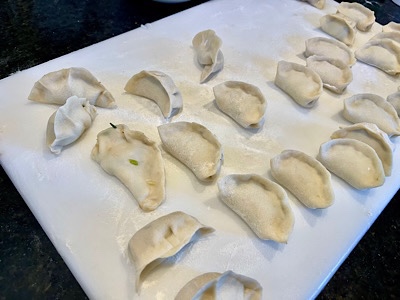
It only took two tries to get a dumpling that wouldn’t explode in the pot and lose its filling. It took several more to make one that had nice pleats and blended in with the rest.

We had an interesting discussion about the difference between learning by eating several variations and then reading several recipes and then trying to replicate a version that resembled what I had eaten prepared by someone who learned from childhood as part of a multigenerational group process.

I have long contemplated, and continue to do so, how my comfort in learning anything from a book and then seeing if I can do it or something like it, has shaped my meditation and movement practices.

It’s pretty easy to see which dumplings I made. No difference in taste. I was also happy to contribute garlic chives from the garden.

Similar Posts

  • | | |

    Gates and Gateways (and Ganesha’s Exhortation)

    A gate might be an obstacle or it might be a way through or it might be that which is containing something that would otherwise be detrimental to our well-being.  One of the key things that we do with the various yoga practices is explore how an apparent barrier is serving us or how a locked gate might turn our path in a more auspicious direction.

    We will learn little and live less fully if we just lament the locked gate and unreasonably expect from the practices the removal of challenges or barriers.  Ganesha–who is often invoked as the remover of obstacles–is less one who just opens all the gates for us than one who empowers us to discover gateways regardless of whether gates are meant to stay locked or whether they seem to block our path.

    ganesha


  • | |

    Spring Cleaning (and Path of Sadhana)

    For the past couple of weeks, I have been spending as much time as possible in the garden.  When it is too rainy or cold to be in the garden, I have been doing indoor spring cleaning.  As the days get noticeably brighter and longer, it is delightful to see the new growth in the garden and to polish my treasures and make room to use and enjoy what I have.  I’ve been noticing how the first major activities in the garden make a mess.  Inside, activities such as cleaning out the refrigerator and the closets also makes things seem messier before they they get cleaner.  I’ve persisted, though, and now the garden is teeming with visible new life, unencumbered by the detritus of dead growth on the perennials or spent annuals from last year.  With things I do not need given away or repurposed and things clean and repaired, I can more easily use and appreciate what I have in the house.  It seemed like quite a mess for a while, though, when I was taking things off of shelves and out of drawers and closets in preparation for cleaning.

    There can be phases in our sadhana –both asana practice and meditation and related practices — where all the practice seems to be doing is bringing up old stuff.  It seems like we are more physically or emotionally challenged than we would have been if we weren’t practicing. The thought may cross our mind that we would be happier just going to the movies and going on an eating tour of Italy.

    Although sometimes strong reactions can mean that a practice is not right for us (at a certain point in time or not at all — similar to a reaction to food), it can also mean that the practice is doing the equivalent of spring cleaning.  Part of sadhana is learning how to react in a more optimal way to what manifests and arises from our practice.  When a host of old memories or emotions arise or we press up against our limits by digging in deep physically to find where and how to rearrange our bones, muscles, sinews, and energy channels to clear an old injury, we have an opportunity to clear out and let go to make room for new growth.  We don’t have to shove the stuff back into our mind-body closet or leave it where it obstructs new growth.  The old patterns and memories come up in practice so we can either release them or change our relationship to them so they can become something that serves instead of weighing us down.

    When I get into one of those messy spots, I remind myself how good I feel when I’ve done my spring cleaning, and I try to keep going forward, doing the best I can with the teachings I’ve been given.  I admit that it is easier to persist because I love the actual activity of the practices (though the ones I need to do most can be the ones that are not my favorite, but that’s a whole other train of thought).

Leave a Reply

Your email address will not be published. Required fields are marked *

This site uses Akismet to reduce spam. Learn how your comment data is processed.