Mudra of Calm Abiding
I was taught that placing your hand on your thigh palm facing down is the mudra of calm, abiding. I personally find it soothing. So, apparently, does Maitri, who demonstrates another variation.
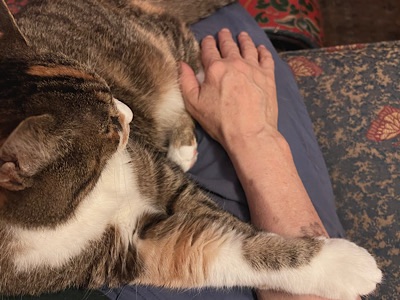
I was taught that placing your hand on your thigh palm facing down is the mudra of calm, abiding. I personally find it soothing. So, apparently, does Maitri, who demonstrates another variation.

We all (or at least most of those who would be reading this blog) have heard the Buddhist-inspired saying: before enlightenment, the laundry. After enlightenment, the laundry. The question is whether after the moments of enlightenment can we infuse doing the laundry with more joy, acceptance, and peace. A young adult acquaintance asked me the other day whether I was readjusting ok. I did not know to what he was referring, and he had to explain that he was asking how I was doing on my return from my India trip. “It was just a vacation–albeit an extraordinary one,” I replied. “Life continues.”
“The good experiences just slip away like dry sand through my fingers,” he made a motion of letting something slip away.
“When you practice and when you get older, it will be easier to bring the temporary, good experiences into your life without feeling they are lost when you have moved onto the next thing,” I said with hope that would actually be true for him, he seemed so bereft.
The yoga teaches us neither to be out searching for the highs nor actively avoiding the lows; the dance of grasping and avoiding is what makes us suffer. That does not mean that the highs, the times of wild abandoned joy, the experiences of utter fulfillment, of exquisite understanding are of no value. What brings joy is a thing of wonder and an opportunity to deepen our ability to love and be generous. They are only a problem if we ruin our time by vainly clinging to or trying to repeat the sensation. As our practice (and our understanding of a life well-lived and loved) matures, we understand that there is no readjusting in the return to the day to day. We welcome what we have had, try to remember what we have learned, including how much joy and delight we are able to drink in, and approach each day as another opportunity to seek and share connection.
This morning I decided it was time to have a public “Rose Garden Yoga” page on Facebook, in addition to the page under my name.
Before I even figured out whether I had done it correctly, a couple of friends had hit the “like” button. I still do not know when and where it appeared so that would happen. After browsing around, I did figure out how to “share” with my friends that I had created the page and that brought in a few more. I have also added a widget to the welcome page of the blog/website, so people can “like” “Rose Garden Yoga.” (Please do).
Did I need to do this? Absolutely not. Do I find knowing my way around these mediums of expression useful? Yes, because they have become so important to how we communicate with each other across generations, the planet, and various social divides. Do I mind that getting it just right or perfectly current takes more time and skill than I have from just experimenting? Not really. When I want to do more, I spend the time to learn or hire someone to help. It is also sort of fun to just mess around and experiment and discover whether I can figure it out just by trusting that if I try enough different things and don’t get frustrated by not getting it “right” right away, I will end up either with something that serves well enough or will decide it is not that important and let go.