|

A Black Rat Snake

I have not picked up a snake since junior high when I was old enough to begin working and the days playing in streams and ponds pretty much came to an end. It’s not something one forgets. And today, there was a black rat snake in the garden (Note: they are harmless and eat small rodents.)

By the time I noticed what was going on, it he snake was completely terrified from having been pulled out from under some heavy farm equipment with a rake. The goal was to bring it to the woods behind the garden, but first to make sure it did not get caught in the machinery.

I invited myself into the fray, gently and securely held the snake about an inch below its head, invited its release from below the rake, and then gave it my other arm for it to wrap around, and it hugged me around my back and to the top of the arm that was holding its head.

Someone else opened the garden gate and I went into the trees and released it into the underbrush. I doubt it helped that I talked softly to it, acknowledging its fear, and apologizing for dislocating it.

It felt like an honor to have this short dance. The musky odor was not so nice; I also appreciated it as a very cool super power.

Similar Posts

  • | |

    Practice Question

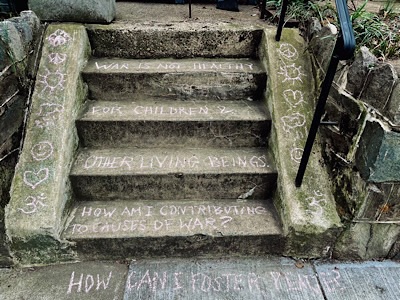
    I found myself thinking this morning of the poster from when I was a child that said, “war is not healthy for children and other living things.” I wrote it on the front stairs and then asked myself the question, how do I contribute to the causes of war?” And so that I am not only asking what I must change or stop doing, I also ask myself, how can I foster peace?

  • | |

    Artha, Kama, Dharma, Moksha (and Politics)

    Last night, Paul Muller-Ortega, as part of the introductory talk for the meditation intensive, spoke at some length about the principles of ardha, kama, dharma, moksha.

    As I have written about before, in the classical yoga view, it is the renunciation of the first three–material well-being, love and relationship, and right work or path, that leads us to the fourth–liberation. From a tantric yoga perspective, it is living and having the first three from the perspective of illuminated wisdom and discerning (viveka) insight (pratibha) that makes us free (jivanmukti) in this life.

    One of the most exquisite things about a steady practice and study, is that each time we revisit a core concept, we hear and understand new aspects to bring into our lives.

    When speaking of approaching these elemental aspects of human being, Paul noted that ardha includes not only material well-being, even wealth, but also the power that wealth brings and how we use it. Although he only mentioned that briefly amidst several other concepts, it really resonated with the current state of my being in relationship to the world and our country.

    I have been contemplating deeply about wealth and power in this time of budget debate, and how they can and should be used to bring nurture, peace, and health to the maximum degree possible. (You might guess that I don’t think increasing spending for war and decreasing spending for education and health is going to bring us freedom).

    Thinking about the power of money as part of our contemplation of our material well-being is something of critical importance at this time. If we shun or disdain in our minds wealth and power while still yearning for our own comforts, than we have lost an opportunity to bring the yoga principles into our lives as optimally as possible. (Of course, grasping and coveting money and power is completely destructive of the possibility of happiness, but most of us think about that, and it is why some say they are bad — money being the root of all evil, etc.).

    If we are really in the world and want to be happy and to share and spread happiness, while living in accordance with the principles of the yamas and niyamas, especially the yamas: ahimsa, satya, aparigraha, brahmacharya, asteya (non-harming, truthfulness, non-greediness, aligning with spirit, and non-stealing), that is when we will start opening up the possibility of true living liberation.

    Imagine, instead of thinking about material well-being as a “guilty pleasure” thinking of ways in which you can use your own well-being (and work through your practice to discover greater health and strength) to be a voice and power for good in your own individual way.

    Peace and light, E — Posted with WordPress for BlackBerry.
  • | | | | |

    April Greetings–Delving into the Essential (Web Version of E-Newsletter)

    Dear Friends,

    It has been a mind-boggling several weeks.  The magnitude of the upheavals and the impact on all of the world, including human beings, is beyond my ability to grasp.  Closer up than the unfolding devastation in Japan and the escalating war in Libya, which daily adds to the bankrupting of this country and planet by our wars, I found myself supporting committed organizations, signing petitions, and writing emails saying that I preferred to be locked out of my work place with no pay than to have taken away any existing protection of the environment or provision health care for low income women.  As my mind tries to expand enough to stay present and active, I am more grateful every day to have and share the practice of yoga.

    Practicing helps us minimize suffering by changing how we relate to pain and the full range of human emotion.  The goal, I think, is to fully and joyously engage in life with an intention to live as harmoniously as possible with all beings, including our individual selves, and simultaneously appreciate and be wonderstruck at the extraordinary and wild vastness of being that makes the time and space of the known universe seem finite relative to life (lives) on earth.  When we can find both perspectives simultaneously, then we can be engaged, but not attached (vairagya).

    How do we focus this intention to live fully and harmoniously in this way?    In the past six weeks, I have had the unbelievably fortuitous combination of circumstances to be able to study with John Friend for three days; to attend the Mahasivaratri celebration with Douglas Brooks, Krishna Das, John Friend, Amy Ippoliti, and Sianna Sherman; Ross Rayburn for a weekend workshop at Willow Street;; Desiree Rumbaugh at a special three-hour practice the following week at Willow Street; and Paul Muller-Ortega via telephone conference.

    Wow, that was a whole lot of input for my practice and contemplation, while living itself was getting more intense.  But, it turned out not to be too much because of the singularity of the teachings.  The message I heard from all of these teachers in their own unique and inspiring voices was that is is a good time to get down to get back to basics, or to put it another way, to explore more deeply the essential principles of practice (and of life).  By getting back to the basics in the practice, we can start knowing at a deeper level what is essential for us to relate as deeply and joyously and non-harmingly (yes, I know it isn’t a word, but I’d like it if it were) on and off the mat to ourselves and all in our web of relationship.

    In both my practice and my public class offerings, this Spring, I am especially focused on exploring what is essential to experience life at its most joyous while still be conscious and committed to the need for effort to change.  In addition to continuing my regular class offerings, I am pleased to be offering a short course in restorative yoga at Willow Street, “Cultivating Relaxation with Restorative Yoga.”

    Restorative yoga is perfect whether you are looking for a gentler way to get started with yoga, an opportunity to relax, or alternative practices for when you are feeling stiff or in pain, or a way for advanced practitioners to explore the alignment principles at the subtlest levels. We will explore a variety of types of supported postures and prop-assisted stretches to enable you to relax into optimal alignment, discover your own space of deep rest and peacefulness, and open your body. The course will also offer simple techniques to ease into sleep, find mini-relaxation moments when things are hectic, and sweeten your home practice–what could be of better service these days?  Everybody welcome. 6 Thursdays, 4/21-5/26.

    To get news in between the occasional email offerings or to see my latest short thoughts, please “like” my new “Rose Garden Yoga” page on Facebook.

    I look forward to seeing you in person soon.  As always, please feel comfortable being in touch by comment on the blog or by email.
    Peace and light,

    Elizabeth

  • |

    Did You Do Anything Fun for the Labor Day Weekend?

    When I go back to work tomorrow, people will ask me whether I did anything “fun” over the Labor Day Weekend, just as before the weekend I was asked it I had anything “fun” planned.  At recent gatherings where I have bumped into people I haven’t seen in a while, all the questions have been about whether I did anything exciting this summer.  I have been pondering these questions and what they say about how we structure our lives.  For me, the seasons change based on what I cook and eat, how I dress, and to some degree, when I sleep (more at night when it is cold and dark; more afternoon naps when it is overly hot and bright), but I both work and take breaks throughout the year, so summer did not bring anything more or less exciting than usual.

    I am acutely aware that part of the reason I have the luxury to live in accordance with the seasons is that I am not on a school schedule, and I have a job that allows me a little flexibility in terms on when to take breaks and when I come and go on any given day.  I also realize that I have blurred the difference between work and “fun.”  I have had a most enjoyable Labor Day weekend, but some would think much of it has been work:  I taught two classes; I gardened; I cooked; I’ve done some housecleaning; I am writing this blog entry, etc.  As I took pleasure in all of these activities, I think of it as having had fun, even though everything I did was something someone could have been doing as “work.”  I think that when we take pleasure in our work, we are less in need of grasping at “fun” and can find more joy in the leisure activities that are more usually labeled as “fun.”

    I hope whatever you have been doing, whether working or playing, you are enjoying the day, and can take a few moments to reflect on those who fought long and hard for ordinary workers to be able to have the time to play in between working.

Leave a Reply

Your email address will not be published. Required fields are marked *

This site uses Akismet to reduce spam. Learn how your comment data is processed.