
Spiritual Unity in Religious Diversity
Filed Under Community and Family | 1 Comment
It has been heart-rending for me to read about the growing rancor and bigotry about religion and race as we approach the mid-term elections. I am concerned as a peace-loving and community-minded citizen. I am also concerned as a personal matter. My great grandparents fled the pograms, and my parents felt free to become members of the Religious Society of Friends (Quakers) and bring their children to Friends’ meeting. I both honor my ancestry and religious upbringing and can study and practice yoga without fear of societal condemnation. Current events remind us all too painfully that the importance of religious and spiritual freedom can never be taken for granted. It is a matter of constant attention to seek spiritual unity in religious diversity, to recognize the spirit in every one, no matter the form of practice they choose (including choosing no practice or faith at all).
Today, I received the following email from Joe Volk at the Friends Committee on National Legislation. I invite you to join me in taking action if you are so moved:
At FCNL, we’ve been sick at heart and concerned at the hate speech, confusion, and misinformation about American Muslims that has spread across the country in the last month. Many of you have told us that you share our concern.
The controversy is not over yet. Between today and the September 11 anniversary of the attacks on the World Trade Center, we at FCNL expect another outpouring of bigotry and misplaced anger at the proposal to build an Islamic cultural center in downtown New York City.
In the first eleven days of September, please state publicly that you stand with our brothers and sisters in the American Muslim community. We support their proposal to exercise their religious freedom by building an Islamic Cultural Center in downtown Manhattan, where they have lived and worshiped for years.
Worship, Talk, Take a Stand
Our country needs this cultural center and the public discussion that it is generating. The proposal for this Islamic cultural center can be transformed from an ugly controversy into perhaps the most important public opportunity in this decade to celebrate and exercise the First Amendment guarantee of freedom of religion.
Many of you are taking this opportunity. From New York to North Carolina and from Maryland to Illinois, we have heard about local community groups using the public focus on the cultural center to organize opportunities for Christians and Muslims to find out what they have in common. To counter the distrust and misinformation, more people need to state publicly that they support the freedom of American Muslims to worship and to gather together.
Please start by signing this petition supporting American Muslims and the proposal to exercise their religious freedom to build an Islamic cultural center in downtown Manhattan. Ask 5 friends to sign it as well. We’ll add the names of those who sign to the bottom of the petition to show the support that’s out there.
That’s the first step, but we encourage you to do more if you can. Here are some suggestions.
- Ask 5 friends to sign the petition too.
- Write a letter to the editor of your local newspaper supporting the Islamic Cultural Center.
- Find out if the American Muslim community in your area might welcome a public or private opportunity to get to know your own local church, meeting or community group;
- On Friday, September 10, many local American Muslim communities around our country organize public celebrations of Eid ul-Fitr — the end of the holy period of Ramadan. Find out if Muslims in your area might welcome the participation of people of other faiths.
- Write your senators to ask them to speak out in support of the Islamic Cultural Center.
“How I Got Into Yoga”
Filed Under Art and Culture, Asana, Pranayama, and Yoga Practice, Community and Family, Food for the Mind (Yoga Philosophy, etc) | Leave a Comment
I enjoyed reading Amy Ippoliti’s blog entry on her first yoga class. My story is here (sorry, it takes two clicks), for those of you have not yet read it. What is your story? Does thinking about it help you reflect on how yoga has shifted your life?
“Meet and Greet” with Tommy Wells
Filed Under Art and Culture, Community and Family, Gardening | 1 Comment
On Friday night, I went to a neighbor’s house for a “meet and greet” with Tommy Wells, who is running for reelection for the Ward 6 Member of the DC Council. I had received an email invitation and was thinking about going. Then on Friday morning, a neighbor who is just around the corner stopped by to give me an invite in case I hadn’t gotten the email. I decided it was important to go to connect with neighbors I already know and like, to meet new neighbors, to clarify my thoughts further about the upcoming primaries (don’t forget to vote!), and to get a chance to talk to my council member.
I walked the two blocks to the party with nothing in my pockets but my keys. Even though I did not know the hosts, I knew or recognized from the neighborhood at least half the people who were there. Given the purpose of the gathering, much if the discussion about what changes we would like to see in the neighborhood and the city to make our lives better (and, of course, I gave information about installing solar panels to a couple more neighbors).
Tommy Wells speaks to my condition, because he takes action in connection with his campaign slogan: “a livable, walkable city.” After we all had time to catch up with each other, Tommy’s campaign manager gave a solid introduction, talking about key accomplishments in the past four years. Tommy then talked about what he wanted to do next and fielded questions, including ones about the disposable bag 5 cent fee, which has cut down pollution in the river significantly) and what is going on with the community gardeners at Virginia Avenue v. the marines.
I, like the others, came with a specific question, but I did not ask it in the group. I was not sure that everyone present would be in agreement with me, and I did not want to cause controversy. I asked about it afterwards, when people went back to connecting and enjoying the food. Tommy recognized me, probably from my three-year stint as a member of the Board of Directors of the Eastern Market Preservation and Development Corporation, which coincided with the time when Tommy was getting noticeably serious about his engagement in politics as a way to make some visions actual.
“I gave up my car for the war,” I started. “That’s great,” replied Tommy, “thank you.” We followed up a little on living without a car in the neighborhood. Then I got to my point.
“Every time I walk to work, it feels like I am taking my life in my hands,” I continued, after thanking the District for having put a four-way stop and zebra crossings at the intersection of Constitution Ave. and 10th St., NE. “I did not want to bring this up in the group, because I was not sure how everyone would feel, but I have a few locations where I think it would be great to have a traffic camera.” I then described the intersections I had in mind. He told me that he has a task force on pedestrian issues, and that if I went to his website, I could contact Ann Phelps, who would be interested in hearing the suggestions for particular intersections. He left me know that the District is getting more cameras and the cameras are mobile, so it would not be hard to try the different intersections suggested.
“Wow, that’s wonderfully more responsive than I’d dreamed,” I thought. I thanked him and left to talk to other friends and to give other people time to ask their own questions.
These are the times when I truly love being part of a neighborhood. It is not just about being able to walk to a party two blocks from your house hosted by someone you have never met and know or recognize at least a few people and find all sorts of connections and commonalities. It is not just about sharing a way of life that holds a similar commitment to the city, even if politics, religion, work, and lifestyle in other ways are diverse. It is also about meeting people who care and have depth and out of a true calling for service truly give of themselves to make things better for all of us.
Solar Panel Installation Update
Filed Under Art and Culture, Community and Family, Gardening | Leave a Comment
Last week the supplemental electrical panel necessitated by living in “this Old House” was installed. The existing panel did not have room for the solar panels to be connected.
Today, the DC Building inspector came, inspected, and gave approval (conditional on contractor sending photos of the roof). Last step is to get PEPCO to come and change the meter. That could take a couple of weeks. Meanwhile, there is no rain in the 15-day forecast. Best start doing the rain dances.
Another Storm Passes Without Any Rain Falling Inside the Beltway
Filed Under Art and Culture, Asana, Pranayama, and Yoga Practice, Community and Family, Food for the Body, Food for the Mind (Yoga Philosophy, etc), Gardening | 1 Comment
What’s a gardener and concerned for the trees and the health of the planet citizen to do? I’ve got enough water in the rain barrel to water the vegetables and herbs once or twice, but what impact does that really have? At work, people were grumbling because it was cloudy. They seemed shocked when I advised them that we are an inch under normal rainfall for August and have a fairly significant deficit for the summer despite the July rains.
Wouldn’t it be great if we could move some of the flood waters that have fallen only a couple hundred miles away to irrigate our fields without disrupting our eco-system? Part of me just wants not to know about the consequences of global climate change, but it is hard not to notice that all the weather patterns I used to know and understand do not seem to apply quite the same way anymore. What do we do when the systems and practices we have in place for our ease, comfort, well-being, and understood day-to-day peace of mind are disrupted?
Yoga will not fix the big outer problems, but it can provide us with the steadiness and ease needed to stay present and be flexible in the face of crisis, upheaval, or disease. It can also provide insight into how we can live in better alignment. In the meantime, I am practicing gratitude. I know how blessed I am that, so far, the wild upheavals I read about in the news have not kept me from all the food and comfort that a person could possibly want. And I pay attention, because to be ignorant ultimately never serves ourselves or others.
Belated Happy Birthday
Filed Under Asana, Pranayama, and Yoga Practice, Community and Family | Leave a Comment
When I took class tonight with Kate Miller at Willow Street, she reminded us that yesterday was the 13th anniversary of Anusara yoga’s officially being Anusara yoga. How delightful to celebrate with each other this yoga that invites us to play, to dance, to celebrate each other and ourselves.
A Memory of My Grandmother
Filed Under Art and Culture, Community and Family | 2 Comments
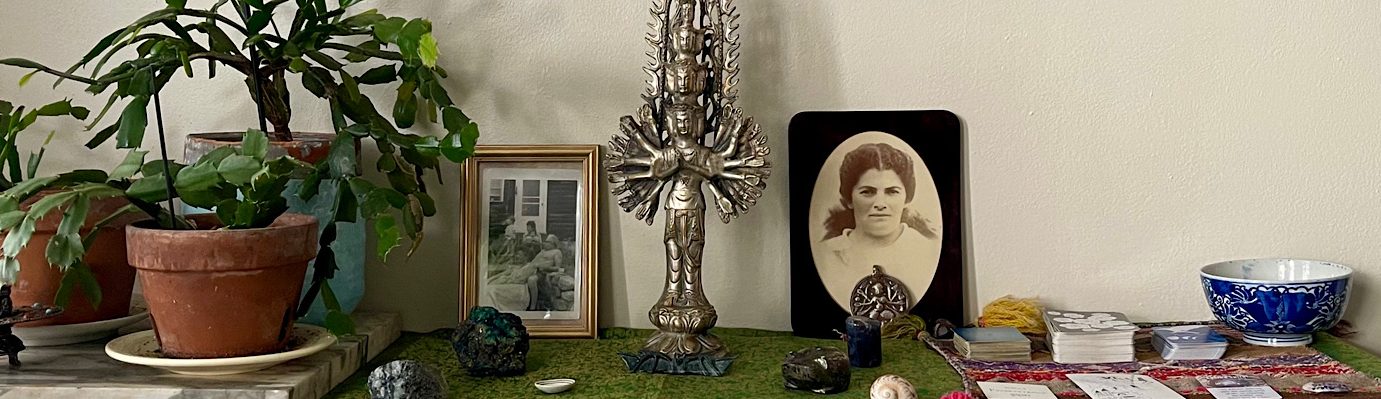
My Grandma Rose (for whom the name of this blog is partly in tribute) was a very important part of my childhood. She had a small, but lovely apartment in Brooklyn Heights, and I spent about a weekend a month for most of my childhood with her. One day when the family was visiting and I was no more than seven or eight, I took a carton of her cigarettes and destroyed them. She was very angry, and I got in a lot of trouble with my parents for the deed. I had just learned in school about all the horrors of smoking (that was the very early years of starting to admit and warn of the hazards of smoking), and I wanted to protect her.
When my grandmother died at age 76 from her heart unexpectedly stopping, I was in 10th grade. They found she had advanced stages of emphysema. Occasionally I wonder how my life would have been different and think about how much she would have enjoyed seeing me grow up if the smoking had not shortened her life.
Although I was too young to know that we cannot change our loved ones by force or even by the force of our love, I hope she knew that my childish act of destruction was borne from love.
Solar Panel Install Progress Report
Filed Under Art and Culture, Community and Family | 1 Comment
Permits all approved; grant application confirmed as complete by DC government; Master supplier application received by PEPCO; materials delivered to roof today; electricians scheduled to come tomorrow.
What Does It Mean to Be Yogic? (and “The New York Times Article”)
Filed Under Asana, Pranayama, and Yoga Practice, Community and Family, Food for the Mind (Yoga Philosophy, etc), Meditation | 5 Comments
This weekend, a friend whose marriage of decades is precipitating towards dissolution, said to me, “I am having trouble reconciling being yogic and still needing to do what I need to do in connection with divorce. How do I deal with that?” I told her about a yoga principle I learned at the first Inner Harmony Retreat I attended with John Friend in the summer of 2003. He had asked a student a question that yielded as the answer the four yoga principles of ardha (physical and material well-being), kama (relationship, including intimate and love relationships), dharma (life path or work), and moksha (liberation or freedom). The fellow student answering the question, who was also my teacher, gave the classic yoga explanation that we try to do the first three elements in alignment so that we can then transcend and go beyond them to become free (enlightened). John replied that was the traditionally correct answer in dualist, classical yoga, but that from the tantric perspective of a person living in the world as a yogi, we look apply the principles differently. By living in a way that we have taken care of our physical and material well-being, have happy and loving relationships, and work with delight and passion that we will be embodying a life of the spirit; we will then be living and embodying freedom (jivanmukti). That encapsulation of tantric yoga resonated deeply and is a significant part of why I have chosen a path of tantric yoga rather than one that preaches renouncing the body and mind (which I think is impossible for one staying in the world).
My friend’s question seemed especially significant to me in light of the dialogue that has ensued following the publication of the New York Times article on John Friend, John’s blog in response, and the Elephant Journal interview. The essence of the article and the reactions, to me, seem to be about the intersection of our “outer” notions of societal success–fame and fortune–and yoga and whether the two can be reconciled. The New York Times article is obviously intended to be sensational and to create controversy; that is what makes a journalist who gets fame and fortune. But the alleged tension highlighted in the article is indicative of a bigger societal confusion of how and whether we can be spiritual or religious beings and also have human needs and wants. Ours is a society that hungers for panaceas and palliatives. In “discovering” yoga and its benefits in the late 20th century, far too many have put onto it expectations that have no basis in what is yoga and how it is supposed to aid us.
There is no word in yoga philosophy or in India for “yogic.” The word “yogic” is a western creation of relatively recent vintage. Webster’s dictionary does not have it as a separate word, but just has it at the end of the definition of “yoga” as “adj, often capitalized.” What do we mean by being “yogic?” It seems that we have gotten this notion that if we practice yoga seriously or teach it, that means we must be perfectly pure and good. We will need only light and air to nourish our bodies (and maybe a little local raw food in season); we will have neither needs nor desires; we will be so suffused with peace, compassion, and equanimity, that we never feel or show anger or grief, even in the face of injustice, violence, pain, or outrageous behavior. We expect that somehow we will be a perfect monk while still living with family and going to work.
We expect this not only of ourselves, but even more so of our teachers. In essence, we somehow expect yoga to release us from the realities of being human. To have such expectations inevitably will lead to disappointment in ourselves and our teachers (for being unable to reach this impossible ideal) or in the practice (both for not yielding this ideal and for, in our delusion, creating this expectation in the first place). My meditation and philosophy teacher Paul Muller-Ortega would say that to have such expectations is “adolescent” spirituality. When we practice “adult” spirituality, we take responsibility for ourselves and our own practice. We expect our teachers to offer us the teachings, but we honor and recognize them as human beings.
To practice yoga sincerely while still living in the world should make us more humane to ourselves and to all around us, not beyond being human. This is the true essence of Anusara yoga. To be richly and freely and wonderfully human and feel great love and compassion for that, even as we balance the realities of life with attempts to live in greater alignment. I am incredibly grateful for the teachings and the community that John Friend has created and the offering to study and get as deeply into the yoga as makes sense for me. Whether there are things I might do differently in the realm of ardha, kama, or dharma if I were “the yoga mogul” is of little moment because to find moksha we all strive to do our best in our own way (and one thing I know of John is that he always strives to do his best).
Good News on Proposition 8
Filed Under Community and Family | Leave a Comment
But what should we think about doing next?
keep looking »