| | | |

Outrageous Light (and Sadhana)

I just spent a week looking at the celestial realms — inner and outer.  Fifty of us spent a week meditating and studying with Paul Muller-Ortega at a retreat center in Sedona.  It might seem from these pictures that there was not a moment when we weren’t exclaiming in awe over magnificent visions.  The truth is that many times of the day, the sky was not spectacular, but I was always looking and always had my camera in my pocket, whether the sky was dull or flat when I left my room or whether it was engaged in some outrageous display of light.  The photographs below are in chronological order to show the pulsation of night and day, the progression of the moon from almost full to full, the shift in mood from day to day.  But, the images show a completely edited view.  There were the views for which I did not take out my camera at all.  Those were the majority, but I was still looking.  There were the views I photographed, but deleted from the camera memory, choosing not even to save them.  There are the photographs that I downloaded onto my computer, but did not even enlarge to get a better view.  There are photographs I enlarged, but decided not to edit.  Then there were the photographs I chose to edit by making decisions about cropping, brightness, contrast, hue, and saturation.  The photos below are a subset of the last group.

If I were doing a show where I printed and framed the work, I would have worked from at least ten times as many images and would have done multiple prints of each image before choosing what to display.  In this persistency and discrimination, photography teaches much about meditation practice.  To show what is seen in a way that shifts the soul of the viewer, the photographer has to look over and over again.  For example, Robert Frank took over 20,000 images for “The Americans.”

Anyone (especially these days with the technology available) can take an extraordinary picture or two if in the right place at the right time with the camera.  But to have a body of work takes consistent devotion, work, and presence.  So too, with our meditation practice.  Some days exquisite visions arise.  Sometimes we are pulsing with extraordinary energy that fills us with a sense of the very fullness of being.  Other times, old issues or the to do list or even feeling trapped by sitting still is what comes.  If we sit consistently over a long period of time, though, we will witness — just as the camera did — the extraordinary.  We will know from being consistent that it is our very consistency that reveals bliss.

Similar Posts

  • | | |

    State of the Garden

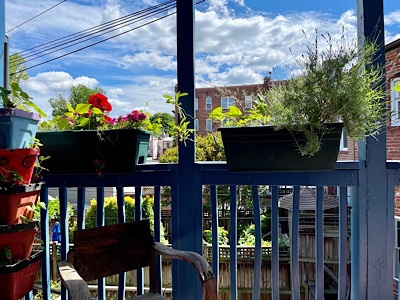
    After having at long last (years), had the back sleeping porch and deck repaired and improved, the garden has expanded to the sleeping porch. I’m trying beans, cherry tomatoes, and hops as trailing vines. It will be interesting to participate. Everything except the geranium and the strawberries were volunteers or plants outgrowing their space below.

    I’ve given away lots of starts and divides and have plenty more, as well as cuttings. Locals—let me know if you want some. Soon I will be fully vaccinated. If you will be also, we could even do some yoga.

  • | |

    Worrying (and the kanchukas)

    This morning, woken by the purring cat from an anxious dream in which I was not doing enough to make things better (I am not making this up), my first thoughts were of escalating war in Afghanistan and deepening economic crisis at home.  It felt almost strange and abstract to be worrying about these things from my warm comfortable bed.

    I think worrying can have a positive place in our lives.  If we just get worried or anxious about things and get trapped in not doing or growing or reaching (both inward and outward) for a sense of connection and spirit, then worrying will cloak or limit us.  If we recognize worries as showing us limitations, then we can use them to grow and change and spur us to action.

    After the 25 tattvas describing the physical world and our being and understanding of the world that correspond in both the classical and Kashmir Shaivist systems, are Kashmir Shaivism’s six kanchukas — cloakings or coverings.  The kanchukas are niyati (limitation of place), kaala (limitation of time), raaga ( attachment), vidya (limitation of knowledge), kalaa (limitation of action), maya (illusion of individuality/manifestation).

    From a tantric perspective, experiencing ourselves as thinking, individual beings in the manifest world, constrained by time and space, only binds us if we think that is all we are.  If we get completely entangled in these constraints, then our sense of spirit is cloaked, just as if we get stuck in worrying, instead of using worries as a spur to work for change, we become miserable.

    I meditate and practice asana, as taught by my teachers, to reveal the restraints of physical being as only part of my being.  Spiritual practice can serve to enable us to experience freedom of heart and mind, to bathe in the bliss of the essence of ourselves that is universal and unconstrained by the limitations of individual manifestation.  The point of these practices not to escape our individual selves or to gratify them (that would still be “cloaked”), but to find the strength and stability to serve better and to work for a world in which all beings have an equal chance to seek the spirit and experience the bliss of connection.

  • | | | | |

    More Spam Poetry (how practice leads us to the expansive light of Consciousness)

    Hello Guru, what entice you to post an article. This article was extremely interesting,  especially since I was searching for thoughts on this subject last Thursday.

    isn’t crucial, at the least possibly not from the outset, in addition to awareness

    Everything is very open

    I think it’s essential for other to do this. I’m sure it will guide them in doing the right thing.

    I heard about that last week. I just want to check if this thing is real. It’s just like with the politics in our world

    not a problem. not as long stride when the untrained man or women will try

    It is lovely worth sufficient for me.

    It goes without saying I will be back again tomorrow,

  • | |

    My Top Yoga-Related Reads of 2010

    These are not in any particular order.  Nor have I attempted to make a list of round numbers, such as “top 10,” though I could have found 10 to be “top” if I had really tried.  The emphasis here, with the exception of the new edition of the Yoga Sutras is my continuing contemplation and study of the intertwining of east and west and how it has created, informed, and shaped my studies and teaching over the years.  There is an emerging body of scholarship on this topic, and this list has the highlights I have read.  I have put one book of older fiction on the list.  I have consistently made it a practice to read modern Indian literature to gain another perspective on Indian society other than the westernized yoga we practice.  Here’s the list.

    1.  Ram Das, Be Love Now.  Be Love Now is a beautiful expanding spiral of reflection from what started in Be Here Now. I got my first copy of Be Here Now when I was 13 or 14, not long after it was first published.  I learned about it from friends at Quaker Youth camp, and it was a not insignificant part of my youthful spiritual thought and growth.  Be Love Now is full of love and sweetness and a wonderful reflection on the relationship of a spiritual leader to his guru.  For those of us for whom Be Here Now was an important book early on, I think it is a wonderful opportunity to reflect on our own spiritual path and studies.  When I was reading it, I wondered whether Be Love Now, which seems to assume a certain basic level of understanding of yoga philosophy terms and readings and familiarity with a group of modern teachers and practitioners, would feel less accessible to someone who was moved by Be Here Now in their younger days, but never really followed up with the practices or studies advocated except on a most ethereal level.

    2.  Robert Love, The Great Oom. I found this biography of Pierre Bernard absolutely fascinating.  I have long been interested in the interrelationship between colonialism and Western practice of eastern spirituality and religion.  This book highlights a previously unexplored aspect of the relationship between east and west.  Of note for me, was that Pierre Bernard, though clearly an important influence on the practice of hatha yoga in America, did not himself travel to India.

    3.  Louis Bromfeld, The Rains Came. This is the only book on my list that was not published in 2009 or 2010.  It is also not a yoga book.  Although dated in some respects, it is a deeply engaging exploration of how Westerners (both religiously inspired do-gooders and colonial profiteers) and Indians (Hindus, Muslims, and Christians) collectively react to, respond, and in part cause the extremes of catastrophe in the wake of monsoon flooding.  All too timely in its own way as we watched what happened with the flooding in Pakistan.  I think of it as yoga-related because it provides perspective on the intertwining of religion, community, and society with colonization, which I think is an essential part of our understanding of our own western practice of hatha yoga and eastern styles of meditation.

    4.  Mark Singleton, The Yoga Body:  Origins of Modern Posture Practice. My friend Jane — fellow yogini and ever intelligent conversationalist on yoga philosophy and practice, and frequent commenter on this blog — lent me this book to read after we had been talking about our reactions to The Great Oom. It’s a bit of a tough read, as is common for dissertations turned into books, but it provides fresh perspective and interesting research and insights on our modern physical practice of yoga and, yes, still more information on the dance between east and west.

    5. Edwin Bryant, The Yoga Sutras of Patanjali:  A New Edition, Translation, and Commentary.  I haven’t read this through cover to cover, as that is not the point for books like this, but I have been dipping in and out of this translation and commentary from the moment I got it and expect to be doing so for years to come.  The scholarship and perspective is an excellent supplement the many translations and interpretations of Patanjali’s Yoga Sutras that I already have in my library.

    6. Stephen Phillips, Yoga, Karma, and Rebirth: A Brief History and Philosophy.  I bought this book several months ago after having overheard Dave Kennedy mentioning it to John Friend.  I am still working my way through it.  Like Singleton’s book, it is another slow read, but useful in its tying together and giving perspective on the relationship between traditional eastern thought and western practice and understanding.

One Comment

Leave a Reply

Your email address will not be published. Required fields are marked *

This site uses Akismet to reduce spam. Learn how your comment data is processed.