A Small (But Highly Nourishing) Break During a Very Long Work Day

In Hindu philosophy, the powers of creation (Brahma), sustaining or preserving (Vishnu), and destruction (Shiva) are all given equal weight in the balance of the universe. Without destruction, there is no place for new creation. Each aspect of this triad is an essential part of the elemental unity of being.
I think that a repeal of the health care act, if it only were to open the path to a single payor system that actually provided health care for most, would be a good human level demonstration of the need for destruction to allow for creative flowering. Alas, I don’t think that is what the would-be destroyers have in mind.
I remember at these times that I am not in charge, and I cannot see the biggest of the big pictures, but somehow, that is not always of much comfort.
I ordered some seeds for the garden–Malabar spinach–a spinach-like green that supposedly likes heat and humidity–from Calabash Tea and Tonic. I’m looking forward to seeing whether it will thrive in the summer. It’s hard to find greens that do well in the long, hot summer.
As I was running low, I also got some powdered ginger. Even though I can make my own, because it came with a good story, I included some Jamaican curry powder in my order. They arrived almost immediately, along with an exhortation.

In this realm we can be hit by a car. That’s why, though I see benefits to having some experience with a wide range of practice, I prefer to concentrate my regular practices to those that are designed to maintain compassionate and serene engagement with embodiment to those designed to renounce, escape, exempt or rise above the messiness, complexity, and, sometimes, trauma of embodiment.
What about you? Perhaps you do not feel any need to examine this question.
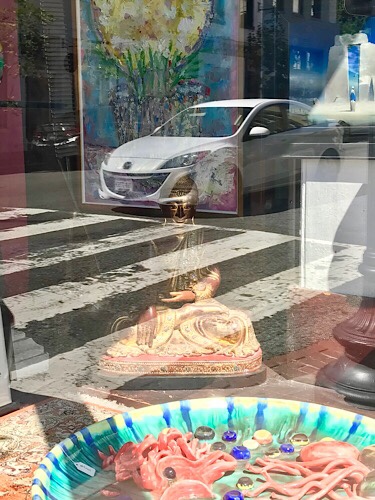
Last night I was thinking about what that phrase means. I was talking with a friend who has a similar enthusiasm for studying, practicing, and teaching yoga, who also has a full-time job/career. At some point in describing the number of hours I have spent studying with John Friend and other Anusara teachers, it came out of my mouth that I have been able to pursue this passionate engagement with yoga because, as others have said to me, “I don’t have a life.” My friend, being in the same society after all, initially went right along with that statement as if it was a perfectly reasonable thing to say.
Then we started questioning it. It is not as though we do not both have rich, full, engaged, active lives. How did the vernacular come up with a phrase that says we do not “have a life,” if we are not so occupied with the things that society would have us do (for the “modern” woman I think this means high-powered career, husband, children, nice house) that we have enough time and flexibility to deeply pursue and explore beyond what we are supposed to do?