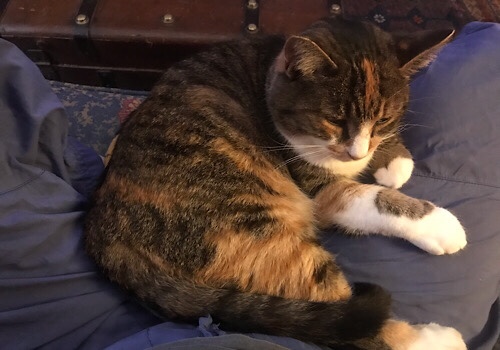
Afternoon Nap
A brief afternoon nap is one of the benefits of working from home.
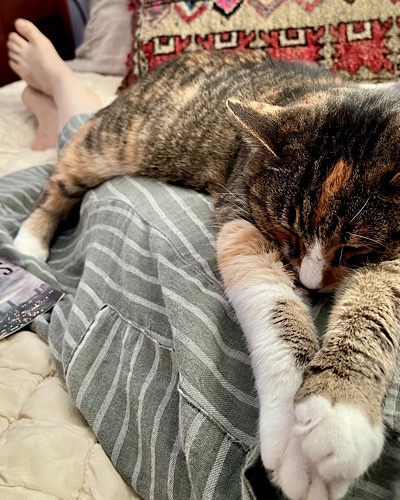
A brief afternoon nap is one of the benefits of working from home.

I contemplated long and hard about how to teach the Anusara principle of pelvic loop. If students are already tending to bring the tops of the thighs forward, without doing enough inner spiral enhanced by thigh loop (which together take the tops of the thighs back and apart and brings curve to the lumbar spine), it would not be helpful to invite them to engage in an action, which if done as a primary movement, will tend to take the curve out of the lower back and bring the tops of the thighs forward, making movement even more limited.
Even if we have the tendency to tuck the buttocks and tailbone too much, we are not necessarily engaging out core, and pelvic loop, when done in proper sequence, really helps us to affirm and find our own strength — and no one should miss out on the opportunity to do that. So crucial to thinking about pelvic loop (especially being myself a reformed “tucker”) are the following:
1. The loops are bilateral and can move separately. This means it is not just bringing the whole of the pelvis forward by a single, central big movement of the tailbone, but using the muscles on each side of the pelvis independently to engage pelvic loop.
2. Although ultimately, all of the principles are done at the same time, they are also done sequentially. A student said last night that doing pelvic loop in a seated position made her feel “lifted up away from the ground.” Once I said to remember that part of “opening to grace” is settling and getting heavy, and we always do “open to grace” first, she was better able to understand how to refine her seat with pelvic loop. Instead of lifting her thighs and pelvic bones, she left her bones heavy and drew her muscles in to firm the buttocks, tone the pelvic floor muscles, and lift the belly to support up-rising energy in the spine, which gave her a sense of power and upliftment, even as she kept a feeling of being rooted to the earth.
3. Last week I wrote and taught about using “thigh loop” to get out of our own way, to choose actively to tip the longest bones in our body into the back plane of our body so that we have more range of movement, freedom, and flexibility in our pelvis and low back. Only after we have made the physical and energetic shift of thigh loop can we really tap into and affirm our own power. If we are still jutting forward (literally and metaphysically) then when we try to tap into power, we will just get more in our way. When we have gotten out of our own way and moved into the back body, then we can better find our power. We still start in the back body, but we affirm the spaciousness and freedom we have created and are able to find a place of empowerment and soar. For example, it is my experience that taking the thighs back and apart is a big part of what gets us into arm balances, but firming the buttocks and engaging the pelvic floor and lower belly muscles that keep us up and give us the ability to choose where to go once we get there.
4. Off the mat, it may be nice to get out of our own way, but then what? Shedding or moving what is blocking or inhibiting us is not for the purpose of having nothing, but so that we are then able to affirm the worth of our own being and find our own power so that we can be more joyous and more generous.
I have a set of cards that I keep on my altar that are designed to be used for contemplation. There are about fifty cards, each of which has a sanskrit word and its meaning. Just as one gets a fortune cookie randomly or picks a tarot card from a deck, but the message often seems right on point, the word that arises from the card picked from the stack often seems uncannily timely. Early Saturday morning, after not having used the cards in a few months, I picked a card from the middle of the stack to see if it would help guide my contemplation and meditations as I was getting ready to say good-bye to Becky. The word on the card I picked blind from the middle of the stack was “moksha” or liberation. In classical yoga, moksha does carry with it the implication of being liberated by transcending body and mind.
Later on Saturday, when I was on my way home from teaching for the appointment with the vet, I stopped at the metaphysical supply shop for a piece of rose quartz (to use in a ritual to assist with the transition and loss that a friend taught me). At the check out were “dolphin saying cards.” There was a sign next to the cards inviting customers to take one for free. The sign also said that it was not necessary to take the one at the top. The cards were face down; I did not look for a particular saying. I dug a few cards down, and the one I selected read: “freedom has its roots within yourself.” In other words, “moksha” for the second time on this day, when I was facing with Becky her transition of the spirit from the body.
Was it a message? Was it a coincidence? I do know that I knew when it was time, as I did with Henrietta. Becky just did not want to be embodied anymore. When I held her in her arms after she stopped breathing, she was released and relaxed in a way she had not been in months. That the signs were saying “moksha” resonated with Becky’s power and connectedness. I hope that when I am ready to go, I will truly understand moksha, that I will be released. It is so resonant of Becky’s life, for all her quirks, that she was still teaching me even as she was dying.