Signs Around Town (and Sadhana)
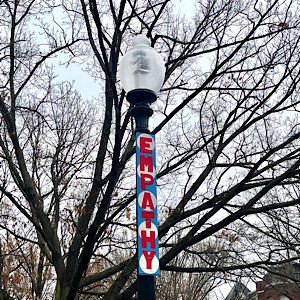

Peace and light, E — Posted with WordPress for BlackBerry.
Last night when I arrived to teach, I found that the room where I teach had been booked with something else (mistakes happen) and the alternative offered by the space just was not viable. I was peeved, but just canceling class did not feel right for the space (which has treated me well), my students, or myself.
Instead, I waited until class time, gathering the students together and giving the options. Fortunately, class was small because it is summer. Two students agreed to drive us to my house, which is usually a walk, but one already had her car with her on her way home from work; and the other had hers just a couple of blocks away at her house. All the students, including two brand new students who came along for the adventure, arrived at my house less than 10 minutes after the usual class start time. To honor everyone for being so flexible, I turned the class into a donation class, with the proceeds going towards July’s cause: the ACLU.
This turn of events seemed to me to fit well with the message of the Shiva archetype Nilakantha, which just happened to be the name of Shiva that I have been contemplating this week as I have been preparing my classes.
Shiva drank the poison that was stirred up when others were searching for the nectar of immortality. In the quest for the unrealistic, these beings brought to the surface a poison that would have killed all humans. Shiva drank this poison and trapped it in his throat, which turned it blue. This gave him the name blue-throated, or nila-kantha.
The challenge I encountered yesterday was certainly one of the well-off middle class. If it were not for our lifestyle, the abrupt change of plans and disruption could not have even felt poisonous, but we are creatures of our place and time. We took the potential chaos from having been stirred up and instead of letting it ruin our evening, we made it into a celebration and an offering.
And I am working with the space not to have it happen again. Many thanks to the students who came and were so gracious.
I went to a delightful brunch yesterday hosted by friend and neighbor K, who lives on the other side of the Hill. A number of the guests turned out to live within a couple of blocks of me on the Northeast side. In describing my house to those who lived farther from the Capitol than I (knowing my block was part of their usual walking path), I said, “mine is the one with the ‘War is not the answer‘” yard sign. “Oh yes, I know which one it is,” was the uniform response.
K said she did not have the yard sign because she did not want a negative message in her front yard. It served its purpose for a time, she claimed, but she wanted a more positive message. I replied that if the sign said “peace is the answer” it would not have the same p0litical meaning. People would just think, “yes, peace is nice, but whatever,” and keep walking. We all agreed that was likely, but I left still thinking about the conversation.
One of the reasons K gave for wishing to turn the sign on its head, was she did not want something renunciatory, and she referenced the principle of “negation” in Buddhism. I knew what she meant. Advaita vedanta has a phrase, “neti, neti” or “not this, not this” which means extinguishment of the individual self and a life of the senses and mind to unite with the ultimate Spirit. The Buddhist “nirvana” literally means “void.” I did not engage the conversation in such a way as to bring it to tantra lest I go too far in the direction of yoga geekiness, but the conversation certainly led me to think in that direction. Tantra seeks to do exactly what K was seeking: to turn the phrase, “not this, not this” into an embrace that will reveal truth and light by means of affirmation rather than negation.
Interestingly, though, I think a possible inspiration for K’s yard sign dilemma could come from from Buddhism: metta meditation (note: I have been offered this meditation in various settings and have practiced it many times, but it is not my regular meditation practice, so I hope I am not misinterpreting or mischaracterizing it here). The theory behind metta meditation is to distance one from anger to cultivate calm. In this creation of calm comes a general demeanor of loving kindness and compassion. I personally become calmer by embracing and aligning with all my emotions, including grief and anger, but still find the languaging of the metta practice beautifully inspiring.
In that spirit, I suggest as a possible rewording of the yard sign that still serves the political message, the call to serve: “may all beings be free from war.”
Or maybe FCNL should make a sign with the query: “what do I do in my life to remove the causes of war?” Is that still a negative, if we are calling for positive actions to remove causes?
Appreciation of beauty-a wonderful source of healing and nurture. Photos taken on my walk through Lincoln Park to get an end of the work week massage.