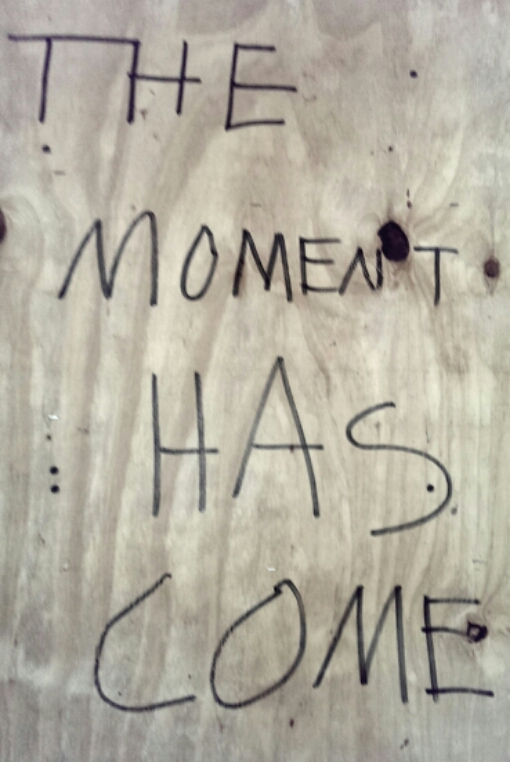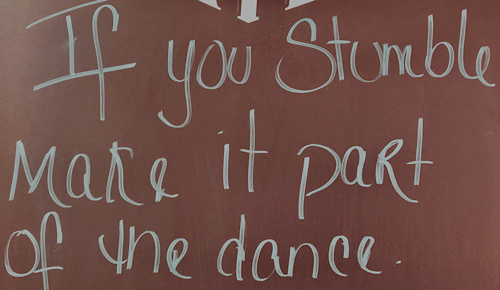
Found Exhortation


Dear Friends ,
As I went through the airport in each direction last week on my way to and from San Francisco to play and to visit with friends, I thought about how much our experience even of something as relatively ordinary as a trip through the airport can change by the difference of 15 minutes. On the way there, we got to the gate just as the flight was boarding. Had we been earlier, we would have sat in a crowded area, perhaps wondering whether the flight would actually leave on time or whether we could leave from home a little later next time. If we had been 15 minutes later, we would have been among those frustrated and harried late boarders whose bags end up over some seat 15 rows farther back.
We each have our own tolerance for sitting and waiting or being at the last minute, respectively. We go through life more easily if we pay sufficient attention to what makes us feel challenged and what makes us feel secure and grounded with regard to how we navigate time and space and figure out how to act in ways that are most supportive (without dulling awareness or denying how we could benefit from change and growth).
An important aspect of meditation and asana practice is how they can deepen our understanding both of how we tend to relate to things in our time-space continuum and how to optimize those relationships. For example, part of learning to sequence a practice is learning how the parts of our body fit together and how to change the order of movements to expand our strength and flexibility beyond what might otherwise have been possible in a safe and joyous way. In all my classes, I emphasize how to structure and sequence your own practice because I think it makes such a difference on and off the mat.
What triggered all this thinking about what a difference 15 minutes can make was that students have been asking for a later time for the Friday night gentle/therapeutics class at Willow Street Takoma Park. Starting this Friday, September 14th, class will begin at 5:45pm and end at 7:15pm–15 minutes later than it has been in previous sessions. The extra 15 minutes later start time can make all the difference in being able to get to class without feeling pressed. Ending only 15 minutes later still leaves open much of the evening. The class is a lovely way to transition from week to weekend–a Friday yoga happy hour and a half that is designed to heal and nourish. Although it is best to sign up for a class to get all the benefits of the progressive teaching method at Willow Street Yoga, drop-ins are always welcome. Do feel free to invite friends or family to join you.
New students of all experience levels are always welcome at the Tuesday night, William Penn House practice. Come by some time and join a wonderful, welcoming group of yogis. For more information, please check the classes page of the website.
Hope to see or speak to many of you soon in person or in the ether. And remember: spending even 15 minutes a day in meditation or yoga practice can make quite a difference in your relationship to life in time and space.
Peace and light,
Elizabeth
A work colleague of mine graciously said to me that he did not know how I got through certain meetings without yelling, he did not know if he could do it. I replied that lots of yoga helped. “Maybe I should get back to transcendental meditation,” he said, “but I found it did not really help; I should find something, though.”
I said that I tried to think of the challenges at work as just part of the dance that yields such rich abundance for me. The discussion carried on, and we not only resolved the minor problem that had led to the phone call, but also felt a deeper connection that will make it easier in the future to resolve work issues that we mutually encounter.
What I like best about the myth of Nataraja is that the dance is not for the purpose of creating the world or with any particular design, but for the sheer bliss of dancing — anantatandava. The dance makes possible both destruction and creation, but it is not its reason. When we engage in the dance of our own lives, yoga invites us just to dance fully with wonder at the rich diversity of experience. We make choices and seek to be more aligned, but ultimately we are just dancing.
As those of you who are regular readers may recall, I have been working to use solar energy to provide most of my electric power. The solar installation was complete in late August, and the public utility responsible for changing the meter to reflect the input of my solar energy to the grid advised on September 3rd that the meter would be changed within three to five weeks. Week five came and went. Week six, I wrote to the utility and asked why nothing had been done. My tone was appropriate, and I did not let it upset me, but still I felt the need to take action. I was advised that the metering people would be contacted, and it would be done or I would hear back within the week. Week six passed with not a word. Now it was week seven. I wrote again asking why I hadn’t gotten a response. The answer was that I deserved to be frustrated and should complain to the public service commission.
I filed a complaint; after all, I was directed to do so by the very entity against which I had the complaint, but was advised by the public service commission that it could take 30 days to respond to my complaint. Meanwhile, my house was continuing to be powered by mountaintop coal mining and nuclear power. This wouldn’t do. I contacted my solar contractor and asked for assistance. The solar contractor had connections with the commission. This morning I received a very apologetic call from a supervisor at the electric company. The meter was installed later in the day (although I still need for the electric company to “authorize” “my use” of the meter–not going to try and understand that one). The authorization is supposed to be processed tomorrow.
Here’s where the apparent disconnect between responding “from the highest” and not being a doormat came into play in my mind. The reason I got an immediate response was not the delay, but my documenting the foolishness of having been advised that the next step was to file a complaint instead of having been told the actions that the employee was taking to try and address my concerns. I work for the government. I know that is something that is wholly unacceptable, and my having used the inappropriate response to my inquiry to make sure I got a result will likely result in unpleasant repercussions for the employee.
This situation triggered a memory of an airport episode in the days when I was still flying around the country as a litigator. When nearly everyone else at the airport was traveling for the holidays (it was December 22nd), I was flying out of National Airport to Hartford to take a deposition the next day. I was waiting in a long line to check-in (this was long before the days of e-ticketing), and the airline announced the flight was canceled and that they would be putting all of us on a bus to Dulles airport on a flight that left two or three hours later (it was already the end of the work day). I was a bit cranky, I am sure. I asked in a way that everyone could hear, keeping in mind I had a ticket that could be changed, whether there were flights on any other airlines going to Hartford from National that night. Gosh, apparently, no one had thought of that or was hoping that no passengers would ask for such a response since it would have a cost for the airline. Within a half hour, several of us were re-booked on a flight with another airline leaving from National. No bus. Hardly any delay. A college-aged woman who ended up with the benefit of the re-booking looked at me with her eyes shining, “are you are lawyer?” she asked. I’ve always thought I might have been responsible for changing her life by having not stood for being treated badly, who knows whether it ultimately was for good or ill.
I often hear people saying that speaking up, taking action, refusing to suffer inappropriate, unjust, or unnecessary conduct is “bad.” What is the difference between being passive and responding from the highest? Where do we draw the line?