Sadhana
The nuns were out practicing again.
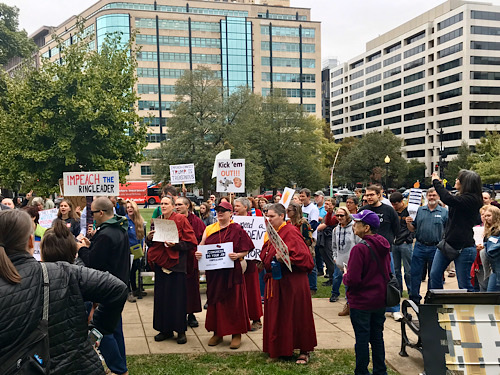
The nuns were out practicing again.
The two books I read while I was traveling to California (San Francisco for the delight of it and Lucerne Valley to study with Paul Muller-Ortega): Home of the Dancing Sivan, India in Mind.
The first I picked to bring because it was one on the bibliography Paul has given us to read that I had not yet read and was also something that I wanted to read in anticipation for my planned trip to to Chidambaram in December. By coincidence, while we were on this intensive, Paul showed us a video of a ceremony at Chidambaram, so I was glad to have read the book on the way there. The second, I picked up recently at the Bryn Mawr Lantern Bookshop, where I do regular volunteer work. India in Mind is an interesting collection–well-known Western voices writing about India, but collected by Pankaj Mishra, an Indian author who lives part of the time in London. Much in the collection I have read before, but the editing gives a very interesting perspective on how we in the West have related to and imagined India. More reading in preparation for my upcoming trip and for my continuing exploration of what has drawn me to the yoga over these many decades.
The five books I bought while in San Francisco (the first three from my every year or three pilgrimage to City Lights Bookstore; the last two from a used bookshop in Hayes Valley near Yoga Tree’s Hayes studio):
The Essential Tagore (a large and beautiful collection), Great Tales of Jewish Fantasy and the Occult (fantasy and magic from my ethnic heritage–why just concentrate on other cultures such as India?), White Hand Society (more on Allen Ginsberg and Timothy Leary, which ties in at a deep level to my Westerner’s understanding of Eastern mysticism); Wintering (I was captivated by Sylvia Plath in my teens and 20s; it looked like a nice book), The Violent Foam (wonderful and profoundly important poetry).

Ellsworth Kelly at the Phillips Collection
When I think of the Anusara principle of calf loop, I think of playing with drinking straws as a child. I’d take the straw out of the glass and bend it back and forth. The straw would end up with a horizontal crease where it was bent — not quite a break — but the place where it bulged at the bend would prevent the straw from serving the purpose of enabling liquid to be drawn up through it. When our knees (or our elbows for that matter) are hyper-extended, I think it disrupts the energy flow from the periphery to the core, weakening the pose, and breaking the integrity of the alignment.
As one whose legs started out bowed (though less after over six solid years of working “shins in/thighs out”), my natural tendency is to hyper-extend. I find that using calf loop, I do not hyper-extend. Calf loop (also called “shin loop”) has us draw energy from the base of the shin, up the back of the lower leg, and loop it through the top of the shin and then back down the front of the leg. We wouldn’t ever start a pose thinking about calf loop, but in the flow of a pose, after the major principles are activated, including muscular energy, we can enhance muscular energy and the integrity of the alignment of the knees by focusing on calf loop. When I practice calf loop, I find that it lifts the calf muscle and draws it more firmly into the top of the shin, and moves the top of the shin forward. These actions do not bend the knee, but firm the muscles behind the lower leg, including the calf and the popliteus (which is the muscle behind the knee that flexes the knee) to the bone.
What is tricky — especially for those who tend to hyper-extend, is that getting the knee in proper alignment feels like bending the knee. If we have been out of alignment, changing our stance will feel strange and perhaps “not right” at first. The sweet subtlety of practice (whether trying to expand our ability to do poses, heal and injury, or live in better alignment overall) is learning what is true integrity in a pose and what is habit, what will serve and enhance and what does not.
Long-store pantry items