Found Exhortation

In the tantric philosophy, one of the aspects ascribed to the ultimacy of being itself is that it is completely free (svatantriya). Even when elemental being manifests itself as limited in time and space (as humans for example), it is part of the very dance, the play (lila) of existence.
I find it fascinating how much of our advertising uses language that in essence promises that we will realize aspects of our divine nature by owning some material thing or indulging in some activity. What is being sold, by those terms, inevitably fails deliver and must thoroughly disappoint. This thing on offer might be a wonderful technological toy that would be great fun to use, but hardly could bring unlimited freedom. If it did, we wouldn’t want to buy the next version.

Peace and light, E — Posted with WordPress for BlackBerry.
I am curious about the concept of guru, and as usual, when I am curious about something some large part of my exploration is through books. As my latest entry in books about gurus, I’ve just finished reading Rachel Manija Brown’s “All the Fishes Come Home to Roost,” memoir about her years as an American child in an Indian ashram.
The tale a wonderful example of how humor and curiosity can help us survive human challenges and discomfort and how story telling itself can be an act of healing. Finishing the book at the start of guru purnima reminds me of how many of my teachers have been books.
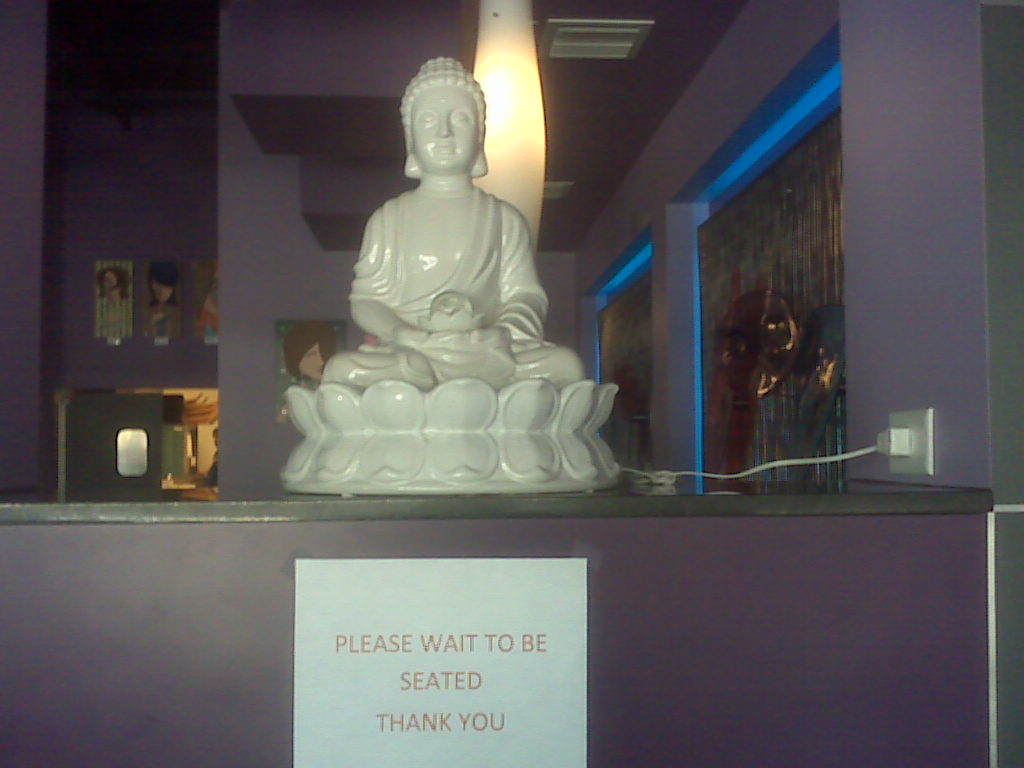
Mixed message? Not really. If you don’t hesitate to sit regularly each day for meditation at home, it will be a lot easier to wait for a seat at a restaurant.
Peace and light, E — Posted with WordPress for BlackBerry.
On the last morning of the trip, when we were standing next to the bus (how blessed we were to have a well-driven, air-conditioned bus to take us through southern India; I was most grateful and conscious of its protective bubble) getting ready to head north for Chennai, I noticed that there were limes under the wheels of the bus. I was standing next to Douglas Brooks, the leader of the trip. “Why are there limes under the wheels?” I asked. “To feed the demons,” he replied, “so that they do not feed on you. We make offering (bali dana) for auspicious memories and a safe trip home.” The offering to the demons, bali dana, recognizes, I think, that we cannot eradicate demons. We can feed them, though, avert their gaze with our offering to something they find more desirable and delicious than feeding on us.
On our last day of riding the bus, we were witness to the aftermath of a cyclone that downed trees and shut down power and tore roofs off of houses and rutted roads (thanks to all who noticed that I was in that part of the world and sent emails inquiring about our safety). When it hit, we were far enough south that all we got was a little rain. We flew out long enough after it showed, that it did not impact our flight, which went perfectly smoothly. I do not know whether putting limes under the wheels of the bus made any difference to the external flow of our trip. I do know, though, that I cannot kill off my demons; they are an essential part of me and my history. Shifting the gaze of my demons and shifting my own gaze at my demons, though, is another matter entirely. When we can turn our gaze (drishti) to the auspicious, even when looking through the eyes of our demons, that is when we can truly see what is best in things and better be able to respond with true embrace to whatever life hands us.


