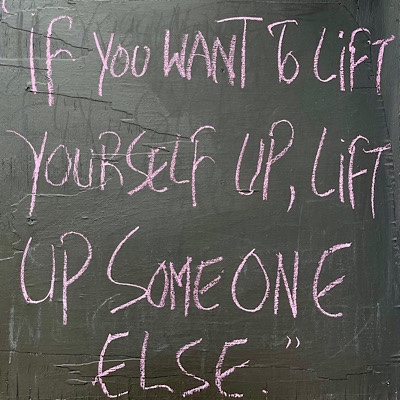
Found Exhortation (Double?)
If we are stuck sitting for long hours for work, I’m pretty sure we need to try and laugh more often.
I wonder, though; are we likely to laugh more often if we steadily sit long for meditation?

If we are stuck sitting for long hours for work, I’m pretty sure we need to try and laugh more often.
I wonder, though; are we likely to laugh more often if we steadily sit long for meditation?
When we are on our mats, being open to grace — the first Anusara alignment principle — includes being open to the teachings so that we can receive and act on them in a healing and loving way. Adding to that muscular energy by lovingly embracing skin to muscle to bone in a conscious embrace, drawing into our center to recognize our inner spirit, and drawing from periphery to the focal point brings us into optimal balance. This pulsation serves as a way off the mat to open, inspire, and engage us in progressively more intentional and uplifting ways of living.
Being open to inspiration from friends and about town, open to learning new ways to be kind to the earth and to ourselves, is a way of bring the principle of “opening to grace” off the mat. Actually keeping the intention and acting on it has the attentive embrace of muscular energy, which draws us onto our inner light in a loving embrace so that we can better serve.
I was thinking about Anusara principles off the mat, yesterday when I went visit a friend in NW one of whose roommates fosters cats. There is a community garden in the back and the house is warm and friendly. In the bathtub were two buckets filled with water leftover from showers. Instead of using fresh, potable water to flush the toilet, when it is time to flush (honoring the drought axiom about yellow mellowing, etc), the house residents fill the tank with the gray water from the shower.
Find it too complicated an idea to shower with a bucket in the bathtub with you? You can still save water by filling your watering can or bucket when you run the water to warm up enough to get into the shower. That will save a few gallons. Not up to using the water to flush the toilet? Use it to water houseplants or for cleaning floors, etc. Or take it outside to water potted plants.
First step is opening and witnessing the possibilities and understanding where you are ready to expand. The second step is to try to more consistently live your inspiration. I know when I see people living with such intention I take better care to move in that direction, even if I am not ready to go as far.
including the yogis or perhaps especially the yogis, Patanjali’s urging to avoid getting caught up in the pair of opposites, pleasure and pain not withstanding,
If you are a true renunciate yogi, then the horsemen of the apocolypse don’t phase you. The ultimate bliss is leaving your body anyway. For those of us who are engaged in the world, care about what we eat, care where we live, care about the well-being of family and friends, then learning, understanding, and acting — knowing of course that we can control that and how we act, but not the outcome — is a critical part of a tantric yoga life.
It’s great to know how to place one’s hands for optimal alignment in downward-facing dog, but do you know how your tax dollars are spent? Here’s a little overview worth sharing widely. And perhaps it will make all that noise in Washington about the budget and the debt ceiling seem a little more important. Check out the “People’s Budget,” which enhances domestic programs, increases participation in paying for our society by the rich, and decreases defense spending and military action.
And then I highly recommend standing on your head or balancing on your hands or otherwise going upside-down, getting twisted, and knowing that the practice will help you stay sane and steady and able to act.
On the Friends Meeting of Washington list serve this week, there has been a fair amount of email exchanged about an upcoming “meeting for discernment for peace.” Very roughly described, a meeting for discernment begins with a period of silent worship in which those present settle into the silence and surrender thought to allow the light of spirit to illuminate a specific subject of contemplation. The subject of the meeting serves to enlighten both the individuals participating and to further both the business and spiritual state of the meeting as a whole.
As I read the emails and invited myself to contemplate the questions offered for the meeting (I will not be able to attend because I had previously committed to volunteer work), it led me to think not only about the topic under discernment, but about how similar it seems to me to the yoga practice of bhavana and how bhavana supports the Anusara teaching method of “heart-oriented posturing language.”
When we practice bhavana ,we invite the fullness of consciousness to illuminate ever deeper levels of understanding of particular teachings from the yoga texts or similar ideas. It is similar to meditation in that we don’t try to think our way through the concept, but rest with it. Bhavana differs from meditation exactly because it is focused on the deepening of a particular concept rather than simply going into the space of meditation as an end in itself.
Although a meeting for discernment is practiced as a form of collective worship rather than an individual practice, it is much like bhavana, and I brought the Quaker method of resting in the light to reveal deeper insight regarding a concept when I first starting teaching Anusara yoga with its emphasis on having a class theme and using heart-oriented language to invite myself and students to experience a heart quality through asana practice.
The queries for contemplation at the meeting for discernment for peace, include the following: