Similar Posts

  • | |

    6:50am flight from BWI (I’ll be off of the computer until Monday)

    I am lucky to have a non-stop.  The storm is supposed to have passed through.  So I can enjoy myself know matter what travel brings, I pack up a variety of reading materials — philosophy, handouts for the workshop, and fiction.  I switched my ankle warmers to bamboo knitting needles so I could get through security and knit (the ankle warmers are on size 2 needles, so it is taking me as long as a sweater).  I have my journal and a pen.  Best, I am traveling with two friends (all different flights, but no one waiting alone in the airport) with whom to visit, who are going to the same retreat.  Takes the edge off of the early wake up time.  Starts the retreat when I leave the door instead of when I arrive at the retreat center.

  • | | |

    Meditate Only for Its Own Sake

    Last night I had the singular pleasure of hearing Gary Snyder read his poetry at the Folger Shakespeare Library.  At the end of the reading, Mr. Snyder answered a few questions.  In response to one question about advice he gives to aspiring poets, he said:  “Don’t be journalists.  Do hard physical labor that leaves y0ur mind open.”  This is not surprising advice, coming from one who has chosen a life requiring regular manual labor.  “Meditate only for its own sake,” he added, in an apparent non sequitur and without elaboration.

    Gary Snyder’s poetry is evidently influenced by his dedicated study and practice of Buddhism.  The insight and clarity of his poetry surely reflects not only his intellectual study, but the deep wisdom of a dedicated, long-standing, and steady meditation practice.  The advice to “meditate for its own sake” seemed almost the offering of a koan by the master (poet) to his pupils.  Meditation, in my experience, definitely  enhances clarity, insight, creativity, and health.  Meditation is not meditation, though, unless when engaging in meditation that is all one is doing and without any goal (like the “actionless action” of the Bhagavad Gita).  It is the deepest of practices to engage fully, but not be doing except for the sake of doing itself (and in alignment with the deepest truths).

  • | | | | |

    Signs Around Town (and Symmetry)

    Advancing
    The practice.
    Community.

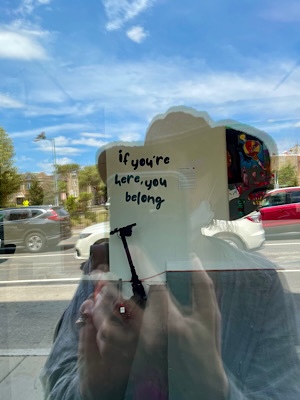
    I spied this sign yesterday in the exhibitor hall on the lower level of the Marriott in Woodley Park. I was attending a portion of the 38th Annual Conference of Enrolled Actuaries. (Go ahead: I dare you to put that into your favorite search engine).

    Although this sign was to invite enrollment in one of the actuarial professional organizations, it seems most similar to the stated aspirations of various yoga groups and schools.

    I’m not surprised by this symmetry. I think that anyone who seeks to live so that employment and dharma (aligned life) are in harmony and who supports, participates, and works in community, is living like a yogin, though perhaps never knowing about or having any interest in yoga per se.

    There are many life paths and humanistic and spiritual practices that guide life towards a contented path of service, the true reason, to my thinking, for a steady, long-term yoga practice (including asana, pranayama, and meditation).

    I personally find the yoga practices to be among the most helpful ways to engage my body and mind for my health and well-being. Among other things, the practices have helped me listen with open enough awareness to be able to comprehend with my law-trained mind some small portion of the language of actuaries.

    Peace and light, E — Posted with WordPress for BlackBerry.

  • |

    On A Bus

    This morning I found myself on a bus instead of the train to New York because of the horrible accident on Tuesday.

    While waiting for the bus, I was interviewed by local TV. They were interested in reactions of people whose travel plans were impacted by the accident.

    This is roughly what I said:

    This was a horrible tragedy that need not have happened.  (I suppose it was for the best that I had not seen the news that a certain candidate for President was quoted as saying that we shouldn’t use a tragedy as an excuse to spend more money on things like safety lest I explain why we need better safety, more spending on mental health care, better treatment of employees, and more investment in infrastructure instead of lowering taxes for the wealthy, etc.) I said that the inconvenience meant nothing to me when I think of those who were on the train. I said that I wouldn’t stop taking the train. One accident would not change my commitment to using public transportation instead of the greater environmental impact of driving.

    And I said I’d had a good experience with Amtrak customer service. I didn’t say it to the camera, but I expect part of my positive experience was my recognizing when I spoke with an agent that the customer service employees must be having an incredibly stressful time of it.

    image

    View from the bus, approaching Manhattan.