| | | | |

Whether It Is Good Weather

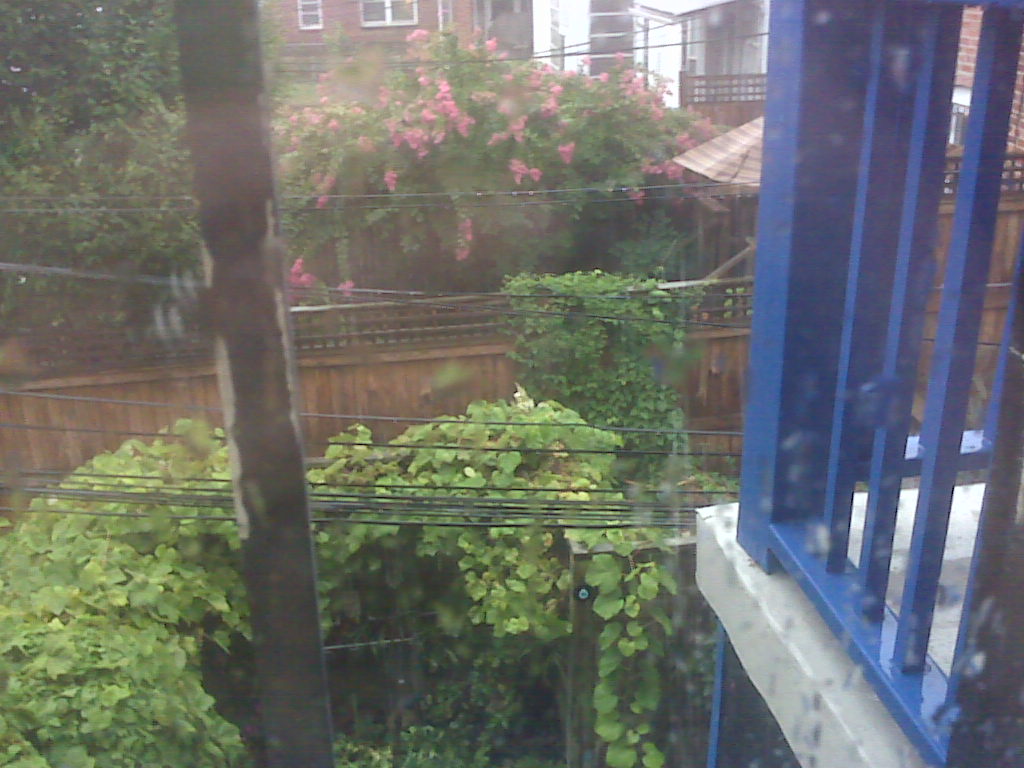
When I was out doing an errand at lunchtime, I bumped into a neighbor I haven’t seen in a long time. We did not spend much time talking; I needed to get back home to my work within the short allotted time, and she was meeting someone. “Did I just hear thunder,” she asked. The sky was thick and white with heat and “Code Orange” air. “You might have heard thunder, but there isn’t any rain with it” I replied. We talked about how much we need some good rain. The trees are really struggling. (Note: forget about cleaning any outside things with water. Forget non-edible annuals. Water established trees and perennials very deeply once a week instead of less watering more frequently. Shallow watering in drought conditions promotes growth of fungus and other pesky things.)

As gardeners, my neighbor and I notice how much rain we are getting in any given season and week. We think about whether the rainfall is what the farmers and the trees and birds and wild animals need, in addition to whether it will interfere with a child’s soccer game or a planned outing. We were at the point that we would far rather get caught out in a deluge than miss out on any chance of rain. On the other hand, those in flooded parts of the north are praying for a few warm (but not blazing hot) dry days in a row. Today’s storm is welcome and needed, though one storm does not end a drought. We need some more good ones for days on end.

I think the approach of various classes and intensity levels of asana practice can feel like a whether a thunderstorm is welcome weather. Sometimes an outrageously intense and fierce practice is what will bring me to my fullest possibility of growth and expansion. At other times, I need to step back and rest my body. Restorative and other gently therapeutic practices are what nurtures best. Sometimes, I have long, steady periods of moderate practice.

The more sensitive, aware, and knowledgeable I get about the weather outside and how it impacts life around me, the better able I am to take care of my garden. The more I am sensitive and open to the weather inside and the more knowledgeable both from study and experience of how my practice best aligns with inner and outer weather, the better able I am to live out the yoga principles I seek ever better to follow–the most important being to see the highest first and to be of service.
Peace and light, E — Posted with WordPress for BlackBerry.


Similar Posts

  • | |

    Samskara (and the awesome and the awful)

    Those of you who have been attending my classes for the past couple of weeks already know that my overall theme for the fall session is cultivating a sense of wonder (abhuta). Feeling wonder is one aspect of the Anusara principle of “opening to grace.” It is seeing who we are and what we are within space and time with a sense of amazement at the limitations and the foibles, as well as the strengths and delights.

    This week I was thinking about abhuta in the context of samskara — the markings or grooves or scars in our being from how we have lived our lives (and perhaps past lives, if those were also lived by us — personally not sure about that). I had a dialogue earlier this week that resulted from over 110 years of combined history that was not optimal. Reflecting on the precipitating factors, though, and marveling at the web of history, environment, education, and action that combined to give rise to the conversation led me to a sense of wonder indeed. It is by cultivating the ability to step back and appreciate the wondrousness of the dance that we learn from a steady practice that, I think, can help make it possible to shift in how we behave and react to things.

    From a physical perspective, most of our challenges and difficulties are based on what we have done with and in our bodies over the course of our lives. We use the yoga alignment principles to create new grooves and to shift from the old repetitive patterns, so that we can not only alleviate pain and misalignment, but to expand the possibility of discovering ever more joy and wonder in and through our bodies and senses. Both the physical and meditation practices help us shift similar patterns (dissolve and transform samscaras and their impact), so that instead of deepening old grooves, we erase or dissolve them and create new life-enhancing ones.

    It may seem odd to marvel at our stuff, especially when it does not appear to be serving us, but keep in mind that both the awesome and the awful, being both all about awe, can give rise to a recognition of the great and exquisite mysteries of being.

  • | | | |

    Found Exhortation (with Commentary)

    This bumper sticker (on an enormous black SUV with suburban plates) is likely intended to have only a message about the current wars in which the US is engaged. I wholeheartedly support the sentiment at that level.

    What if we took it at other levels? What if we applied it to spiritual-religious practices? We could interpret this as suggesting that we honor the great teachers who have gone before us, invite religious observance and spiritual practice to heal ourselves and others, and dissolve notions of differences among religions and spiritual practices as bases for conflict. How many wars between countries or civil wars would end if saw unity while still honoring difference in this regard?

    Perhaps most cogent for the yogi: what if we thought of the exhortation in terms of our own personal practice? It would be an invocation to honor our ancestors, heal the wounds of our family and upbringing (samskaras), and release inner conflict. This is, I think the point of practicing (whatever the style of practice) so that true peace can abound.

    Peace and light, E — Posted with WordPress for BlackBerry.

  • | | | |

    Practicing

    I hope you are practicing something that helps you hold and heal yourself. I wish for you, as I wish and work for myself, some joy and equanimity amidst the global and climatic upheaval and whatever challenges you may be facing personally.

    Do not turn away from suffering and also appreciate moments of beauty.

  • | | | | |

    A Practice

    With each new horror — another I have been blessed to avoid proximity and immediate impact—I ask myself (and make some follow through) on how I can contribute more both to speaking out against injustice, inequality, and warmongering, and also to making collective life more joyous.

    On a day I grieve and speak my outrage , I share work, and food, and moments of beauty.

Leave a Reply

Your email address will not be published. Required fields are marked *

This site uses Akismet to reduce spam. Learn how your comment data is processed.