| | | | |

Outside the Verizon Center

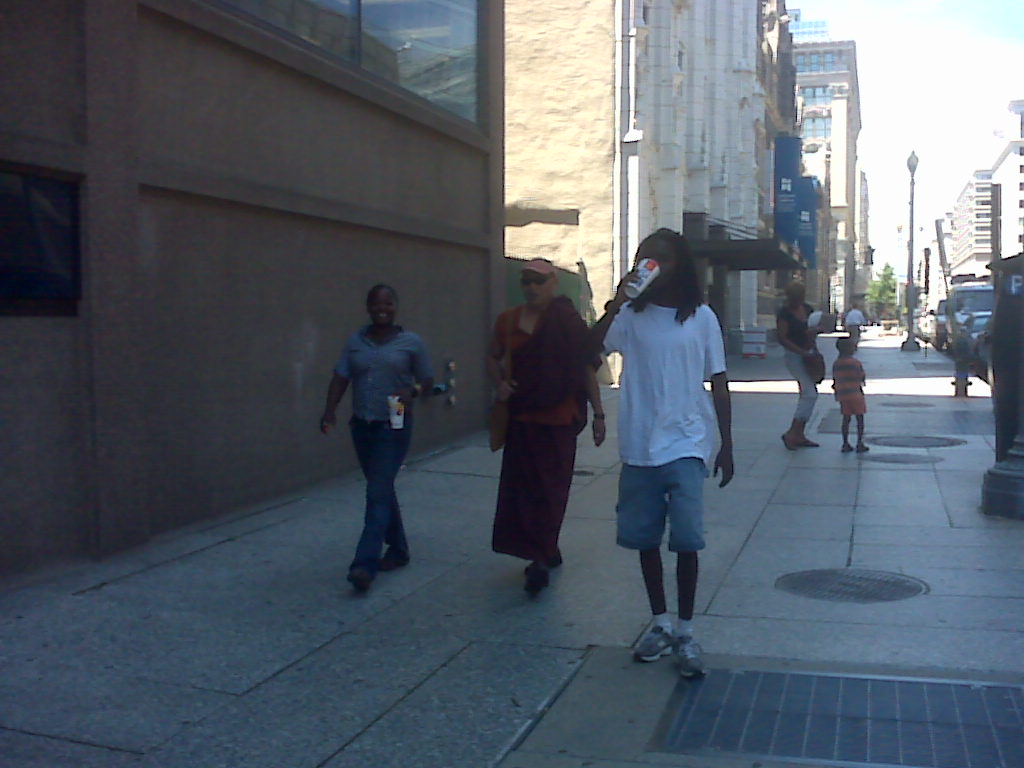
I walked over to the Verizon Center to see how the kalachakra was spreading into the space around it. Towards the end of my foray, the traffic light at a corner outside the Verizon Center changed in my direction, and I headed into the crosswalk. A cyclist going north in the southbound lane started cursing and screaming at me for blocking his way. The loudspeakers were blaring their usual commercial fare, the neon were glaringly lit even by day, the big video screens showing ads and offerings of upcoming sports events, and the tourists were jostling down the sidewalk, carrying their plastic containers full of stuff from McDonalds and Starbucks. On the other side of the Portrait Gallery was a special “market place” with silk shawls, t-shirts, silver and turquoise jewelry, thangkas, prayer wheels, and Himalayan food served in styrofoam containers with plastic forks.

I am as certain as it is possible to be that the space inside the Verizon Center is being transformed by the practice of the kalachakra for world peace empowerment inside. We cannot make others receive such an offering if they are closed and uninterested. We can, though, seek to open our own receptivity and our own hearts. As I observed my reaction to the plastics and the noise and having been cursed out when I had the “right of way,” I thought that the axiom “peace starts from within” is counsel that though we may not be able to change others, we can and are responsible for ourselves.
Peace and light, E — Posted with WordPress for BlackBerry.


Similar Posts

  • | | |

    When We Choose the Pleasure of the Beautiful (DWTD)

    When we choose a tantric path, we choose to experience pleasure as an expression of spirit, rather than seeking to transcend such experience as would one who is on the classical renunciatory yoga path. The choice to remain engaged, to honor mind and body as divine, comes with great responsibility.

    When we choose engagement, we choose to experience the divine reality not just of pleasure, but also of pain. The true tantric path does not turn a blind eye to ugliness and suffering. Just taking the pleasure without recognizing its opposite is not authentic practice. If the pleasure of the sunrise is “real,” then the garbage on the beach is just as real.

    Recognizing the reality of ugliness and pain as part of the play of the real does not mean, though, that it should diminish our joy in the beautiful and in the dance of the play of opposites of life.

    Rather, it is our delight in and engagement with beauty that invites us to serve as best we can to alleviate suffering, to try and clean up the garbage where we can. In other words, as we recognize that ugliness and destruction are part of the play (lila), we seek to be heart-full rather than heart-broken when we witness the suffering from violence to others or our living planet. If we let our hearts break, we become blind to the beauty. Like those who only see what brings pleasure, those who only see the painful are also not experiencing all of the real.

    As I head back to the world inside the Beltway, I bring the deepened and replenished sense of beauty and the dance that I always get from collective study and practice. I will try to share the privilege of having this experience by doing my best to clean up what garbage I can, while still dancing and loving in the light.

  • | | |

    Darshan or Puja?

    The other day I was telling one of my regulars that I’d described the group house practice as starting with receiving darshan — receiving sacred knowledge, sitting in the presence of the divine embodied in a great being — from Uma and Sully, who wait downstairs for the students to arrive and expect a petting before everyone goes upstairs to practice.

    ” Is it darshan or puja [performance of ritual worship]?” my student asked.  The two are intertwined.  We naturally offer our gratitude and worship for those in whom we recognize the divine and from whom we learn to know the sacred.

    What would our lives be like if we treated all our encounters and relationships as both darshan and puja, if we came to each person and being open to receiving a glimpse of the divine and the knowledge the divine imparts and approached each encounter as an opportunity to make puja, to formally act with reverence?  The cats certainly expect it.

  • | | |

    Standing Vigil

    My walk in the neighborhood led me to Eastern Market this morning although I was not looking for anything in particular. A small group of people were standing at the four corners of 7th and C Streets Southeast, standing vigil for the children in Gaza and asking for ceasefire.

    I asked if I might join them and they offered me a sign. The demonstrator next to whom I was standing was most curious about what led me to be supportive of Palestine and we mostly talked about Quakers and Quaker emphasis on peaceful and fair solutions.

    How could I not, in this small way, not add my voice and add my physical presence when I imagine how much more brave to be speaking out and how much more painful for those with friends and family and familiar places under siege.

  • | | | | |

    Living Mindfully in a Heat Wave, Ahimsa, and “Opening to Grace”

    Ahimsa, which is the first of the yamas in Patanjali’s Yoga Sutras, and thus is the first practice or principle of the eight-limbed path, is usually translated as non-violence or non-harming.  Over my years of practice and study, I have read and heard many versions–some general, some personal beliefs–as to what it means to practice nonviolence as part of a path of yoga.  As I watch the way people around me are behaving and reacting to the heat and drought, I thought about how, for me, the practice ahimsa is as much about seeking to be in alignment with the movements and shifts around us that we cannot change as about refraining from specific acts of violence (though that is obviously a basic element).

    In terms of aligning with the world arounds us and the cycles of our own body-mind, when we are sensitive to what will best serve our own self while having the least impact on the environment, we are practicing ahimsa, in other words, “opening to grace.”  How does practicing ahimsa by behaving mindfully incorporate many aspects of the Anusara first principle of opening to grace? Opening to grace, as a practice principle, invites us to be open, sensitive, spacious, and radically affirm what is so that we can expand, shift, and serve ourselves and others in the best way possible under the circumstance. To be open in this way, try not to rage at the heat–or whatever is your weather. Soften, listen, and mindfully discover how you can live at your fullest, kindest, and most generous with what you cannot change.

    When the temperature soars above 95F for days in a row, it is an act of violence to rage against it or to consume outrageous amounts of fossil fuels to cool our businesses and homes enough to wear warm clothes, sleep under blankets, cook and eat hot foods, or do an athletic asana practice or workout (lest we feel that we are not fulfilling some externally motivated personal notion of fitness–having external notions of how we should look, act govern us without accepting the actual situation is its own form of violence against ourselves) that we would not do if we could not artificially cool our environment.

    Perhaps I have no call to speak on this: my central air conditioning is on, though I’ve been keeping it between 78-82F and I have been moving, dressing, and eating in a way that honors the fact that those temperatures are as cool as it is going to be until the heat wave breaks. Some might argue that using any air conditioning or even an electric fan or a refrigerator is doing excessive harm to the environment. That may in fact be true, but asking for more than we can do just makes things seem impossible, and then we are less likely to make any shift at all.

    Peace and light, E — Posted with WordPress for BlackBerry.

Leave a Reply

Your email address will not be published. Required fields are marked *

This site uses Akismet to reduce spam. Learn how your comment data is processed.