Food for the Mind (Yoga Philosophy, etc)

Contemplations on readings and yoga philosophy.

  • | |

    Shiva Lingam?

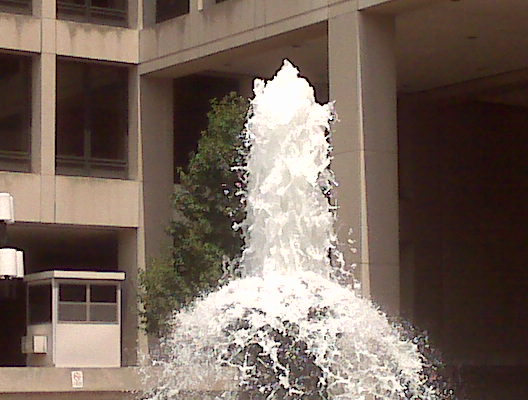
    This fountain is at the main entrance (not on the Mall, but around the corner) to the Department of Labor. It is only on every once and a while, and I do not usually use this entrance, so the fountain is not a main part of my relationship to the building.

    One day, a couple of years ago, when I was sitting quietly near the fountain to get some soothing energy from the sound of the water and being outside, I thought about how much it resembled a shiva lingam. Was I seeing symbols that were not intended? Was the artist pulling one over on the government by submitting a design that carried symbolism that, in 1974, would not have been acceptable to many in charge? Was the symbolism there and understood when the design was permitted to be implemented? Do the answers to any of those questions matter with the fountain and all its imagery present in all its effusion?

  • | | |

    Ecstatic Serenity

    When I was eight or nine, a teacher asked everyone in my class to say what they wanted to be when they grew up.  The other children named the various jobs or professions that appealed to them at the time.  I responded that I wanted to be independently wealthy.  At that age, I was expressing something I already knew from family issues.  Though I did not have the words for it or a clear understanding, what I was saying was not just false precocity.  I knew at a basic level what is taught in yoga:  I would need enough material support (ardha) to follow my heart in love (kama) and work (dharma); then my life could be free (moksha).

    When I was 22 and visiting my friend Dan, he asked me what I really wanted to do with my life.  We had just graduated from college.  Dan was working for a sculptor who was a professor in the art department; I had just moved back to New York, had just gotten over a failed attempt to serve as an office manager for an off-off Broadway theater, was in a place of deep emotional and financial struggle, and was trying to determine what work and corresponding further education I wanted.  “I want to be content,” I said.  “That’s too passive,” he replied.  “No, that’s not what I mean,” I tried to explain.  “For me being content being satisfied and engaged with my work and life, but still working hard and having goals.  It’s not just hanging out.”  I had all sorts of things that I found interesting and possibilities for a life path, but I didn’t have one specific career or life plan that I was certain would be more fulfilling than any of the others.  They just would have satisfied me in different ways.  Because of the dilemma of too many choices, I wanted to be able happy with whatever choice I made, even if it seemed like a compromise.  I was conscious that once I picked, because of the inherent limitations of time and space, that I would either have to be content with my choice or be unhappy.  I have since learned to think of contentment (samtosha), which is one of the niyamas of the path of yoga expounded by Patanjali, as a practice rather than a goal (and it is a very important and continuing practice for me).  Contentment is not an end, as I had thought when I was 22; it is just one part of the path to a goal of living liberated (jivanmukti), experiencing self as spirit in all that one does.

    On a recent telephone seminar, Paul Muller-Ortega, my meditation and philosophy teacher, in the midst of a broad dialogue regarding various studies and practices, spoke a little of ecstatic serenity.  Memories of the discussions I had had long ago about what I wanted welled up in the forefront of my thoughts.  In thinking about what is my intention now, especially with regard to my practice (sadhana), I witnessed my previously stated intentions as just stages on the path to this discovery.  As soon as I heard Paul say the phrase, I thought, “that’s what I want; I want to be ecstatically serene.”   I seek to be always in some part of my conscious being still and peaceful, while simultaneously being passionately engaged in what life brings to me and I bring to life.

  • |

    What’s Up with the Heavens?

    I am no astrologer, but I tend to be sensitive to the subtle energies. After having a week of wild shifts, things not functioning, and sequences not behaving in their usual manner, I resorted to asking a question of my friends on Facebook. Is Mercury in retrograde again, I asked, knowing from the general word I hear that it was not. But it felt like that only more so. This generated a whole dialogue.  My friends commiserated and a couple educated me and gave me some reading material.  I read it, and thought, “yes, that’s what seems to be happening.”

    Have you been noticing any especially wild energetic occurrences for you?

  • | | |

    A Flood of Memories (and Luminous Spaciouness)

    I returned home yesterday from teaching my Willow Street classes and having a late lunch with a friend to a message on my answering machine from my mother advising me that a cousin had died. Although I was not close to my cousin, her parents, my great Aunt and Uncle, were a significant part of my formative years.

    As I made telephone calls and sent emails to get coverage for work meetings on Monday and care for the cats so that I could leave for New York, I found myself flooded with long-ago memories of my cousin, my family, and myself. I could also hear and feel old patterns surfacing, as they tend to do in such situations.

    In counterpoise to the tumble of memory, I felt a strong pull to go into the space of meditation.

    In the spaciousness, I no longer feel trapped by the inevitable consequences from the events giving rise to all those memories that have partly shaped my path. The light of consciousness itself, as the ground of the play and the illumination of inner space, begins to reveal the links and sequnces of the memories, the cause and effect, thus allowing me to see other ways to react. Instead of remaining entangled by trying to dismiss or reject or cling to any part of my history, I could see shapes, sequences, and opportunities.

    At lunch, one of the things my friend and I had been discussing was the idea of bringing into “luminous spaciousness” our relationships. John Friend had invited us to think about that concept at the Teachers’ Gathering last month, and I have been contemplating the practice in a variety of contexts and discussing with fellow Anusara yogis what it would mean to them to bring luminous wisdom to relationship by seeking to create the true spaciousness we can find in our practice of yoga and meditation. I had talked about it previously with the friend with whom I lunched yesterday. She asked, “where was your blog entry on luminous spaciousness; I’d been looking forward to it.” “I haven’t found the right context for describing it that would convey what I think it means for my practice,” I’d replied. When I came home to my mother’s message, because I had been continuing both the contemplation and the dialogue, I was focused on the practice when I found myself in a situation where I really needed it. (Great reminder of the need for a steady practice).

    I am now on the Long Island Railroad, heading to my parents’ house. Tomorrow we will go back into the City for the memorial service.

    As I allow my thoughts to be stirred up–giving myself space, as it were to have natural mind processes–I seek space and light for myself in my relationship with my family to try and foster more love and clarity.

  • New(ish) Edition of Patanjali’s Yoga Sutras

    One of the things I am enjoying about studying in depth with Paul Muller-Ortega is permission to invest in new books for my library.  I already had on my book shelves a number of the suggested books for supplementing our practices and studies, but there are a number of new ones I am excited to read.

    I was taught by my philosophy professors to read at least three translations of a philosophy text side by side unless you can read the text in the original language.  Alas, I cannot read Sanskrit, so I have, therefore, multiple translations of the seminal yoga texts, including the Yoga Sutras of Patanjali.  The translation of the Yoga Sutras on which I have relied the most, is BKS Iyengar’s Light on the Yoga Sutras of Patanjali, in part because his approach is clear, and I can tell why he translated certain words the way he did.

    At Paul Muller-Ortega’s suggestion, I just started reading Edwin Bryant’s translation, which includes translations of the key commentaries, which is a fantastic resource and opportunity for new contemplation.  I can tell that it is going to be an important part of my library.

  • | |

    “How did I get to be so lucky?”

    most of us might ask, who have the health, education, material well-being, and computer access and skills to be able to read this.  “Not luck, but grace,” Paul Muller-Ortega advises that Swami Chidvilasananda would say.  For this grace, practice gratitude.

    When we fully recognize that what we have are gifts, then it should lead us naturally to want to use our gifts to serve and share our well-being.

  • | |

    Not just freedom from

    Paul Muller-Ortega, who is offering a meditation and philosophy workshop at Willow Street Yoga Center this weekend, says that sadhana (yoga practice, incuding meditation), doesn’t just give us “freedom from, but also freedom to.”

    The “freedom from” is freedom from suffering. The freedom to” is freedom to move towards light and blissfulness.

    When we first come to the yoga mat or meditation cushion, we are usually coming to discover the “freedom from” we have heard about — perhaps relief from aches and pains or disease, perhaps weight loss or improved body image, perhaps lowering anxiety or easing depression. We discover, when we start practicing, that even if we do not get “freedom from” exactly as hoped within a limited view, that discovery of the “freedom to” itself provides a “freedom from” by making that from which we seek freedom less prevailing as the focus of our being.

  • | |

    Stringing Baby Seed Pearls (and “Opening to Grace”)

    Last night I sat down at my kitchen table to string baby seed pearls for a mother-of-pearl charm I had gotten from Manoj a few years ago.

    When I took the pearles off of the thread they came on and put them on my jeweler’s mat, several challenges were revealed:  even with the lights on bright and my reading glasses, it was almost impossible to see the bead hole; if I touched the wire other than on the hole, the pearl bounced; if I tried to hold the pearl still, the hold was obscured by my fingernail. Using a needle was not a viable option because the holes were too small for a wire-threaded needle.

    At this point, since I was doing this after a long and frustrating day at the office, the tendency was to get more frustrated. Should I just give away the pearls? Get stronger glasses or a loupe? Try to return them?

    Instead I softened. There was no mandate I get the pearls strung. I was doing this solely for enjoyment.

    In softening, I discovered — to mix philosophical underpinnings — the zen of baby seed pearl stringing. If I grouped a bunch of pearls together, not only was it easier to see holes in certain pearls, but the others around it held the pearl in place for the wire to pierce the pearl. By softening, it occurred to me to use the technique of cutting the wire on a bias (and repeating it every several pearls strung), which gave me a smaller, sharper point, making the threading much easier. Most important, though, I stopped trying so hard. I let the wire and each pearl meet each other instead of my trying to force the meeting. When I did that, the openings were revealed, and I entered a quiet and serene meditative state during which the project completed itself through my agency.

    It is for discovering, experiencing, and always being able to engage this essential and blissful merging of being and acting that I meditate and practice asana. We practice the Anusara principle “opening to grace” so that we can experience grace itself (whatever grace means to you) doing our acting, both on the mat and off.  As such, “opening to grace” is both the primary and ultimate activator of this merged state of being that is yoga--union..

  • | | |

    Green advertising (and viveka)

    One of the important principles of yoga practice is viveka — discrimination.  The longer and more steadily one practices, the greater ease with which one will find path that leads towards recognition and remembrance of our own light and the light in others.  In modern culture, I think one of the critical aspects of practicing viveka is having a healthy doubt and willingness to question claims that consuming certain things will make us happier, or better, or will make the world better.  Paying too much attention will probably just create a tangle of intellectual confusion that will not lead to a greater openness of spirit.  Learning to listen well to your body and mind and what and how you feel and hear on and off the mat will help you start to know better your body and mind and how they interrelate with all around you, is likely to shift your choices and actions.

    It is now fashionable to be “green.”  Discerning what that means, though, is where we need to practice discrimination.  For example, claims of “natural” foods, “organic” foods, and “green” products are now ubiquitous by companies that are part of the existing Wall Street profit-driven industrial and marketing complex because they think they are money-makers and expect most consumers not to question the claims.  We are also seeing more and more articles and stories debunking these claims and calls for regulation so that consumers will understand what is bunk.  If we stop and pause, we can probably figure out some of this without reading about the pros and cons.  Do you know who is selling it to you?  Does it come in packaging with a lot of small print?  Is the packaging recyclable?  Are shareholder profits critical to the entity selling you the food or garden supplies or other consumer good?

    Taking the example of the success of the big companies, small entities are using “green” in their names and advertising without discrimination.  Around town I see fairly regularly, landscaping companies with cozy-sounding “green” names.  When I watch them working, though, they are using Round-up or other chemical weedkillers, throwing into the trash compostable yard waste, and planting non-native shrubs.  They may be making a garden the color green, but they certainly aren’t doing “green” gardening.

    Here’s some great information on having a “climate-friendly” garden from the Union of Concerned Scientists.  The tips are more helpful for a yard large enough to have a lawn, and do not fully apply for my small patio (though I have a tree in front, don’t leave bare soil, and do not use pesticides or chemical fertilizers.  I haven’t yet tried planting winter crops in my containers, but I’ve rearranged the patio so that I have a place for a raised bed (to sit on the brick where the table and chairs once were).  This winter, I’m hoping to add the bed and a cold frame to lengthen the growing season.