Food for the Mind (Yoga Philosophy, etc)

Contemplations on readings and yoga philosophy.

  • | | |

    What Does It Mean to Be Yogic? (and “The New York Times Article”)

    This weekend, a friend whose marriage of decades is precipitating towards dissolution, said to me, “I am having trouble reconciling being yogic and still needing to do what I need to do in connection with divorce.  How do I deal with that?”  I told her about a yoga principle I learned at the first Inner Harmony Retreat I attended with John Friend in the summer of 2003.  He had asked a student a question that yielded as the answer the four yoga principles of ardha (physical and material well-being), kama (relationship, including intimate and love relationships), dharma (life path or work), and moksha (liberation or freedom).  The fellow student answering the question, who was also my teacher, gave the classic yoga explanation that we try to do the first three elements in alignment so that we can then transcend and go beyond them to become free (enlightened).  John replied that was the traditionally correct answer in dualist, classical yoga, but that from the tantric perspective of a person living in the world as a yogi, we look apply the principles differently.  By living in a way that we have taken care of our physical and material well-being, have happy and loving relationships, and work with delight and passion that we will be embodying a life of the spirit; we will then be living and embodying freedom (jivanmukti).  That encapsulation of tantric yoga resonated deeply and is a significant part of why I have chosen a path of tantric yoga rather than one that preaches renouncing the body and mind (which I think is impossible for one staying in the world).

    My friend’s question seemed especially significant to me in light of the dialogue that has ensued following the publication of the New York Times article on John Friend, John’s blog in response, and the Elephant Journal interview.  The essence of the article and the reactions, to me, seem to be about the intersection of our “outer” notions of societal success–fame and fortune–and yoga and whether the two can be reconciled.  The New York Times article is obviously intended to be sensational and to create controversy; that is what makes a journalist who gets fame and fortune.  But the alleged tension highlighted in the article is indicative of a bigger societal confusion of how and whether we can be spiritual or religious beings and also have human needs and wants.  Ours is a society that hungers for panaceas and palliatives.  In “discovering” yoga and its benefits in the late 20th century, far too many have put onto it expectations that have no basis in what is yoga and how it is supposed to aid us.

    There is no word in yoga philosophy or in India for “yogic.”  The word “yogic” is a western creation of relatively recent vintage.  Webster’s dictionary does not have it as a separate word, but just has it at the end of the definition of “yoga” as “adj, often capitalized.” What do we mean by being “yogic?”  It seems that we have gotten this notion that if we practice yoga seriously or teach it, that means we must be perfectly pure and good.  We will need only light and air to nourish our bodies (and maybe a little local raw food in season); we will have neither needs nor desires; we will be so suffused with peace, compassion, and equanimity, that we never feel or show anger or grief, even in the face of injustice, violence, pain, or outrageous behavior.  We expect that somehow we will be a perfect monk while still living with family and going to work.

    We expect this not only of ourselves, but even more so of our teachers.  In essence, we somehow expect yoga to release us from the realities of being human.  To have such expectations inevitably will lead to disappointment in ourselves and our teachers (for being unable to reach this impossible ideal) or in the practice (both for not yielding this ideal and for, in our delusion, creating this expectation in the first place).  My meditation and philosophy teacher Paul Muller-Ortega would say that to have such expectations is “adolescent” spirituality.  When we practice “adult” spirituality, we take responsibility for ourselves and our own practice.  We expect our teachers to offer us the teachings, but we honor and recognize them as human beings.

    To practice yoga sincerely while still living in the world should make us more humane to ourselves and to all around us, not beyond being human.  This is the true essence of Anusara yoga.  To be richly and freely and wonderfully human and feel great love and compassion for that, even as we balance the realities of life with attempts to live in greater alignment.   I am incredibly grateful for the teachings and the community that John Friend has created and the offering to study and get as deeply into the yoga as makes sense for me.  Whether there are things I might do differently in the realm of ardha, kama, or dharma if I were “the yoga mogul” is of little moment because to find moksha we all strive to do our best in our own way (and one thing I know of John is that he always strives to do his best).

  • | |

    Shiva Nataraja

    This murti of Nataraja has been in the window of a store near where I work for at least 20 years. I often walk past is and just as often stop to admire it. I have never really considered taking it home, lovely as it is. The murti is simply too large for any of my rooms. I have mentioned its needing a home to a couple of different friends, who were looking for large murtis of Nataraja, over the past few months, but none have followed through.

    Today, when I was walking past it on a lunchtime walk to the bank, I noticed a “commercial property for rent” sign in the window. I will miss having this resplendent image in my work neighborhood, but not enough to buy it and bring it home. I decided, though, to take a photograph. I know the owner only very casually, but well enough to know he is retiring, rather than being driven out by rising rental costs or the recession. The neighborhood has gotten trendier since Nataraja first appeared in the window. Nataraja might be replaced with a delicious restaurant or a fabulous store purveying things that entice me. Or the space could stay vacant or be used for something that holds no interest for me whatsoever.

    Nataraja–lord of the dance of concealment and revelation, of dissolution and manifestation–is dancing here. The murti will be sold or transported away when the shop closes and will physically be gone.

    I will have my memories of the image, a photograph I took with my BlackBerry, and will have had a sweet opportunity to observe the lord of the dance dancing away his own image.

  • | | | |

    Outrageous Light (and Sadhana)

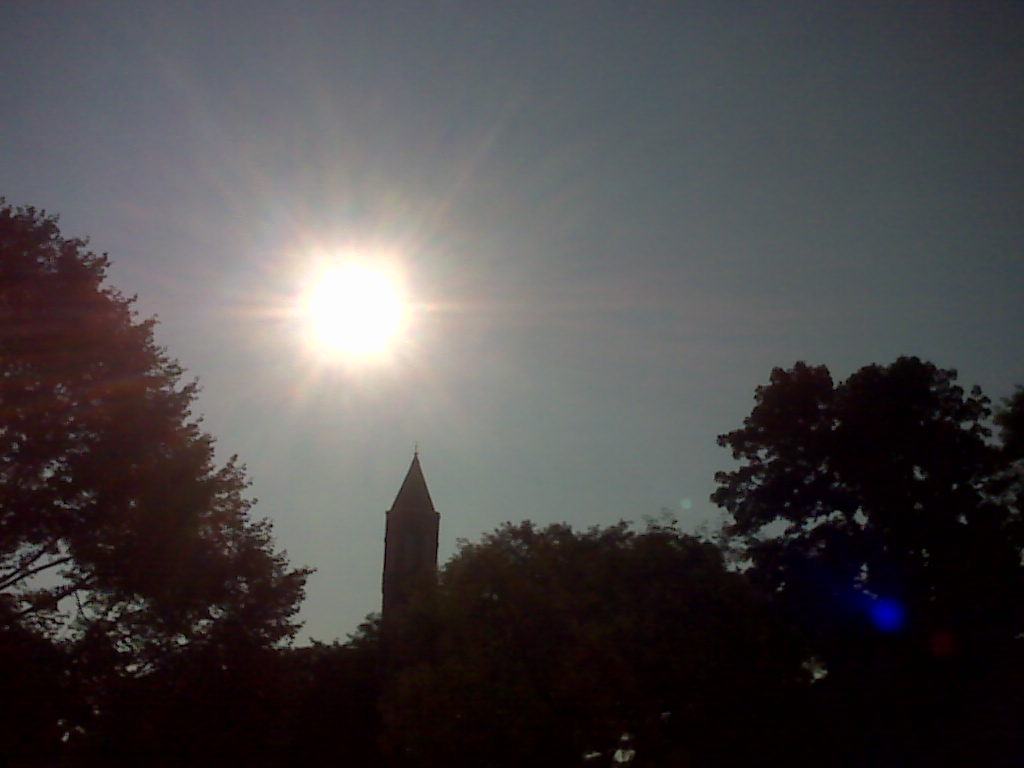
    I just spent a week looking at the celestial realms — inner and outer.  Fifty of us spent a week meditating and studying with Paul Muller-Ortega at a retreat center in Sedona.  It might seem from these pictures that there was not a moment when we weren’t exclaiming in awe over magnificent visions.  The truth is that many times of the day, the sky was not spectacular, but I was always looking and always had my camera in my pocket, whether the sky was dull or flat when I left my room or whether it was engaged in some outrageous display of light.  The photographs below are in chronological order to show the pulsation of night and day, the progression of the moon from almost full to full, the shift in mood from day to day.  But, the images show a completely edited view.  There were the views for which I did not take out my camera at all.  Those were the majority, but I was still looking.  There were the views I photographed, but deleted from the camera memory, choosing not even to save them.  There are the photographs that I downloaded onto my computer, but did not even enlarge to get a better view.  There are photographs I enlarged, but decided not to edit.  Then there were the photographs I chose to edit by making decisions about cropping, brightness, contrast, hue, and saturation.  The photos below are a subset of the last group.

    If I were doing a show where I printed and framed the work, I would have worked from at least ten times as many images and would have done multiple prints of each image before choosing what to display.  In this persistency and discrimination, photography teaches much about meditation practice.  To show what is seen in a way that shifts the soul of the viewer, the photographer has to look over and over again.  For example, Robert Frank took over 20,000 images for “The Americans.”

    Anyone (especially these days with the technology available) can take an extraordinary picture or two if in the right place at the right time with the camera.  But to have a body of work takes consistent devotion, work, and presence.  So too, with our meditation practice.  Some days exquisite visions arise.  Sometimes we are pulsing with extraordinary energy that fills us with a sense of the very fullness of being.  Other times, old issues or the to do list or even feeling trapped by sitting still is what comes.  If we sit consistently over a long period of time, though, we will witness — just as the camera did — the extraordinary.  We will know from being consistent that it is our very consistency that reveals bliss.

  • |

    Rain in the Night (and the four states of consciousness)

    This morning when I woke, my first thought was that I thought it had rained in the night. My second thought was that I felt well-rested for having slept through the night — not having had my sleep disrupted by thunder or the earthquake, as was the case for recent nights — perhaps I had just dreamed about the sound of rain..

    The yoga teachings say that there are four states of consciousness: waking, dreaming, deep (dreamless) sleep, and the fourth or turya state. The fourth state is both beyond the other states and also encompasses the others. It is where we find in meditation the merger of the individual consciousness with universal consciousness. The better we are able to access the fourth state, the more the other three states, and how we think and act in them, are illuminated by the very light of being.

    The more I meditate, the more aware I am of what is going on around me while I am in a non-waking state. I am also finding that waking and dreaming are more luminous.

    My awareness of the rain without knowing whether the awareness came while I was awake or asleep show both that I am finding more awareness in the different states and that I have a long way to go and much to discover.

  • | | | |

    Hot Day (and aligning with it instead if fighting it)

    It astonishes me how much time is spent complaining that it is hot. It is July, and I live south of the Mason-Dixon Line. Much of what gives rise to the complaints has to do with trying to dress in accordance with traditional office dress, being active according to some preconceived exercise routine, and wanting to eat heavy food from a diet based on habit rather than season.

    Yes. It is hot, and being hot can be uncomfortable, especially if we try to fight it.

    If we wear loose, light clothing, exercise less vigorously and only in the morning or after the heat of the day has waned, and eat lightly of the fruits of the season, then we can experience less discomfort. We also then can better open to the delights of the heat–stretchier muscles, a call to stillness, and chilled watermelon are a few things that make summer a joy for me.

  • | |

    Any Words of Wisdom? (and “Opening to Grace”)

    I had lunch the other day with a friend whose life is suddenly brimming full with a variety of opportunities.  Any one of them by itself would feel like a bounty.  With multiple ones arising simultaneously, because they are not necessarily in perfect sequence with each other, making decisions seems like a conundrum rather than a blessing.  Over a rather delightful lunch, my friend gave me many details of the various things that were going on, and the places where they seemed not to synchronize in a way that would allow her to have it all with ease.  “Any words of wisdom?” she asked.  When I was younger, I might have tried to make specific suggestions.  Specific suggestions, though, are always colored by our own particular preferences, prejudices, and desires.  Instead, I said, “In the style of yoga I practice, the first principle for starting every pose, which I find works for what I do off the mat as well, is to ‘open to grace.’

    “Opening to grace means to soften, to listen, to open ourselves to the universal in which the details arise, to allow what is to be in the flow,” I added.

    “Without getting into the details, the essence of the next alignment principle [muscular energy] is the application of proper boundaries.  Even though we want to be soft and open, we still do not say ‘yes’ to everything.  Although open to everything, we steady ourselves and use our knowledge to discriminate and find a good container for ourselves so that we can act with more light.”

    “Ah,” my friend replied, “I’ve been trying to control everything without allowing things to unfold.  What you are saying makes sense.”

    My friend will find her own way, and I look forward to witnessing the great joys potentially unfolding for her.  Any time she invites me to share some of the wisdom I’ve received from my teachers, it will be my delight to pass it on.

  • | | | |

    Web Version of Hot Summer E-Newsletter

    Dear Friends,

    Recent newsletters I have received from well-known yoga teachers, in addition to sharing their wonderful offerings and teachings about yoga, have included references to the Gulf Oil Spill, the on-going economic crisis, and the humanitarian tragedies in Chili and Haiti and elsewhere.  The information is presented as showing what yoga can do to help us better serve those in need, seek change in ourselves and the world around us, and find our own light in the face of things we cannot change, but these teachers are no longer keeping quiet about the presence of serious turmoil and tragedy.

    As one who has been outspoken (perhaps too much so) about such issues in the context of yoga, as those of you who follow my blog know, it seems that it is no longer possible to be silent.  We are all familiar with adages, “silence is golden” and “silence speaks louder than words.”  We are also invited, as yogis, to observe the four gates of speech to the best of our ability, on and off the mat:  (1) is it truthful?  (2) is it necessary? (3) is it the right time? and (4) is it said in a kind manner?  These gates are important for evaluating individual utterances.

    For the past couple of weeks, I have been thinking about turning the “four gates” on their head, turning them upside-down in the tantric tradition, and asking how they apply to silence.  When we are silent on an issue, on something that moves us, on something in a relationship that is important to us, are we being true to ourselves to be silent?  Are we being honest by saying nothing (for saying nothing is, indeed, saying something)? Is staying silent timely or is it truly timely to speak up (using the four gates as guidance on how to speak up?); is being silent kind–we’ve all done it ourselves or experienced cold or hostile silences?

    For me, more than ever, it is no longer the time to be silent.  We must speak for the light, for action, for aligning better with nature, for deepening community, for enhancing the subtle energies that will help us heal and grow and shift society.  As long as we are not practicing true “renunciate” yoga–giving up family, friends, shelter, and creature comforts, but instead are practicing the yoga of those still engaged in “regular” life, then we need to become more and more sensitive to how we can joyously affirm life, but passionately engage in seeking change that makes the light more available to all, while still going about our daily business.  This is a razor’s edge balance.  It can be so difficult to live consistently with our ideals, to speak and act in truth and kindness for ourselves and others the ideal all of the time.  Our yoga invites us to cultivate and celebrate our strengths, to affirm ourselves and then to expand.  Expansion can be intensely challenging and sometimes as much painful as exhilerating, but I think it is worth it.

    This summer, in classes, I will be inviting all to join me in the questions I am exploring for myself:  what is my intention?  How can manifesting my intention make life sweeter for myself and those around me?

    Join me for both class offerings and a special workshop up at Willow Street.  William Penn House classes continue with special pricing for public interest workers, students, seniors, and those with other challenges.  A portion of the proceeds from every student goes to support William Penn House’s work.

    At Willow Street, the Saturday morning class has changed:  it is now a “Fusion Flow” from 8:45-10.  What’s the difference between the flow class and Level 2?  We’ve already been doing a slow flow, but there will be fewer breaks, and more time for silence (a timely, nurturing silence), for students to get into their own groove to work towards manifesting their intention.  We will have music most times to bring in a stronger sense of the dance, but I will continue, as always, to emphasize healthy alignment for the class as a whole and be responsive to questions.  Gentle/Therapeutics is at noon as usual.  There’s a free class weekend up at Willow Street where I will be teaching both types of classes on July 17th in the Takoma Park studio and Gentle/Therapeutics in the Silver Spring Studio on Sunday July 18th.  The summer session starts on July 24th.  Those who sign up for a class and a workshop simultaneously, get a $20 discount.  For more information or to register on-line, please visit www.willowstreetyoga.com.

    Want a siesta-like retreat from the heat?  Ready for some relaxation and self-nurture?  Treat yourself to two blissful hours of restorative yoga poses for a sweet afternoon retreat without all the travel!  All levels welcome at the:  Summertime Restorative Extravaganza, Saturday, July 31, 2010, 2:30pm-4:30pm, Willow Street Yoga Center, Takoma Park.  $35.

    As always, feel free to email me with questions or comments or join me on the blog:  www.rosegardenyoga.com.  Just FYI, we’ve fixed the issues with subscribing to the blog.  If you haven’t already, just hit subscribe on the home page, follow the instructions, and then get an email in your inbox the day after I’ve posted a new blog entry.

    Hope you are all having a great start to your summer and look forward to seeing you soon.
    Peace and light,

    Elizabeth

  • | | |

    Darshan or Puja?

    The other day I was telling one of my regulars that I’d described the group house practice as starting with receiving darshan — receiving sacred knowledge, sitting in the presence of the divine embodied in a great being — from Uma and Sully, who wait downstairs for the students to arrive and expect a petting before everyone goes upstairs to practice.

    ” Is it darshan or puja [performance of ritual worship]?” my student asked.  The two are intertwined.  We naturally offer our gratitude and worship for those in whom we recognize the divine and from whom we learn to know the sacred.

    What would our lives be like if we treated all our encounters and relationships as both darshan and puja, if we came to each person and being open to receiving a glimpse of the divine and the knowledge the divine imparts and approached each encounter as an opportunity to make puja, to formally act with reverence?  The cats certainly expect it.

  • | |

    IRS (and Opening to Grace)

    It is a gloriously cool and breezy morning of the type that is common for New England and very rare for DC, especially heading into Independence Day weekend. I had a longer and earlier walk than I usually do. I have an early morning meeting at the Internal Revenue Service.

    As I walked down Constitution Avenue past the museums and federal buildings, I wondered how many of the hundreds of millions of people whose lives are impacted by the IRS ever think of it as a building with real, live human beings working inside of it.

    It can be tremendously difficult to see a broader perspective when faced with things that cause us burden, obligation, or challenge. One of the key reasons to practice yoga, and in Anusara yoga to practice (it is indeed a practice we have to work on) opening to grace, is to recognize our humanity and the light in all things so that life feels more beautiful even when we are struggling.