| | |

Darshan or Puja?

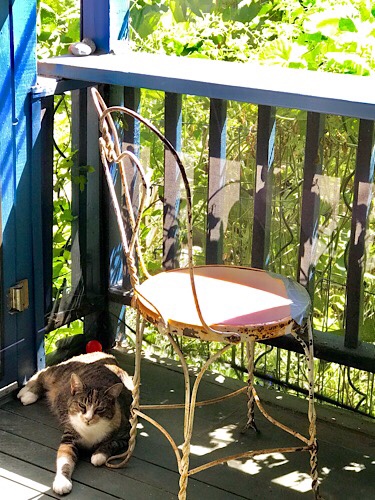
The other day I was telling one of my regulars that I’d described the group house practice as starting with receiving darshan — receiving sacred knowledge, sitting in the presence of the divine embodied in a great being — from Uma and Sully, who wait downstairs for the students to arrive and expect a petting before everyone goes upstairs to practice.

” Is it darshan or puja [performance of ritual worship]?” my student asked.  The two are intertwined.  We naturally offer our gratitude and worship for those in whom we recognize the divine and from whom we learn to know the sacred.

What would our lives be like if we treated all our encounters and relationships as both darshan and puja, if we came to each person and being open to receiving a glimpse of the divine and the knowledge the divine imparts and approached each encounter as an opportunity to make puja, to formally act with reverence?  The cats certainly expect it.

Similar Posts

  • |

    “You Seem Pretty Mellow,”

    said the guy who is doing the exterior painting and repairs to me this morning, after we were talking about what needed to be done with the stairs, and we talked a little to the downstairs resident who was on his way out to work.  Then he paused, after thinking about what he had seen of my house and garden and added, “unless it is cultivated.”

    “Yes,” I replied, “it is cultivated.”  I will never be completely easy-going, but at the same time as some might wish me more easy going, one of my strengths is my attention to detail and my ability to create order.  I cultivate, though, an ease with necessary disorder — the disruptions that come hand-in-hand with construction, repairs, creation (art, kitchen, garden, home), growing relationships, and comfort where I am.  We may not be able to change our nature, but we can make shifts that ease our being.  Radical affirmation in yoga is accepting our tendencies, but then seeking shifts to make life even fuller.

  • | | |

    Personal History (and Samskara and Opening to Grace)

    A samskara is generally defined as an impression left in us by a past action or experience.  I found myself thinking about the process of samskara yesterday, when I went with long time friends of my family to watch their son taking class at the summer program at the Kirov Academy of Ballet.

    I have not watched a ballet class (except on the occasional film) since I was actively studying ballet as a teenager and young adult.  I have long been conscious of how ballet imprinted my body image and way of looking at myself, but have not found a space before where I was able to look at this aspect of my history with fresh eyes.

    What was different yesterday, was that I was observing with openness.  I was sitting with people I have known all my life, sharing their warmth, love, and parental pride for their son, rather than concentrating on my own history.  It brought back memories, but not in the same way that sitting by myself or with a girlfriend, watching a documentary has done.

    In this open state of reflection, I witnessed something that I knew at some level, but had not given much thought to before:  how much having taken thousands of hours of ballet class has informed the way I teach.  My tendency in my own practice and in my teaching to see the details of  alignment and to try asanas repeatedly until it seems that I or my students have experienced the alignment in the most optimal way for the day is straight out of my experience in ballet class.

    Softening and witnessing instead of feeling or judging from past experience gives the possibility of shifting from samskaras, even ones that are very deeply etched into body and mind.  Being with my friends yesterday, of course, gave me the joy of seeing the spectacular dancing of these young men and the delight of connection.  It also gave me the unexpected gift of a moment of understanding how the Anusara principle of “opening to grace” allows us to shift.  When we are open, nonjudging witness consciousness  (an aspect of “opening to grace”), that is when we have the possibility with each thing we repeat, to experience it new without being bound by our samskaras.

  • | | | |

    State of the Garden (and Choosing Where to Focus Your Attention)

    You wouldn’t know, from seeing Maitri enjoying the shade while the sun shines brightly on the curtain of beans and soon to come next wave of cherry tomatoes, what an extremely agitating work day I was having that started too early and was not as productive as I think would have been desirable.

    Work day done, I prefer to remember the moments with Maitri and out in the garden.

  • | |

    On Seeing

    When I paused to photograph this marker on a DC sidewalk yesterday, I wondered how many hundreds of people have walked past it–once or hundreds of times–without noticing it at all. I connected this sense of acute awareness with a conversation I had with Douglas Brooks in India, in which he said to me that he guaranteed that at that moment he was seeing more than I was seeing. He had experienced the place before, studied it extensively and intensively, and was still open to seeing. I did not take offense and none was meant. I am one who notices, but it is a given that study and experience, if one retains an openness to new understanding, maximizes the opportunity to witness.

    Paul Muller-Ortega describes the expanding ability to see and understand in terms of the essential interrelationship between jnana and vijnana–book knowledge and experiential knowledge. One without the other does not permit for complete understanding. The two together, with ever-expanding and present openness is what leads to wisdom.

    Thus, though I am one who tends to notice much of what is in my field of vision, I could not, on my first visit, possibly have seen as much in the immediate landscape as one who has devoted much of his life both to studying and experiencing it.

    Peace and light, E — Posted with WordPress for BlackBerry.

  • | | |

    State of the Garden (First Weekend After the Fall Equinox)

    I pulled no longer productive summer plants and planted lettuce, spinach, chard, and arugula. The birds have been eating my seeds, so I got seedlings at Eastern Market yesterday morning.  I have planted some more seeds, but wanted back up.  The grape tomato is still prolific, alone among the tomatoes.  The cucumbers are completely past, making room for chard and turnips.  It is time to make the last batches of pesto with the basil and parsley.  Another blossom has come and not quite gone on the night-blooming cereus.

One Comment

  1. I like this and accept the opportunity to view all of my encounters as the interlaced union of darshan and puja. Thanks for the encouragement love.

Leave a Reply

Your email address will not be published. Required fields are marked *

This site uses Akismet to reduce spam. Learn how your comment data is processed.