Intention
To manifest an intention, one first has to have an intention. What do you want to manifest?
I am asking myself the same question.
To manifest an intention, one first has to have an intention. What do you want to manifest?
I am asking myself the same question.

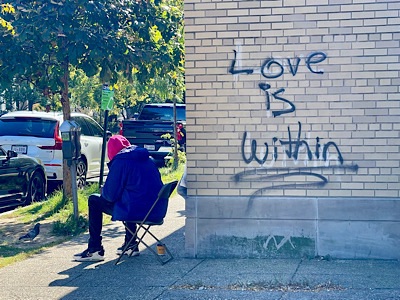
Anacostia River Walk a couple of weeks ago. Today, for my midday break, I walked to the post office and then returned to my work. Because I committed to doing it.
 I returned home last night from eight days away, five of which were truly on retreat — just meditating, bathing in hot springs, hiking, eating well, practicing yoga, and celebrating with dance and music. To see pictures, click here.
The focus of the week was honoring the past and engaging in the present so as best to serve the future.
We left Breitenbush Hot Springs mid-afternoon on Thursday. Rather than take a red eye, I stayed Thursday night at an airport hotel and took an early morning flight home on Friday. I woke early Friday morning and rested in meditation to ease the shock of going from an off-the-grid community in the forest to an airport hotel. This rainbow glowed over the airport while I was waiting for the hotel shuttle to take me there for my flight.
The rainbow reminded me to carry the deep joy of the retreat home with me.
The fresh, lovely green of new leaves emerging is the green of the anahata chakra–the chakra of the heart, midway between that of earth and sky, where in meditation we can open to experience the intertwinedness (yes, I know that is not a “real” word) of matter and spirit.

Peace and light, E — Posted with WordPress for BlackBerry.