The Spell Check Alternative for Satcitananda
is catsitting. Hmmm.

Peace and light, E — Posted with WordPress for BlackBerry.
is catsitting. Hmmm.
Peace and light, E — Posted with WordPress for BlackBerry.
The key concept of yoga–satcitananda can be elusive, like all abstract concepts in the yoga philosophy and in other philosophies or areas of study. We are given metaphors and analogies in the texts to help us recognize when, through our practice, we experience in our self the manifestation of what had just been theory (book knowledge).
It is hard to describe, for example, what it truly means to be fully present and aware in the moment and thus suffused with bliss
(satcitananda).
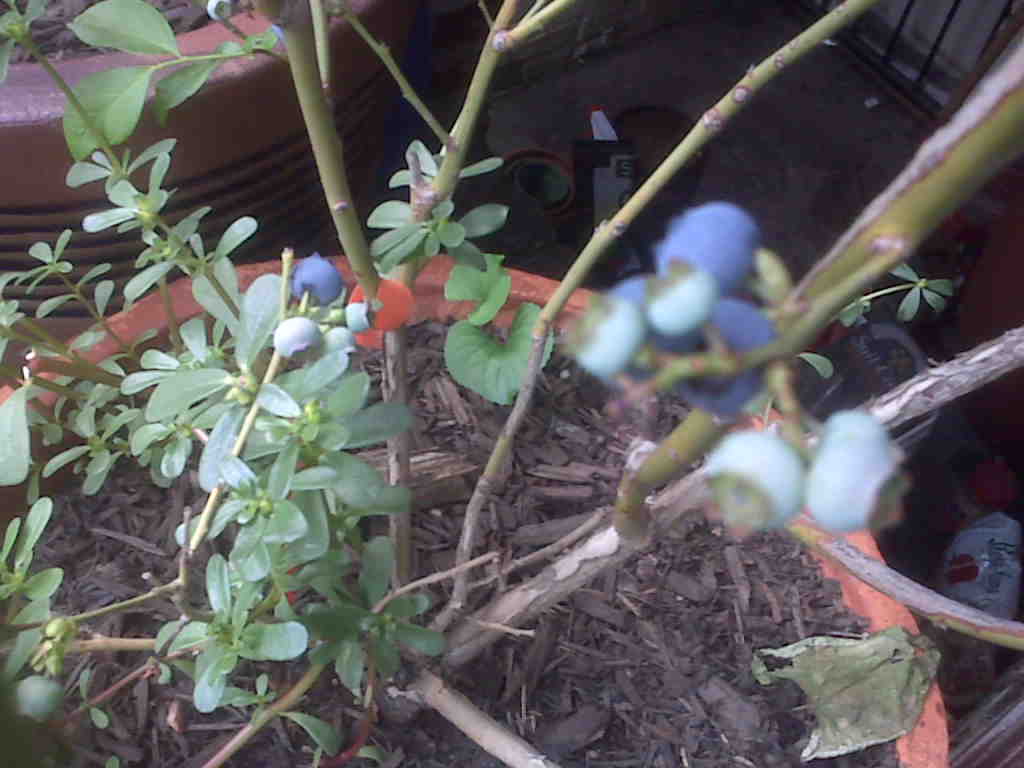
There was a moment, standing in the hot sun, when I tasted a sun-warmed, perfectly ripe blueberry that I thought, this is a moment many of my students might imagine to be able to extrapolate the abstract concept of satcitananda.
Notice also the volunteer purslane at the base of the blueberry bush. Weeding and harvesting greens for salad and stir fry can be coextensive. Don’t poison or discard your purslane (or your dandelions). Pick it and eat it; purslane is a great plant source of omega fatty acids.
Peace and light, E — Posted with WordPress for BlackBerry.
The hunched over woman lit a cigarette. Another man bummed one from her and leaned against the trash cans to smoke. Smoking helps make the bus come–right?
Nowadays, I contemplate, or chant, or stand on one foot, or maybe post a blog entry.

Peace and light, E — Posted with WordPress for BlackBerry.

Peace and light, E — Posted with WordPress for BlackBerry.
As I get deeper into studying tantric philosophy I have taken the time to pause and reflect on how that philosophy originated and grew and who were the people offering and practicing the teachings. The tantric teachings I have received and offer are completely chaste. Put “tantra” into your favorite search engine, though, and you will see that people tend to think it is about intimate physical connection (my first euphemism). What is tantra? Is it one or the other? Is it something one can have without the other?
To help me think through and contemplate the issue, I read David Gordon White’s The Alchemical Body. I followed this with Lilian Silburn’s Kundalinia–Energy of the Depths.” What seems fairly evident–if you want the details, I invite you to read the books yourself (and also on sri vidya, Douglas Renfrew Brooks’ The Secret of the Three Cities)–is that despite the inclusion of those not twice born and women in the rituals, the community of tantrikas was no less sexist than more traditional society. The role of women in the secret rituals, as I have read it described, is one that would be wholly unacceptable to me in terms of equality, gender neutrality, and respect for women as human beings and not as archtypes and means to an end for male practitioners.
I did not get into the depths of knowing the historical details before I had been strongly drawn to the metaphysics of Kashmir Shaivism, which has been an integral part of my yoga studies. As I think about how a feminist, pacifist can find the universal teachings while still acknowledging the historical and social context in other texts such as the Bhagavad Gita and the Bible, it seemed given tantra’s rap in today’s society, I should see what my answer is for the tantric teachings as well. In thinking about the issue, I contemplated how I see the teachings in and out of the historical context (as you can see from the link to Swami Lakshmanjoo, the philosophical teachings are presented today without a hint the secret rituals).
I also asked the following, among other questions: How important is it for the student to take the teacher for the whole of the teachings and his or her human strengths and weaknesses? Is it ok to just really believe in one aspect of the teachings? Can we pick and choose what to learn and still be faithful to the lineage? Can we love and respect someone fully even if we disagree with his or her way or life and/or way of participating in society? Is extraordinary grace and genius enough to make what might otherwise trouble or even appall us seem irrelevant? Is it easier to come to terms with this issue for those teachers from different time periods or cultures and thus for whom our own choices or “modern thinking” might not have been available?
I think that the Wikipedia entry for Abhinavagupta, which mentions that the community would have engaged in secret (my spam-avoidance euphemism) ritual, but avers that “[w]e can only speculate about whether he was physically chaste, and either answer to this question is not very meaningful in the context of his life and teachings” gets it half right. It seems to me that it would be meaningful when looking at his life, but not of import in the modern receipt of the teachings. I think, for me, the very resonance of the philosophy and the practices with which I am familiar are not less meaningful for the historical concomitance of the hidden practices.
Come join us. For details, click on the link above for “Classes.”

Peace and light, E — Posted with WordPress for BlackBerry.
There’s lots of arugula in the garden. Some still new enough to save for salad, some that has bolted in the heat. The cilantro is just about gone with the dry heat. The basil and parsley have gone to flower. As I thought about how best to enjoy all of what was there while simultaneously best tending the garden for optimal growth (much like yoga practice), I remembered that I had seen a farmer with arugula pesto at the Dupont Circle Fresh Farm Market last week. I bought something else from the farmer to honor the idea, fully conscious of my own garden full of arugula calling out to me.
Making pesto was a great way to optimize the bitter tang of the flowers on the older plants. (I left a few of each type of plant to go to seed for a second crop starting in late summer on a volunteer basis). I added enough of the young arugula and some tender parsley and basil leaves, along with the basil flowers, to bring out the arugula taste that would have been hidden by the bitterness in the plants that had flowered if not been combined with other foods. I pureed the chopped greens with olive oil, walnuts, and green garlic. Salt and pepper to taste.

Peace and light, E — Posted with WordPress for BlackBerry.
I was looking at an age spot on my forearm the other day and wondered whether I should get a tattoo to cover or incorporate it. “Something small and modest, but with meaning,” I thought. “Something that would not admit to the original reason. Perhaps a realistic version of the smallest of butterflies.” Then I thought without any apparent trigger, “what about a firefly?” When they are not lit up, they look like the kind of bug we would swat at or try to avoid, but at night, when the firefly glows, it is magic.
How many things are there that seem ordinary or even distasteful until we open our eyes, our minds, and our hearts to see their full and true essence?
I do not know whether I will get the tattoo. But I hope that those that can (those with backyards) will take a few simple steps to make a home for some fireflies.
This bumper sticker (on an enormous black SUV with suburban plates) is likely intended to have only a message about the current wars in which the US is engaged. I wholeheartedly support the sentiment at that level.
What if we took it at other levels? What if we applied it to spiritual-religious practices? We could interpret this as suggesting that we honor the great teachers who have gone before us, invite religious observance and spiritual practice to heal ourselves and others, and dissolve notions of differences among religions and spiritual practices as bases for conflict. How many wars between countries or civil wars would end if saw unity while still honoring difference in this regard?
Perhaps most cogent for the yogi: what if we thought of the exhortation in terms of our own personal practice? It would be an invocation to honor our ancestors, heal the wounds of our family and upbringing (samskaras), and release inner conflict. This is, I think the point of practicing (whatever the style of practice) so that true peace can abound.

Peace and light, E — Posted with WordPress for BlackBerry.