Similar Posts
Thoughts on Democracy (and “Actionless Action”)
My friend Dan posted some interesting thoughts about democracy on his blog. He is writing in the context of the Unitarian Universalist community, but the thoughts are equally applicable to our lives as citizens. The thoughts on democracy also for me highlighted what is really meant in the Bhagavad Gita about “actionless action.” To embody our spiritual practice in the way we live our lives, we serve to our best ability out of love, out of delight in acting, out of a sincere joy in serving, but we do not get attached to a particular outcome.
Mudra of Calm Abiding
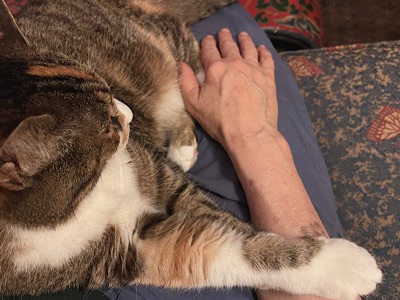
I was taught that placing your hand on your thigh palm facing down is the mudra of calm, abiding. I personally find it soothing. So, apparently, does Maitri, who demonstrates another variation.

- Art and Culture | Asana, Pranayama, and Yoga Practice | Community and Family | Food for the Mind (Yoga Philosophy, etc)
Tatah Dvandavah Anabhighatah (and “winners and losers”)
Patanjali’s Yoga Sutra II.48, tatah dvandaha anabhighataha is translated by B.K.S. Iyengar as “from then on [after the yogi through steady practice has absorbed him/herself in the practice of yoga), the sadhaka (practitioner) is undisturbed by dualities.” This sutra follows the only two in all of Patanjali’s Yoga Sutras that specifically discuss asana, which Patanjali describes as a controlled and perfect ease and steadiness of mind and body.
I was thinking about the freedom from the “pairs of opposites” — pleasure and pain, etc. — when I read an article in the Washington Post yesterday dividing everyone who was impacted by the blizzard as a winner or a loser. Children off from school were winners, frustrated parents, travelers who were grounded from flying, and politicians sure to be blamed for not having planned in a Southern city to have the snow removal equipment, personnel, and budget of a city like Buffalo, NY, were losers. I am fairly certain (based on the harangues on the blogs) that the author was not alone in seeing everything as winning or losing. To me, though, it feels like one of the “afflictions” described by Patanjali. I was a grounded flyer. I was much looking forward to a trip to San Francisco to see a dear friend from college and then to attend the weekend workshop with John Friend. It would have been great fun to be there. I was disappointed. But it never would have occurred to me to label myself a loser. Do so so would just had me hold onto unhappiness.
Yoga teaches us to look for the good, to accept what we cannot change, and to seek to respond in the highest. In essence, we are changing what we can change, which is how we react. If my only reaction to the storm was pain and sadness from having the pleasure of my planned trip taken away from me, then I would in fact be a loser. If I just accept that no one can anticipate when record-breaking winter storms are going to arrive and then have the best day I can under the unavoidable circumstances, then I am a winner. I am not a winner in a game where someone else is a loser. I am not a winner in that I did not let Mother Nature win. Rather, I have learned that the steady practice of yoga makes life more easeful and delightful even in challenges and disappointments. I am motivated to practice more. The lessons learned from being confined a blizzard when I was warm, well fed, and surrounded by friends are a hopeful prelude for how the yoga will serve when I really face a challenge.
- Art and Culture | Asana, Pranayama, and Yoga Practice | Community and Family | Food for the Mind (Yoga Philosophy, etc) | Meditation | Quaker
“Meeting for Discernment for Peace,” Bhavana, and Heart-Oriented Posturing Language
On the Friends Meeting of Washington list serve this week, there has been a fair amount of email exchanged about an upcoming “meeting for discernment for peace.” Very roughly described, a meeting for discernment begins with a period of silent worship in which those present settle into the silence and surrender thought to allow the light of spirit to illuminate a specific subject of contemplation. The subject of the meeting serves to enlighten both the individuals participating and to further both the business and spiritual state of the meeting as a whole.
As I read the emails and invited myself to contemplate the questions offered for the meeting (I will not be able to attend because I had previously committed to volunteer work), it led me to think not only about the topic under discernment, but about how similar it seems to me to the yoga practice of bhavana and how bhavana supports the Anusara teaching method of “heart-oriented posturing language.”
When we practice bhavana ,we invite the fullness of consciousness to illuminate ever deeper levels of understanding of particular teachings from the yoga texts or similar ideas. It is similar to meditation in that we don’t try to think our way through the concept, but rest with it. Bhavana differs from meditation exactly because it is focused on the deepening of a particular concept rather than simply going into the space of meditation as an end in itself.
Although a meeting for discernment is practiced as a form of collective worship rather than an individual practice, it is much like bhavana, and I brought the Quaker method of resting in the light to reveal deeper insight regarding a concept when I first starting teaching Anusara yoga with its emphasis on having a class theme and using heart-oriented language to invite myself and students to experience a heart quality through asana practice.
The queries for contemplation at the meeting for discernment for peace, include the following:
What does it mean to “live in the virtue of that life and power which takes away the occasion of all war?”How am I deepening my understanding of peace?How am I living into this understanding?How do I support others in following peace?What can be most powerful about our practice on the mat is bringing what we learn in relationship to our body, mind, and emotions in attempting and achieving poses, off the mat. As I will be doing myself this week in my own practice in support of my friends who will be attending the meeting for discernment, I invite you, as you are practicing at home after reading this, to observe with love, spaciousness, and humor how you react to certain classes of poses, efforts you make, moves you are able to do or not do with ease. Where are you in conflict with yourself? What are you doing to deepen your understanding of how to be at peace with your strengths and shortcomings? How are you taking the observations on the mat into your daily life? How do you and how can you better use what you learn to support others, to eliminate the causes of war, and to foster peace?