Community and Family

thoughts on how we fit into the web of community, family and society

  • |

    Signs Around Town (and Some Thoughts on Community)

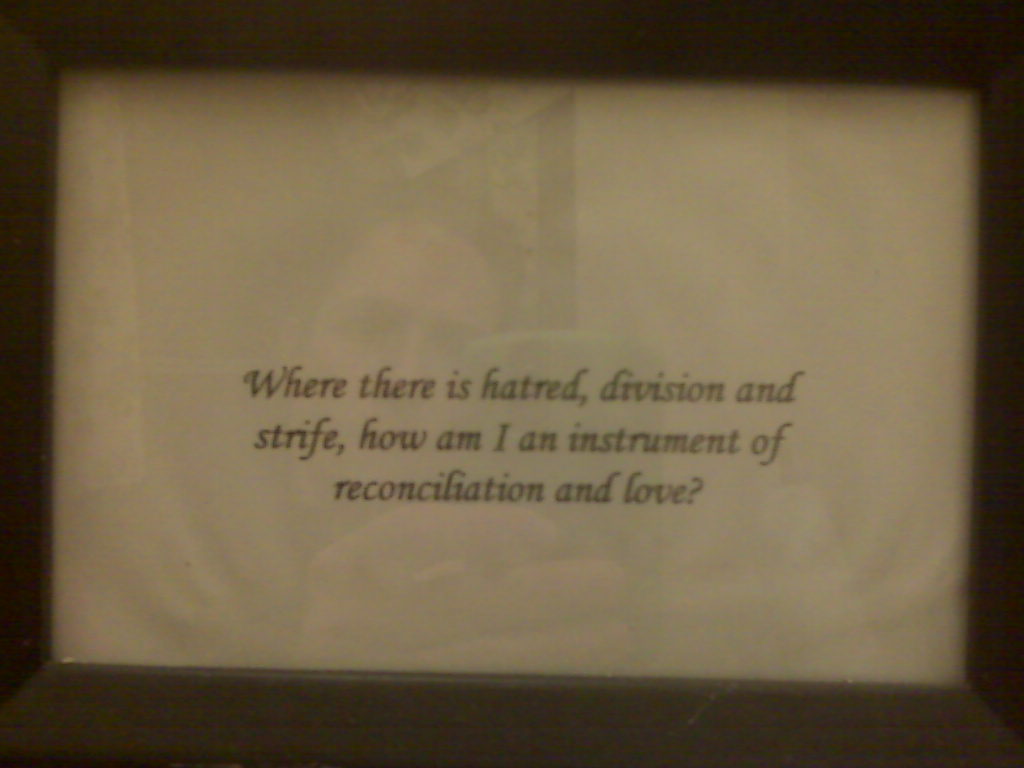
    I found on first and second and even third reading this declaration a little confusing. It may be that something was lost in translation (from the Bulgarian–a completely unknown language to me).

    It does not say that to each his own is freedom, but that we should have freedom AND to each his own.

    I think this means that true freedom is not everyone getting his or her own. Rather, out of freedom, we choose the binds of community and sometimes elect to forego complete individualism so that we can maximize the fulfillment of each individual as a member of the community.

    To each his own as the only governing principle does not permit anything other than suspicious and antagonistice relationship. Honoring that everyone wants to be recognized as a free individual but that getting the benefit and support of community requires freely choosing to submit, commit, and work to a relationship in which maximum individuality thrives but the community of individuals is greater than any of its individual members–that’s a great and worthy dance.

    Peace and light, E — Posted with WordPress for BlackBerry.
  • |

    A Momentary Yearning

    I am having a momentary yearning that it is hard for me to imagine realizing.  Given all my commitments (commitments that I treasure for the groundedness, sense of place, and community that they give me in return), I cannot quite figure out how I could fit in a long weekend in Paris before March 11, 2012. 

    Nonetheless, I have been enjoying this morning a fantasy of picking up and going to Paris to see the Tagore exhibit at the Petit Palais, and incidentally eating and walking and photographing and delighting in everything else Paris has to offer.  I suppose I could buy the catalogue–the internet has made such things ever so easy, but it wouldn’t quite be the same.

  • | |

    Occupy DC–The Morning After

    When I was on my way to do volunteer work this morning, I rode the bus past the dregs of Occupy DC-McPherson Square.  The police presence was thick.  I wasn’t sure why the heavy construction equipment was necessary.  It is hard to know what will happen to the movement when it loses its physical location.  It is clear that the idea of “occupy” has already entered popular culture, and the idea of the 99% will be part of this year’s Federal elections.

    As things are created and dissolved, it is always hard to know what will stay and what will disappear from the fabric of our lives.  Part of it depends on the strength of the ideas.  Part depends on the commitment of those involved to transform and evolve to keep what is good moving forward even when beset with challenge and upheaval.  As for the last photograph, which was taken just down the street (the cop cars were clearly related to those in the Square)–I couldn’t tell you what god or whose country; could you?

  • | | | | |

    Devotion (Bhakti)

    Much is said about devotion in yoga, and there is a great privileging by many of the path of devotion — bhakti.  With no clear answers, I contemplate often what it means to practice bhakti, to be devoted in a religious or spiritual sense.  Witnessing those on pilgrimage when I was in India (it was “pilgrimage season”), I was flooded with memories and ideas for contemplation about what it means to be devoted and how people express devotion.

    Among the thoughts and memories were having observed the operaphiles in their expensive clothes swoon and gasp and applaud at the Vienna Opera House on the opera level where I had paid a dollar for standing room; having been literally swept off of my feet in the press of the crowds heading to the tube at Wembley Stadium after seeing the Rolling Stones in concert; watching the people do the standing wave thing at ball games while hollering for their team as if their whole view of the world was dependent on who wins; having taken, standing room only, the third class train from Florence to Rome during Easter week (a different pilgrimage season), on asking who is that woman on the billboards, discovering that India, too, has a habit of electing movie stars to political office.

  • | | | | |

    After the Exhileration, Work

    We all (or at least most of those who would be reading this blog) have heard the Buddhist-inspired saying:  before enlightenment, the laundry.  After enlightenment, the laundry.  The question is whether after the moments of enlightenment can we infuse doing the laundry with more joy, acceptance, and peace.  A young adult acquaintance asked me the other day whether I was readjusting ok.  I did not know to what he was referring, and he had to explain that he was asking how I was doing on my return from my India trip.  “It was just a vacation–albeit an extraordinary one,” I replied.  “Life continues.”

    “The good experiences just slip away like dry sand through my fingers,” he made a motion of letting something slip away.

    “When you practice and when you get older, it will be easier to bring the temporary, good experiences into your life without feeling they are lost when you have moved onto the next thing,” I said with hope that would  actually be true for him, he seemed so bereft.

    The yoga teaches us neither to be out searching for the highs nor actively avoiding the lows; the dance of grasping and avoiding is what makes us suffer.  That does not mean that the highs, the times of wild abandoned joy, the experiences of utter fulfillment, of exquisite understanding are of no value.  What brings joy is a thing of wonder and an opportunity to deepen our ability to love and be generous.  They are only a problem if we ruin our time by vainly clinging to or trying to repeat the sensation.  As our practice (and our understanding of a life well-lived and loved) matures, we understand that there is no readjusting in the return to the day to day.  We welcome what we have had, try to remember what we have learned, including how much joy and delight we are able to drink in, and approach each day as another opportunity to seek and share connection.

  • | |

    “Culture Wars” (and Mayiya-Mala)

    When I saw this headline the other day, the first thought that came to mind was how much pleasanter life would be if those spending huge amounts of effort and money to “fight” gay marriage would pour that energy into educating children, tending gardens, and being friendly with their neighbors. The next thought, which was not unrelated, was that the headline was a prime example of how the action of mayiya mala serves to alienate us and cause unnecessary rancor.

    The three malas or cloakings, in tantric philosophy, are aspects of consciousness that prevent us from recognizing the unifying spirit in all beings. We tend to hear a fair amount in yoga class about the first of these —anava mala, which clouds or covers over our recognition of the divine in ourselves, thus leading to feelings of unworthiness–but there is less focus on the other two (the third is karma mala, which is the illusion that we are doing everything all by ourselves–that’s an oversimplification. Perhaps more another time).

    At an elemental level, mayiya mala is the distinction between subject and object that leads us to feel separate from other beings. When this separateness makes us feel threatened or needy, then we can behave very badly indeed (mild understatement). I believe that our superficial requirements of outer sameness–think dress codes or neighborhood rules on what one can plant in one’s front yard–are exactly because we fear difference. If we can instead accept difference as part of the play of what actually connects us (see through mayiya mala, then we can more easily love and embrace others and widest variety of creative expression.

    On our mats, one of the things that leads to injury is mayiya mala. When we forget that we the purpose of the practice is to seek the peaceful joyous space within ourselves and instead get competitive or acquisitive about postures (or external emblems of “spiritual advancement”), we are getting caught up in the differences and comparisons generated by mayiya mala and get compelled to push and strive in unhealthy and dangerous ways. When we remember the true purpose of practice, we will seek to expand, but with such sensitivity that we do not hurt ourselves. This, of course, is easier said than done.

    Peace and light, E — Posted with WordPress for BlackBerry.