Signs Around Town

Peace and light, E — Posted with WordPress for BlackBerry.
Peace and light, E — Posted with WordPress for BlackBerry.
Fill in the blank?
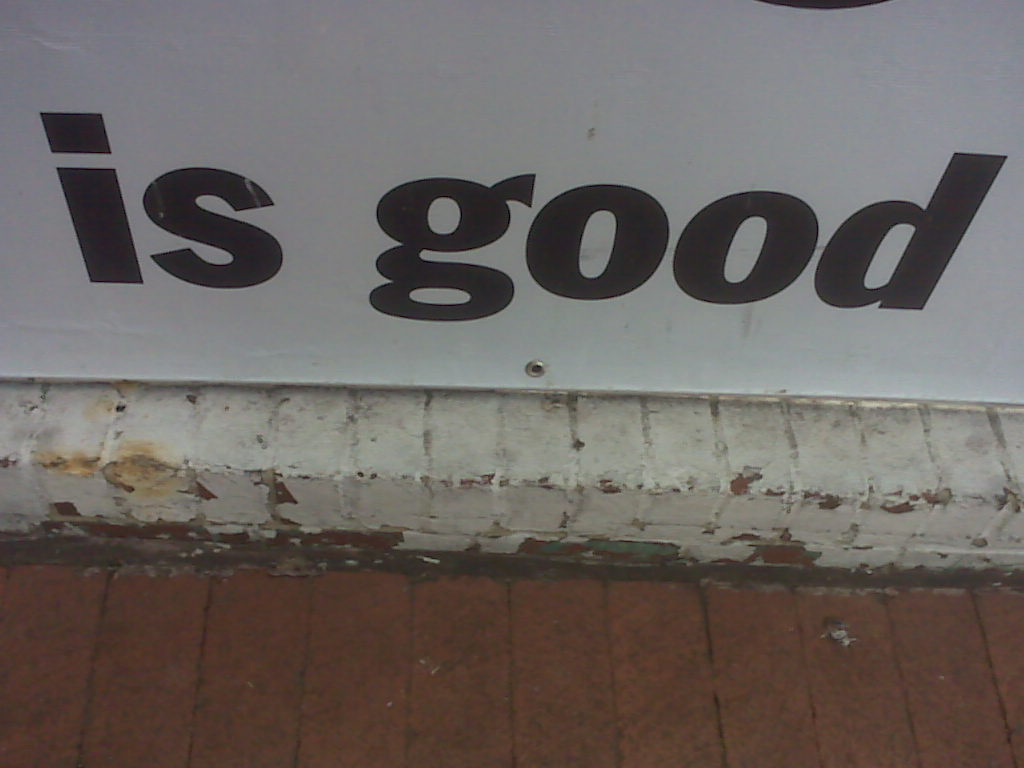
Peace and light, E — Posted with WordPress for BlackBerry.
When I selected Oxfam to be the donee of the proceeds from my first Thanksgiving Day Yoga Fundraiser ten years ago, I took into account that its mission is to “create[] lasting solutions to poverty, hunger, and injustice,” which seemed to me deeply related to what I believe is the best aspect of the history and tradition of making a holiday of thanks giving (leaving aside the shadow side of the history). Last night, when I was writing the newsletter inviting all to come and join me for the fundraising class, I thought about whether some readers would wonder why the donee of the proceeds wasn’t being changed to the Red Cross or Doctors Without Borders or other reputable organizations that are out in the field helping those known to us who are closer to home and are still suffering from the ravages of Hurricane Sandy.
Over the past few months, in ever increasing quantity as the elections approached, I received several emails a day and sometimes in an hour (and if I had been willing to answer the phone, calls) pleading for me to donate money and time. For some, it was asking again and again, even though or perhaps especially because I had given generously already. In the face of an unexpectedly large disaster, we cannot help but wish we could do something to help. Not surprisingly, I am feeling a little of what they call in the business “donor fatigue,” and I expect that many others feel the same. It is important, when faced with urgent cries for help, to remember that the preexisting calls on our resources have not gone away (newspaper reporting and the absence thereof notwithstanding). I do not question for a minute that those who are able to do so should share some resources with those whose homes and lives have been turned upside down by Hurricane Sandy, but it is also important to remember and continue to support the causes that are not today’s news.
When a student asks a question and I do not know the answer, I do not try to answer it then and there. I do go home and take the time to try and find an answer. If I find enough information to be useful, I follow up. Last night, before the William Penn House class, a student asked whether I had received a recent mass e-mailing from John Friend in which he mentioned teaching about biotensegrity. I knew the answer to whether I had received the email–yes, a friend had forwarded it. I did not know, though, how John was using the term biotensegrity. I went and did a little research.
Buckminster Fuller coined the word “tensegrity”as the conjunction of tension and integration. The idea of tensegrity is being actively taught by anatomy teacher Tom Myers, a student of both Buckminster Fuller and Ida Rolf and a teacher of certain of my yoga teachers. It also bears a trademark when called “Carlos Castenada tensegrity.” I never got into the “magical passes” of Castenada’s students turned teachers, but at some point relatively recently found a used copy of “Magical Passes.” As I had delved fairly deeply into Carlos Castenada in my youth, I picked up the book and made it part of my library, though did not read it at the time.
I am not surprised that John is talking about biotensegrity. From my few hours of reading, it seems resonant with the “universal principles of alignment” that were the foundation of his Anusara teachings and also consistent with his movement towards the exploration and teaching of “sacred geometry” near the end of his Anusara days.
Yes, I know I haven’t actually said what is tensegrity or biotensegrity in the yoga/body awareness and movement context. But I do not teach unless I have learned something well enough to integrate it fully into mind and body such that I can articulate it in my own words, and I have not thought enough about the term tensegrity as it relates to yoga practice, though the concept makes initial intuitive sense. If the links inspire interest, I invite you to look more deeply. And I’m going to put “Magical Passes” on my stack of reading, though not necessarily at the top.

Peace and light, E — Posted with WordPress for BlackBerry.