Signs Around Town

Peace and light, E — Posted with WordPress for BlackBerry.
thoughts on how we fit into the web of community, family and society
Peace and light, E — Posted with WordPress for BlackBerry.
This week’s Department of Labor elevator poster.

Peace and light, E — Posted with WordPress for BlackBerry.
A friend wrote an email to me this morning that in a recent office move, the plaster ganesha he’s had on his wall broke. Not to worry, though, he had been given another one to sit on his computer. Ganesha, though sometimes hailed as the remover of obstacles, does not so much remove them as help us navigate through life so that the inevitable challenges and hurdles will feel less like insurmountable obstacles and more like opportunities to move in new directions.
It seemed almost everywhere I turned in India, I bumped into another image of Ganesha. He’s a powerful one. I did not attempt to photograph them all, and these are not all the photographs. One of them is not ganesha–sometimes an elephant is just an elephant, even in a sculpture devoted to the gods.
If you are enjoying one of these images in particular, click on it so that you get to it at the largest size and then right-click to make it your wallpaper or background. Enjoy!
It is hard to believe that having arrived home only two weeks ago from my trip to India that I have already gone on and returned home from another trip. As I looked out the train window at the landscape that still holds my interest though I have seen it hundreds of time, but yet is restful in its very familiarity, I thought about how strange and wondrous it would seem to one newly visiting from a place like Tamil Nadu, especially the rural areas.


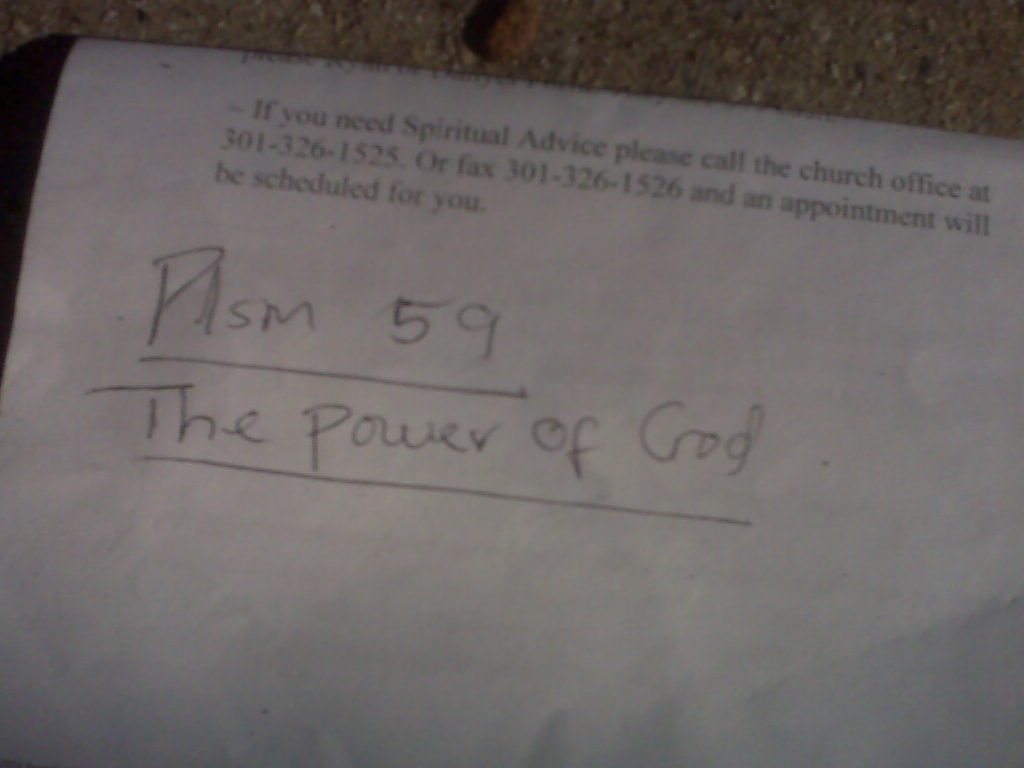
When I saw this on the sidewalk, I wondered whether it was litter–the content of a note unless autographed by someone famous is still litter if it is discarded on the street; or was it a note that slipped out of someone’s hand who would miss having the phone number and the reference; or was it intentionally placed on the sidewalk so a do-gooder who routinely picks up litter from the sidewalk and walks it to the nearest trash can would be given a message?
Peace and light, E — Posted with WordPress for BlackBerry.
Dear Friends,
Midnight of the new year found me sitting in a hotel room near the Chidambaram temple at festival time engaged in intense conversation while listening to wild music and chanting and the cracks and explosions of fire crackers. Quite a change from my long-standing practice of making a healthy meal, doing a long yoga practice, taking a hot bubble bath by candlelight and going to sleep well before midnight so that I can start the year rested and refreshed (an excellent way to spend New Year’s Eve if you haven’t tried it). Though I did not start this new year well rested, I wouldn’t have traded the experience I had for the world. Sometimes we need to radically break out of our old patterns to discover how much we can expand.
One of the practices at the temples we visited on the India Pilgrimage with Douglas Brooks is to take a coconut and break it open. The coconut symbolizes your head and all the preconceived notions and rules we set for ourselves that bind us into our old habits. The symbolic act of breaking open the coconut is to remind us that we sometimes need to break ourselves open in order to get at the true meat of our existence and to drink the sweet nectar of life.
Many times during the trip I thought about my first experiences attending “Advanced Intensives” with John Friend. I, like many others I know, showed up at my first Advanced Intensive wondering how I got there, asking myself whether I was worthy, and worrying that I was in way over my head and would get injured. Though I have now been to a number, each time I still have had to practice with both an absolute willingness to be open to the possibility of expansion while being impeccably mindful of my own limits. It is a subtle dance of consciousness, and part of the learning is finding the exact balance point where we can both break out of our preconceived limitations and still honor that we in fact have some.
I approached going to India with much trepidation. A friend whom I met in Peru and who I later visited in South Africa, having seen my emotional reactions to the deep poverty of developing nations had warned me off of India. As one who likes things to be quiet and clean and thrives on healthy meals and regular sleep, I knew India would be physically and emotionally challenging. But I wanted the visions. I wanted to see and experience its very “otherness,” its beauty, and the source of the yoga teachings. I packed my bags with emergency supplies, some of which I turned out to need, some of which served others on the trip, most of which I ended up donating to a village that the trip helps to support. I had to ask people to help me (one of my hardest practices) by being close when we were in dense crowds. I confess that I wore earplugs when it got really loud in the temples, which it does. And having prepared and taken care, I was exhilerated. I experienced radically more with my heart getting fuller and fuller in a short time than I thought ever possible for me. Like discovering one can do a wild yoga pose that one thought totally out of reach and then sensibly stopping before blowing past physical limits, I broke myself open and was able to drink deeply of the nectar. And yes, I did actually hurl a coconut to the ground to break it. And yes, it took two tries.
I was lucky. This time, I got to choose when and where to break open the coconut. Sometimes life does it for us and then we have the choice either to despair or to rise to the occasion. This year, I invite you to the yoga to find where you can break open and find ever more sweetness, nourishment, and delight than you ever dreamed possible. For me this includes not just the exhileration of advancing the intensity of poses, but the deepness of meditation, the precise use of alignment for therapeutics to better experience life, and the emotional depth of a long restorative practice.
Come join me as regular classes continue at William Penn House on Tuesdays, invitation group house practice for charity on Wednesdays, and gentle/therapeutics at Willow Street on Saturdays at noon in Takoma Park. All info on the classes page of the web site. Mark your calendars, too, for:
Finding the Warmth Inside: Relax Into Optimal Alignment with Anusara Restoratives, Saturday, February 25 2012, 2:30 PM – 5:00 PM, Willow Street Yoga, Takoma Park Studio, $35.00, click to Register Online or download a paper form to bring to Willow Street in person. After a little gentle stretching and self-massage to bring awareness to the breath and body, we will enjoy the exquisite application of Anusara’s Universal Principles of Alignment to restful and supported restorative postures to release old patterns and invite in the new to find greater ease of body and mind. A great workshop and practice for all levels.
I have been sharing photos and experiences of India on the blog (if you have missed them, do check them out and enjoy). Some of you have asked how you can subscribe to the blog in addition to the newsletter. Please just click here and follow the instructions to get the blog posts by email.
I look forward to seeing you through the new year and sign off expressing my ever growing love, appreciation, and gratitude for all of you and the deepening and expanding connection through the yoga, neighborhood, and all that life here in DC and in the greater yoga community brings us.
Peace and light,
Elizabeth
In Anusara yoga, one of the ways the first principle of “opening to grace” can be experienced and practiced is as a radical expansion of the capacity to receive and appreciate the very wonder of being. During my visit to India with Professor Douglas Brooks, I found myself repeatedly thinking of the concept of radical expansion and also the preamble to the Isha Upanishad (long a favorite of mine; Shantala on their first CD, Love Window, have done an exquisite rendition), which can be roughly translated as saying that adding fullness to fullness is itself fullness (fullness can also be translated here as perfection).
What I believe this is saying that being itself is infinitely full; thus, we cannot make it more infinite by adding to it. Human consciousness of the infinitude of being, though, is limited by the filters of space and time. One of the key reasons to practice yoga (including meditation) is to expand both our capacity to appreciate the fullness and to receive its full wonder by uniting our own consciousness with the infinitude. When we can appreciate ever more the wonder of our being, we will naturally be more joyous, and I believe, led to be more compassionate and generous with ourselves and others.
Day after day on the India pilgrimage, just when I thought my heart and mind were already full to bursting, there were yet more experiences of the beauty and extraordinariness of life and creativity and nature. I found myself chanting the Isha Upanishad—purnamadah, purnamidam, puranata purnamudatacyate. Fullness and fullness is fullness. “Let me expand still more to appreciate to its utmost yet more beauty,” I thought to myself again and again. Though I already thought I’d developed a fairly full understanding of the concept through study and practice, I thought, “this is what John Friend means when he is talking about radical expansion.” I look forward to studying and practicing to experience and share ever more beauty.

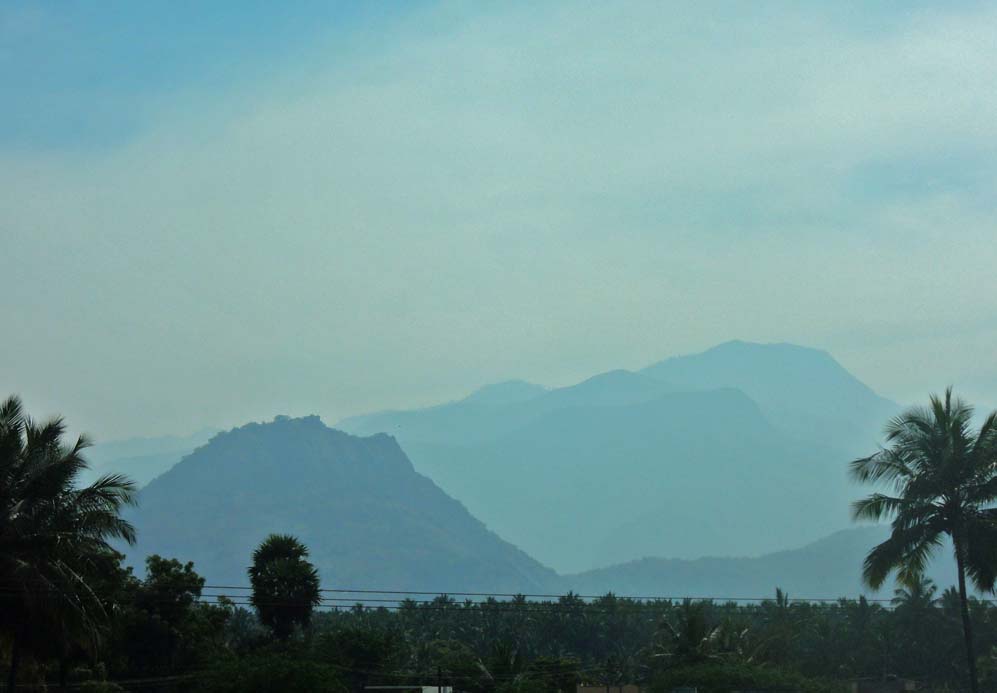
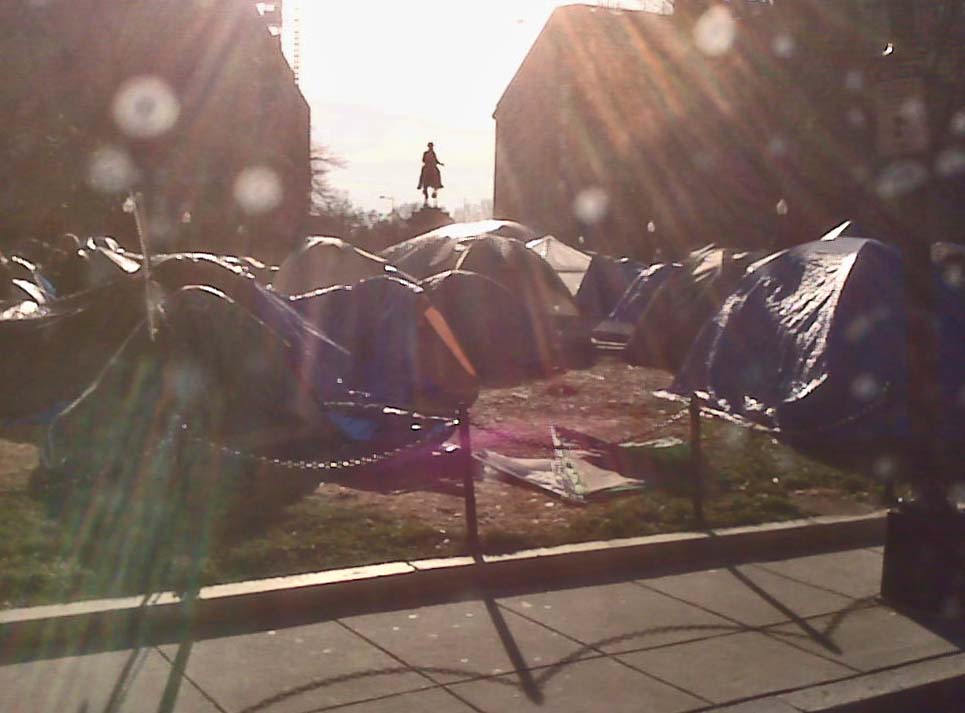
I was not witness to the most abject poverty in India (both because of where I went and because of how I was guided). These makeshift, but semi-permanent shelters seen from the window of the bus made me think of the Occupy movement. They are nothing like those of Occupy and much of what Occupy is trying to warn against forgetting to care. And, oh yeah, McPherson Square is still occupied, though more and more uneasily.

Only after walking along the two lane streets in a sari and sandals, sharing the road with exhaust-fume spewing buses, three-wheelers, motorcycles, mopeds, bicycles, cows, goats, dogs, street vendors, and pedestrians amidst dust, puddles, sewage, potholes, cowpats, dog shit, goat turds, and piles of organic and non-biodegradable trash, could one understand how a campaign to end the practice of littering would link it to evil. Thanks to my fellow traveler Eric for pointing out this sign.

The New York Times just published a lengthy article on “How Yoga Can Wreck Your Body.” The response of one of my fellow certified Anusara yoga instructors was “duh!” This conversation greets me as I am about to offer a free gentle and therapeutic yoga class at Willow Street Yoga to invite new and continuing students to discover the power of the Anusara alignment principles to heal and transform challenges of embodiment. If I were not highly confident in the power of Anusara yoga to heal when practiced mindfully, I might be worried that the article would keep away potential students. Instead, I welcome the “news” as a way to broaden the invitation to discovery.
As I have blogged about before, at an intensive, John Friend once compared advanced asana to digitalis–depending on dosage and circumstances of the individual digitalis is at once the deadliest plant in the garden and one of the most powerful medications to heal the heart. We don’t read much about digitalis in the news, but we are constantly bombarded with contradictory news flashes about the health risks and benefits of lots of things — coffee, red wine, vitamins, running, anything that has been either held out as either a cure all or an evil that is ubiquitously practiced or imbibed. Why? I think it is because we in this society are hungry for panaceas, for effortless solutions, for the latest thing, for something to save us from emptiness and ill health, without actually having to work at it. It is newsworthy that yoga bears risks precisely because we (the general societal we) wanted it to be a perfect solution without actually requiring any change how we live the rest of our lives (including diet, exercise, relationship to others) and to bring to yoga the mindfulness, determination, and steadiness that it requires to bring the peace, harmony, and healing it offers.