Asana, Pranayama, and Yoga Practice

Discussion of physical aspects of yoga (on and off the mat)

  • |

    Will There Be Any Change in My Local Yoga Class Following the Events of the Past Few Weeks?

    A regular reader of this blog, who was a member of the Willow Street Yoga community until she moved out of the country, wrote and said that though she enjoyed the classes in her new home, she missed the adjustments and alignment instructions at Willow Street.  She asked in this context the following:  “I’ve been wondering lately, when teachers leave anusara, can they still use the same terminology in their classes?  If not, why not?  Does JF have a copyright on some of the words?”  I cannot speak to any copyright and trademark issues–I took a copyright class in law school, but that was 25 years ago.

    All that I can speak to is how I will continue teaching, both at William Penn House, where the only class of the week is the one I teach, and at Willow Street Yoga Center, where I will continue to teach my gentle/therapeutic class, and the other workshops and classes I may teach.  Although I have not tendered a formal resignation, I have removed the title “certified Anusara instructor” from the header of the blog.  At this time, I do not even know, given John’s decision to step down for at least some period of time, what is the organization from which I would resign or whether a renewal license would be sent.  For the moment, there is no need for me to make any specific changes in how I teach.

    If my formal affiliation with Anusara as a corporate entity were to change, the thousands of hours I have spent contemplating, exploring, and studying the principles of alignment and how to teach them will still be the major part of my asana practice and teaching.  Anusara is a deep, strong, significant  presence and has been the most significant physical and energetic component of my practice and teaching and to some extent my yogic framework for being in the world for a decade.  Given the healing and delight I have experienced from practicing in accordance with the principles, I do not expect anything to be otherwise.  As I have been taught only to teach what I have practiced and experienced myself, and not just what I have heard from a teacher or read in a book, although obviously I cannot have experienced in my own body healing for all the various challenges of embodiment that my students have experienced, how could I not be teaching from my own interpretation of the principles of alignment, regardless of a possible need to shift vocabulary?

    What will happen with the organization from a business perspective remains to be seen.  The name of the system carries a trademark.   Whatever happens and wherever I am led in my practice and commitments in the future, as have always done, I will  honor John Friend and Anusara as the source of much of my learning and it will be a recognizable influence on my teaching.  I will say in class or when I am writing that the alignment principles I have just articulated would be called [insert Anusara alignment principle] in Anusara.  This will be true regardless of how the Anusara community is reconfigured and what my relationship is to any future organizational structure.

    In answer to the question of what will my local yoga class be like now from my own perspective:  Yes, I will be offering the same alignment instructions and adjustments–and hoping to get better over time with continued study and practice.  But also, I will be even more precise about attribution, and  I will be less likely to be using the “short hand,” which I already use relatively minimally.  I have always found that a description of the actual physical and energetic aspect of one of Anusara’s “Universal Principles of Alignment” that applied to what was going on in the practice far more helpful than just using the name of the principle as a pointer to the action being emphasized.

    It is a great question, and I am sure that the answer will be slightly different for each teacher, though I trust that all are committed to offering the best yoga class possible, just as they were before.  For me, it will take a little feeling my way around the changed landscape to see how it influences my teaching.  All I can say is that I am still committed to offering yoga practices that bring healing, joy, and connection, and I hope that I can do an ever better and fuller job of living up to my commitment.  This is true wherever I teach and whatever name is given to the hatha yoga I teach.

  • |

    A Little (or Maybe Big) Perspective

    I admit it. So caught up I have been in what my friends and colleagues have been posting on the internet about what has happened in our little corner of the world, that I haven’t been reading the news of the world with my usual diligence.

    When I head out the door of my building to walk home, I walk past a big homeless shelter. There is a grassy patch and a ledge on the side of the street where I leave the building, and there are always people hanging out. Sometimes they get somewhat belligerent with each other or talk or shout loudly to no one in particular. When I stay late, and it is fully dark, it can feel a bit intimidating.

    Tonight the line for a bed inside was especially long; it has been a wet day, and the temperature is dropping. I thought about our tempest as I looked at those who are homeless standing patiently in line in the hope of being able to spend a night inside, and I thought how much service, compassion, and love matter, and how little it matters exactly how or through whom we learn to better embody and live them.

    Peace and light, E — Posted with WordPress for BlackBerry.

  • “Finding the Warm Inside” — A Restorative Yoga Workshop, Feb 25th (Web Version of E-Newsletter)

    Dear Friends,

    It is a time for me of great emotional expansion and challenge.  In such times, both more active, energizing yoga and sweetly, deeply meditative still yoga is a continuing gift to give myself and to share.

    Please join me and like-minded yogis together creating a shared stillness on Saturday, February 25th for a nurturing, healing, and generally delightful afternoon of restorative yoga:

    Finding the Warmth Inside: Relax Into Optimal Alignment with Anusara Restoratives, Saturday, February 25 2012, 2:30 PM – 5:00 PM, Willow Street Yoga, Takoma Park Studio, $35.00, click to Register Online or download a paper form to bring to Willow Street in person.  After a little gentle stretching and self-massage to bring awareness to the breath and body, we will enjoy the exquisite application of Anusara’s Universal Principles of Alignment to restful and supported restorative postures to release old patterns and invite in the new to find greater ease of body and mind. A great workshop and practice for all levels.

    For a treat of free yoga–do bring or send a friend, I’ll be teaching the Friday Yoga Happy Hour at Willow Street Yoga, Silver Spring, next Friday, February 17th.  All levels are welcome.

    I hope to see many of you.  As always, feel free to email me with any questions you might have. There is always a new photo or idea on the blog.  Take a look at what’s new–there’s still more to come on my trip to India as I find it relating to things going on at the moment.

    Peace and light,

    Elizabeth

  • | |

    What I Wrote Last Week

    By now, the news of scandal has become widespread on the internet.  The Huffington Post has put in its two cents in the way that modern journalism does–highlight the bad, forecast turmoil, and invite continued readership.  Put John Friend or Anusara scandal into your favorite search engine and you will get a couple of dozen blog entries about broken-hearted yoga teachers feeling they need to resign from the organization (though many say they will be teaching the method, just not articulating it as the brand, which confuses me somewhat).

    Last week, I chose to post only a guest blog on the District Kula website (since that posting, District Kula is no longer affiliated with Anusara).  Though I have much more information now than I did last week, I am still waiting to see.  I will be gradually revealing more of my thoughts here as things develop now that I believe that those far beyond the immediate (though large) community of practitioners are discussing the allegations and potential repercussions with intelligence and kindness or gleeful malice or somewhere in between.

    One thing I can say, is that I have always consistently separated the man from the message, and  I continue to believe in the soundness of the Anusara principles.  I also believe that the situation is emblematic of the uneasy, but inseparable relationship between spiritual practice and commercial enterprise in our current market-driven world.  While it is unfortunate and sad that it is in my chosen community, I am no stranger to upheaval and controversy in either workplaces or communities and there may have been no better time to have this discussion both within the community and as a broader societal matter.

  • How Injuries Can Help Us Open to Grace

    Earlier this week one of my long-time students emailed me before class to say that even though she had strained a muscle in her mid-back, she still intended to come to practice because she hoped it would make her feel better.  “It even hurts when I laugh,” she added.  I emailed her back saying that I would offer alignment instructions to help with her back, but I could not promise that we would not laugh (which, of course, she reported made her laugh).  In fact, it was a class filled with much laughter, but applying the principles of alignment served to alleviate the pain the student had been experiencing.

    Towards the end of the class, as we were getting ready to move into a seated forward bend, I asked my student what alignment principles she should apply to take care of her back in the pose.  Demonstrating as she spoke, she said that she should spread her toes to activate “shins in;” take her inner thighs in, back, and apart to inner spiral her legs in order to widen her pelvic floor and enable curve in the lumbar spine, releasing some of the strain on her back; and then work outer spiral to engage and protect her back.   “Perfect,” I said, “but what should you do before those actions?”

    Another student jumped in, “open to grace.”  Quite right, but how, I asked, would you apply “opening to grace” as a physical principle in this instance?  That seemed a little like a trick question, so I explained how I use the action of “opening to grace” when I am working with an injury (obviously this applies all the time, but it especially applies both when working with an injury and when moving towards a more advanced pose than you have previously practiced.)

    Opening to grace here means being patiently and exquisitely sensitive, moving slowly and mindfully enough to be able to tell from the beginning and throughout the entire cycle of entering into, reaching pinnacle (whatever that may be under the circumstances), and getting out of the pose whether the movements are serving to heal and expand before causing more pain and injury.  Does any movement into the pose at all aggravate the injury?  Does applying the principles gently make it better?  Does applying them with fierce intensity help more?  If we start with the strongest, we will have already gone past the place where we discover that resting or just a gentle attempt would have been healing or expanding, but any more would be aggravating.  When we start with the gentle and sensitive and then move in deeper and stronger without losing the perfect sensitivity that is when true change can occur.

    It never feels good to be injured, but because of the immediate motivation to get out of pain, injuries can be great teachers of just how much practicing with true sensitivity and awareness can enable us to expand heart and mind instead of just moving towards wilder poses for the sake of some idea that we are better yogis if we can do more poses.


  • | | |

    In Which My Camera Sees the Good

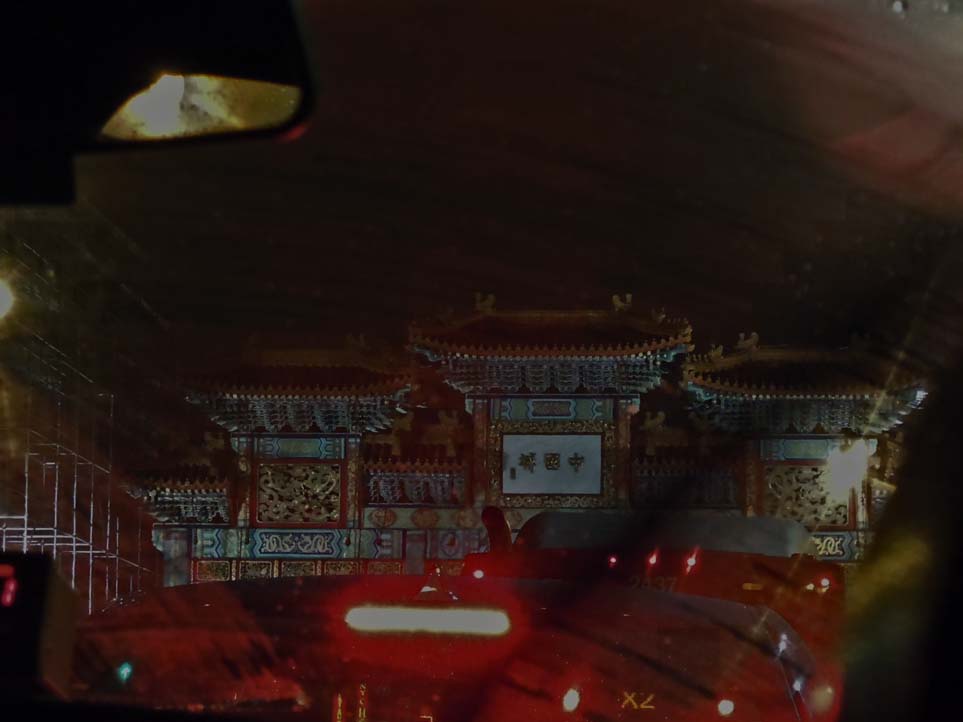
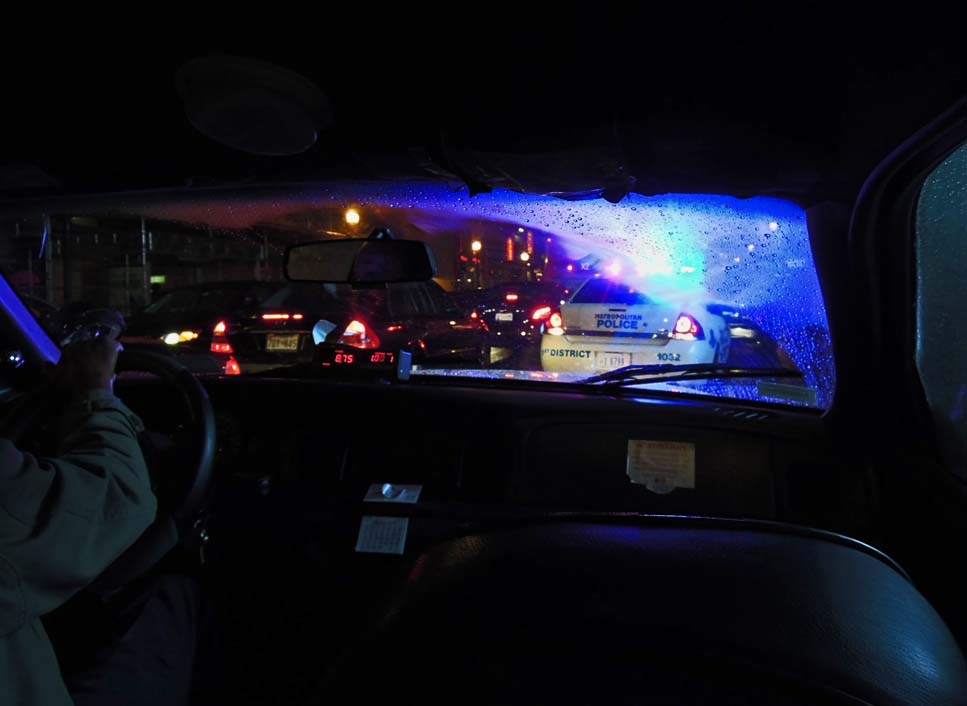
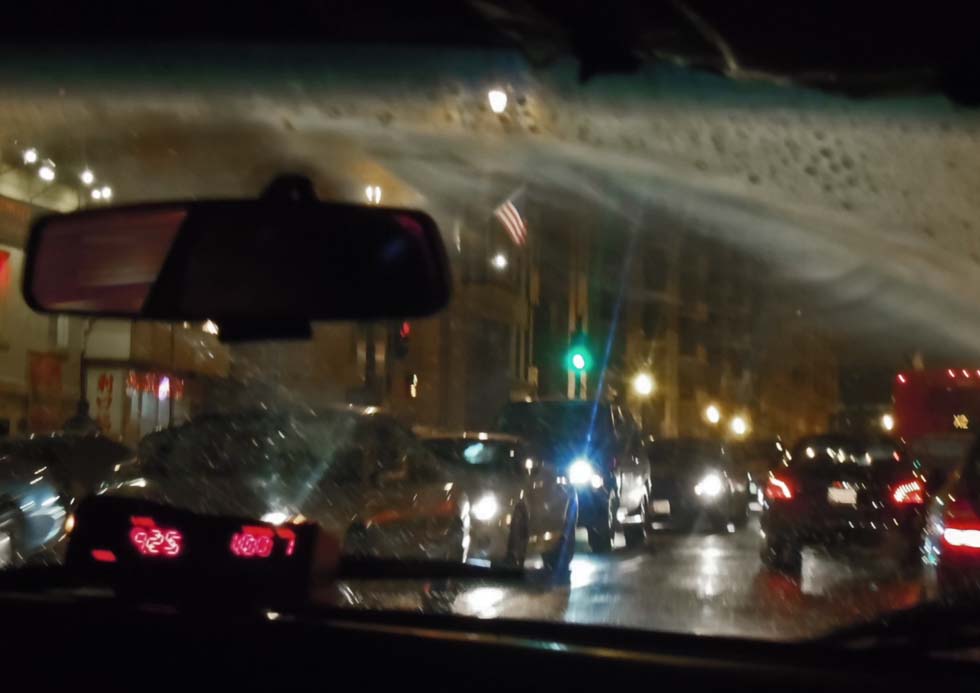
    It was one of those days when it was hard to get home.  I’d gone to the museum to see the Harry Callahan at 100 and then went out for tea in Georgetown with a friend.  I stopped on my way home for some groceries.  I got to the bus stop just as a bus was arriving, but with a big suburban SUV hogging the bus stop and the dark rainy night, the driver sailed past without stopping.  He must have been really late and was taking advantage of a short break in traffic.  I caught a taxi rather than wait in the cold rain for the next bus.

    Traffic was completely still on K Street because of the police trying to clear out Occupy DC from McPherson Square and a number of streets were closed off to traffic, so the driver went to H Street, which was almost equally congested.  Things started to move for a bit, but then there was then some issue with another big black SUV with suburban plates in Chinatown that had been pulled over by the police.  This resulted in absolute tirade by the taxi driver as to why DC should not be allowed to be a state.  I was having trouble explaining that Federal voting rights for citizens in the District had nothing to do with whether the cops could have pulled the car over better or faster so that it would less obstruct traffic.  I gave up completely when he started in on how DC schools should be better than Maryland’s and Virginia’s because they had so much more tax revenue.

    I remembered I had my camera in my pocket.  I accepted the the meter was going to run unless I got out of the taxi in the rain (and then what was I going to do?) and enjoyed photographing the lights of the city at night.  Sometimes, my camera really helps me accept whatever is and see the beauty in it.


  • | | | | |

    Devotion (Bhakti)

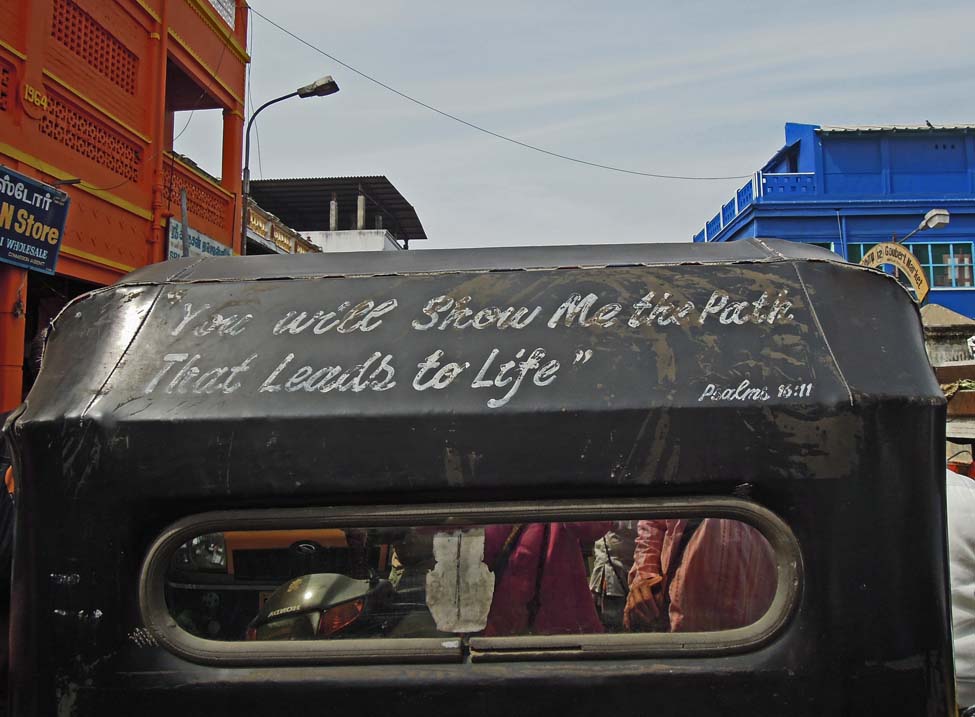
    Much is said about devotion in yoga, and there is a great privileging by many of the path of devotion — bhakti.  With no clear answers, I contemplate often what it means to practice bhakti, to be devoted in a religious or spiritual sense.  Witnessing those on pilgrimage when I was in India (it was “pilgrimage season”), I was flooded with memories and ideas for contemplation about what it means to be devoted and how people express devotion.

    Among the thoughts and memories were having observed the operaphiles in their expensive clothes swoon and gasp and applaud at the Vienna Opera House on the opera level where I had paid a dollar for standing room; having been literally swept off of my feet in the press of the crowds heading to the tube at Wembley Stadium after seeing the Rolling Stones in concert; watching the people do the standing wave thing at ball games while hollering for their team as if their whole view of the world was dependent on who wins; having taken, standing room only, the third class train from Florence to Rome during Easter week (a different pilgrimage season), on asking who is that woman on the billboards, discovering that India, too, has a habit of electing movie stars to political office.

  • | | |

    What Do You See?

    What do you see when you walk down the street or into a room?  Do you see more or less depending on whether the surroundings are new to you or familiar?  John Friend has said that when leading a class teachers need to be able simultaneously to see the whole room (and how everything and the students are in relationship to each other in the room), each student as a part of the whole and as a whole person, and the individual alignment of each student.

    What it takes to do this is the ability to be completely soft, spacious, and open in our seeing (“open to grace”) and also well enough educated and experienced to appreciate and understand the details.  I think that when we can see both the big picture and the details simultaneously, we have the greatest opportunity to experience the most of life, are more likely to be able to look for the good, and to make the most positive changes.


  • | |

    “In, Back, and Apart”

    As I was preparing my week’s classes, I was led to contemplate the off-the-mat import of the words — “in, back, and apart” — used to describe the actions that activate the Anusara alignment principle “inner spiral,” which is also referred to as “expanding spiral.”

    The meaning and point of “yoga,” we are told is union. In the Anusara system, inner or expanding spiral is a critical element of the “universal principles of alignment,” which are designed to get us physically and energetically into our optimal blue-print.

    How can going in, back, and apart be what would create an expansion that would enable us to better experience our whole selves and all beings as spirit and in unity? Doesn’t that sound entirely backwards?

    Going “in” is one of the key aspects of yoga practice. If we only look out, we can get caught up is grasping and longing, which causes great suffering. Although we need also to appreciate the outside, going in, especially by means of meditation. Going in is what enables us to discover our only true freedom, which is the freedom to choose how we react internally to whatever is going on outside of ourselves.

    Moving back in yoga is not the same as backing off or away or turning one’s back on things, which would move us away from connection. Rather, when we move our awareness to the back body or open to what is all around us and not just what is forward-looking, we can soften and open to the unknown and to the unseen, allowing the subtle energies to move and guide us to deeper insight as to what connects and unifies.

    Moving apart in inner spiral literally is the expansive component of the action. Moving apart is not becoming more separate, but making space (spaciousness) where there was binding, allowing for more freedom to experience all that is possible. It is also about breaking apart from our preconceived notions of being limited and different.

    Moving in, back, and apart does not just realign the legs so that we can heal our pelvis and low backs and radically expand our flexibility even as our bodies age (as if that weren’t good enough). Energetically, it can revolve our whole way of connecting to ourselves and the world.

    Peace and light, E — Posted with WordPress for BlackBerry.

  • | | | | |

    After the Exhileration, Work

    We all (or at least most of those who would be reading this blog) have heard the Buddhist-inspired saying:  before enlightenment, the laundry.  After enlightenment, the laundry.  The question is whether after the moments of enlightenment can we infuse doing the laundry with more joy, acceptance, and peace.  A young adult acquaintance asked me the other day whether I was readjusting ok.  I did not know to what he was referring, and he had to explain that he was asking how I was doing on my return from my India trip.  “It was just a vacation–albeit an extraordinary one,” I replied.  “Life continues.”

    “The good experiences just slip away like dry sand through my fingers,” he made a motion of letting something slip away.

    “When you practice and when you get older, it will be easier to bring the temporary, good experiences into your life without feeling they are lost when you have moved onto the next thing,” I said with hope that would  actually be true for him, he seemed so bereft.

    The yoga teaches us neither to be out searching for the highs nor actively avoiding the lows; the dance of grasping and avoiding is what makes us suffer.  That does not mean that the highs, the times of wild abandoned joy, the experiences of utter fulfillment, of exquisite understanding are of no value.  What brings joy is a thing of wonder and an opportunity to deepen our ability to love and be generous.  They are only a problem if we ruin our time by vainly clinging to or trying to repeat the sensation.  As our practice (and our understanding of a life well-lived and loved) matures, we understand that there is no readjusting in the return to the day to day.  We welcome what we have had, try to remember what we have learned, including how much joy and delight we are able to drink in, and approach each day as another opportunity to seek and share connection.