Author: Elizabeth

  • | | | | |

    Eating Local, Annamaya Kosha, and “Human Landscape Dance”

    When my friend Mac asked if I would let my readers know that his dance group Human Landscape Dance will be performing at Dance Place on Saturday and Sunday, July 9th and 10th, I agreed without hesitation.  As I was contemplating what to write, I found myself thinking about the koshas–the energetic sheaths of the body.  The yogis claim that the individual has five koshas.  The outermost, the annamaya kosha, is the “food body.”  “Food” in this context encompasses everything that comes into our body through all of our senses–touch, taste, sight, hearing, smell.  I thought about what it might mean to “eat local” if eating meant everything that we encounter with our senses.

    I am not a locavore (I too thoroughly enjoy avocado, coconut and, in winter, citrus), but I do try to emphasize local food as the mainstay of my diet.  I do it mostly for energetic reasons.  I want fresh food to have been picked as recently as possible and not to have grown weary from travel.  I want as few hands as possible to have touched the food I buy, and those hands to be those of a person who is happy with farming and is paid a living wage by the sale of the produce.  When your food growers, transporters, and preparers live nearby you are getting to know your neighbors and community, and not just getting food from a faceless corporate entity.  Over the years, you get to know each other a bit and learn what friends you have in common.  More threads are woven into the fabric of your community.

    Just as knowing the person who grows and sells you food means you can be more certain that it was raised and offered for sale with nourishment intended at every stage, so too having the art and entertainment we bring into our senses be created within our community creates a network of connection and support that we do not get when we only consume commercially prepared entertainment (though I cheerfully buy music from my favorite “stars,” go to the movies, and enjoy trips to Lincoln Center,and London’s West End, etc., just as I get avocados and citrus along with the greens from my garden and the fruits from the local farmers’ market).

    I feel blessed to be able to connect with Mac as a neighbor (Mac, his wife Jennifer Mueller, who is a student of mine and fellow yoga teacher on the Hill, and their delightful daughter live several blocks from me) and others who are performing next Saturday as fellow dancers at the Sunday Contact Improv Jam.  My dancing and personal explorations are raised up by the company of the wonderful dancers and friends who share that space, including those who will be performing next weekend.

    Why wouldn’t I want to both support my friends and learn more about them by going to Dance Place to receive the dance offering they are so lovingly preparing for all of us?  Such is the nature of feeding mindfully the annamaya kosha to help lead us to the opening and nurturing of our innermost spirit, finding and creating more bliss in ourselves and in the very essence of our community.

    FYI.  I’m looking for company to carpool or walk together to and from the Brookland Metro (for safety on the way home).  Perhaps Sunday CI Jam, dinner on the Hill, and the Sunday night show?

    Photo courtesy of Human Landscape Dance.

  • | | | |

    July Greetings–Ultimate Freedom (and Some Free Yoga) (Web Version of E-Newsletter)

    Dear Friends,

    It is Saturday morning of Independence Day weekend.  I have sat for my morning meditation, watered the garden, pet the cats, and done a few errands around the house.  In an hour or so, I will be heading up to Willow Street to teach my noon class.  As I take the time to care for garden, cats, house, and prepare to teach, I have been contemplating the concept of freedom.

    In the tantric shaivite tradition, we are taught that one of the key aspects of spirit is svatantriya — ultimate freedom.  We are also taught that we are ourselves inseparable from spirit, just as a drop of ocean water is no less part of the ocean for being a drop.  Spirit chooses, out of its freedom and play (lila) to embody itself in forms that are limited in space and time.  One of our greatest sources of suffering is feeling bound, thinking that we are stuck with who and what we are in the constraints of this mortal body, with all its quirks, forgetting our own auspiciousness.

    I could get grumpy about the need to do errands and to teach on a holiday weekend.  I could feel constrained from my usual activities around town by the combination of single-tracking on the Metro and the influx of tourists for the activities on the Mall, the combination of which will likely add an hour’s communiting time to teach today and to do volunteer work in Georgetown tomorrow at the Lantern Bookshop.  I could choose instead to be grateful that I have a house that needs caring, a garden to water, a class that gives me great joy and abiding satisfaction to share the incredible yoga principles that have so enhanced my own life, and volunteer work that I have enjoyed for over 15 years.

    I am not going to be telling anyone that we are without limitation, being as we are in time and space.  We are always and perfectly free, however, to choose to turn towards the auspicious, the light, the good, the uplifting, the highest or we can turn away.  We can act in ways that bring us ever more in alignment with spirit , or we can act in ways that take ourselves and that in our orbit farther from the good.  The more we exercise our freedom to turn towards the auspicious, the happier and healthier we will be, regardless of the fact of life in a mortal body.  That choice is our true freedom and the way to our hearts.

    To help you experience svatantriya, to choose freedom of heart, there’s nothing better than some free yoga.  The weekend of July 15-17, Willow Street Yoga will be offering it’s summer free class weekend. I’ll be offering gentle/therapeutics at noon on July 16th in Takoma Park.  Preference is giving to new students and to returning students who have brought new students with them.

    For July at William Penn House, I’m offering a two-part freebie:  (1) brand new students get first class free; please invite your friends and neighbors; (2) if you are an existing student who brings a new student with you, you get a free class when the new student comes back for a second class.

    Have a wonderful Independence Day, however you choose to celebrate and see you soon.
    Peace and light,

    Elizabeth

  • |

    Different Ways of Turning Your World Upside Down

    Yesterday at the William Penn House class, we were emphasizing strong working of our tailbones.  One of the regular students came to class even though she was still exhausted from recent and sudden major loss and upheaval in her life.  She wanted to be with the spirit of the class even if she would not be able to do everything.

    When we went to the wall to work on half and full arm balance, I advised her to give it a try if she felt up to it and then said to do legs up the wall if she knew trying to hold the arm balance would be too much.  After all, I pointed out, legs up the wall (vipariti karani) is just half handstand upside down.  And what is awesome about both the poses is that the both turn us upside down (albeit in energetically different ways) and can thus help give us a fresh perspective on how we are in our bodies and minds.

  • | |

    Can One Be Shy and a Successful Yoga Teacher?

    I have wondered over the years, as I see the emphasis on being buoyant, outgoing, and cheerful as the hallmark of a fun yoga teacher, whether it is possible to be a successful yoga teacher in today’s society if one (like me) tends toward introversion and shyness.  I recently heard an internationally recognized teacher say that the way to know if you are a successful teacher is if your classes are consistently doubling in size.  Ever-growing classes are certainly important to help the teacher and the studio pay the rent, but is that the key measure of individual success?  I think part of the sense that the measure of success is a burgeoning group of people attracted to the teacher is our societal premium on extroversion.  A more introverted teacher may not seem as cuddly and fun outside of class, but may have other things to offer that in fact grow from his or her tendency towards introversion.

    Check out this article for some perspective on introversion in today’s society.  What are your thoughts about this in the context of yoga?

  • | | | | | | |

    Loops and Spirals and the Still Point at the Center (NYC, Vt, Long Island, DC)

    My trip to the Anusara Grand Gathering was some loop of a trip, spiraling and pulsing between urban and rural, quiet time and enthusiastic gathering, old places and new scenery.  Last Saturday, I took a morning train to Manhattan, where I went to the Rubin Museum–one of my favorite spaces in the City, walked to see the Ai Weiwei sculptures in front of the Plaza, and ate good food.  On Sunday morning, I got back on the train, this time heading north to Saratoga Springs.  Just north of Croton-on-Hudson, I saw soaring over the river a raptor with an enormous wing span, white head, and brown body and wings — most likely a bald eagle.

    My friend Suzanne picked me up at the Amtrak Station in Saratoga Springs.  We went back to her house for lunch.  Before driving to Stratton Mountain for the Anusara Grand Gathering, she showed me her studio, which is a wonderful space; I look forward to visiting again.  And then we were in Vermont with John Friend, the scholars, the certified teachers leading the break out sessions and assisting, the musicians, the outdoor art, and a few hundred committed yogis.  (See previous four posts for my thoughts o the Grand Gathering).

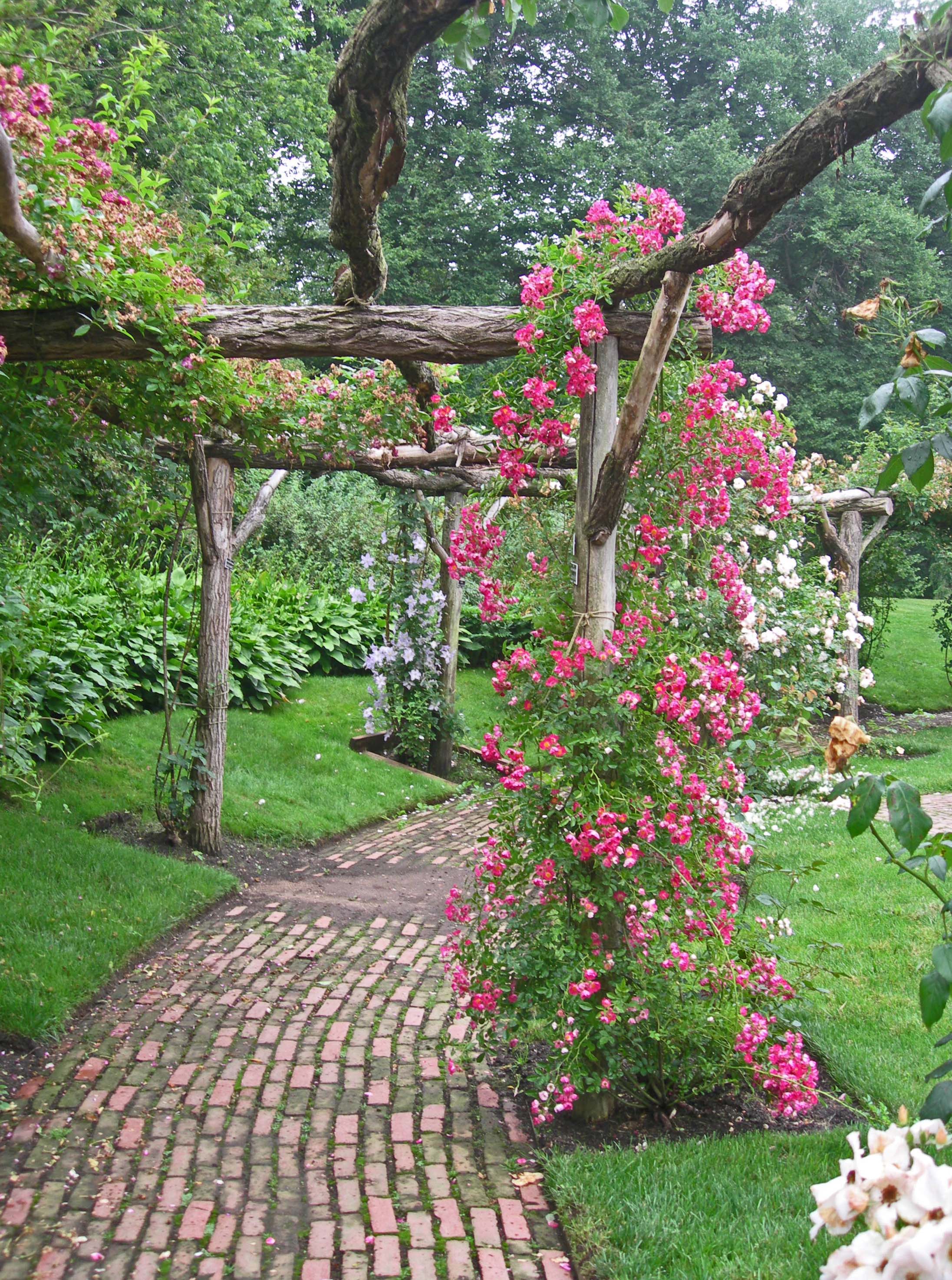
    On Wednesday afternoon, I rode back to New York with a fellow yogi and teacher I have long admired.  I decided on pure impulse, since we were getting to the City a couple of hours early, to visit my parents.  We were able to spend the evening and morning talking, and then my mother and I went to Old Westbury Gardens (check out the new Facebook profile picture my mother took in the rose garden on my personal page and please “like” my public page, if you haven’t already).

    I caught the Long Island Railroad to Penn Station and then Amtrak back to DC.  The next morning (Friday), I worked a full day, returning to quite a slew of emails.  In the evening I had a massage and went into the garden to reground myself.  Went up to Takoma on Saturday to teach, circling immediately back into the rhythm of home.

    The photo montage below gives an idea of the wide variety and quantity of input into mind and senses.  There was actually much quiet time in this whirlwind.  I spent all the time on the train listening to teleseminars, studying, writing in my journal, watching the scenery, contemplating, and napping.  More important than the quiet space of the train rides, every day of the trip, I sat, as I do each day wherever I am, for meditation morning and evening.  While on the road, my meditation gave me a space that was home; when I came home, it helped get me settled and able to carry forward the openings and shifts from going on vacation into my at home routine.

    A steady practice gives us a still point, a space that stays steady and nourishing.  The more consistent we are, the easier it is to access this space (hridaya), no matter how much life seems to whirl and spiral around us.


    Photos are in order of travel:  Manhattan, Upstate New York, Vermont, Anusara Grand Gathering, Old Westbury Gardens, points on route, and back home with offerings from the garden on my kitchen counter (welcome home).

  • | | |

    “If there were lights to turn on…” (and Purna) (at the Anusara Grand Gathering)

    The first two days, including the Solstice, of the Anusara Grand Gathering were bright and blue and sunny and pleasantly cool in the morning and warm in the afternoon–“perfect” New England summer days.  The third morning dawned cloudy.  By the time the morning session was underway, a pleasant drizzle had turned into a deluge.  Rain started coming in from the sides where the tent was open, and then the roof started leaking.  The clouds were sufficiently dense that the light was no more than at dawn or dusk.  It was getting pretty dark and wet in the tent.  At one point, after having told stories about rain being regarded as blessings in Hindu rituals and exhorting us in surya namaskar to jump forward and splash in a puddle like a kid, John said, “I would turn the lights on, but there aren’t any lights to turn on.  So this is perfect!”

    One of the conundrums in explaining the philosophical principle of purna, which means “perfect” or “fullness” is reconciling it with the evident fact that our divine perfection or fullness aside, we are still working to shift and realign our minds and bodies through the practices.  The divine consciousness, which is everything, say the yogis, is utterly perfect as it is and completely full (or fully empty and thus all potential, depending on how you look at it).  We are told that we (and all of being) are the divine consciousness manifest and then given a slew of techniques and instruction to help us change ourselves.

    If we are completely perfect and full, what is the point of learning all the technique and seeking to expand and shift our bodies and minds?  The yoga teachings say that we forget that we are this fullness and perfection, and it is our forgetting that leads to suffering (which is different than pain, but discussing that distinction will have to wait for another blog entry).  The practices are not to perfect or improve us, but rather to shift our alignment (mind and body) so that we remember the perfection of ourselves as spirit.  When we remember, we are better able to recognize the perfection in ourselves, other people, beings, things, or events, even what we find challenging or difficult.  From this space of recognition, in my experience, we naturally become happier and more generous of spirit.

    I think that moment at the Anusara Grand Gathering is a perfect (word choice intentional) illustration of the apparent dichotomy of seeking change and appreciation of the perfection of every moment.  If there had been lights to turn on, John would have turned on the lights so that we could have observed the alignment better during the demonstrations and he and the assistants could have seen the students more easily.  The universe did not have it in store for us to have a light-filled dry day; we were getting a wet and dark one whether we liked it or not.  Having no lights to turn on, John reminded us in a light-hearted way that the teachings and practices would invite us to fully embrace and enjoy the weather we got and practice space we had (while staff were busily making alternative arrangements for classes later in the day), getting the most out of it.  I thought it was pretty fun to practice in the cool rain, though it’s easy for me to say since I and my things stayed dry, and the rain was a welcome respite from the worsening drought in the DC area.


  • | | |

    Found Exhortation

    One of the most profound and essential teachings of the great yogis is to “watch the gap.” We are given the practice of watching the gap, the space, the pause, the turning point between the in breath and the out breath, the out breath and the in breath. In the gap, we are able to witness perfect fullness (purna) and perfect emptiness (sunyata). In minding the gap, we can experience perfect stillness and serenity. It is an extraordinary practice in its simplicity and in its gift of peace and repose.

    Whether you have never heard of this practice, learned it at some point but have mostly forgotten about it, or just did it with your own practice, I invite you to take a few minutes on reading this: make your seat steady and as comfortable as possible, close your eyes, invite an intention of finding a still spaciousness in your heart. Draw your attention to the breath and start to notice the space (maybe almost instantaneous and unobservable, maybe a real pause) between the in and out breaths.

    If you are moved, comment on your experience to share with each other. There is no one right reaction nor a wrong one. If it was challenging to sit still and focus, just be gentle and soften to how enjoyable it can be to do nothing other than watch the breath, like the sweet and easy restfulness of watching the movement of waves at the beach.

    Peace and light, E — Posted with WordPress for BlackBerry.