|

Different Ways of Turning Your World Upside Down

Yesterday at the William Penn House class, we were emphasizing strong working of our tailbones.  One of the regular students came to class even though she was still exhausted from recent and sudden major loss and upheaval in her life.  She wanted to be with the spirit of the class even if she would not be able to do everything.

When we went to the wall to work on half and full arm balance, I advised her to give it a try if she felt up to it and then said to do legs up the wall if she knew trying to hold the arm balance would be too much.  After all, I pointed out, legs up the wall (vipariti karani) is just half handstand upside down.  And what is awesome about both the poses is that the both turn us upside down (albeit in energetically different ways) and can thus help give us a fresh perspective on how we are in our bodies and minds.

Similar Posts

  • |

    A Memory Triggered (and a Reminder to Live Each Day to Its Fullest)

    The home page of The New York Times on-line today had photographs and an article about a deadly tornado in Joplin, Missouri.  Reading about the devastation brought the spontaneous emotions of compassion and concern, as we have with all such news.  I was moved to read the article more thoroughly than I might otherwise have done because for a couple of years of my life, I was deeply engaged in a matter that concerned Joplin and traveled there a number of times.

    The original intent of the Employee Retirement Income Security Act of 1974 (known by its acronym ERISA)–my legal specialty– was to make sure that if workers were promised a retirement benefit, they would actually get it.  What has happened with the expansion and revisions of the law since is like any complicated matter in a society that is subject to the entanglements of the economics of business and human nature and far beyond the scope of this blog. 

    At its most basic level, the ERISA requires that if a company promises to pay workers a certain amount on retirement, they must put money in trust to be able to pay it.  A company in Joplin had promised dozens of workers a retirement starting long before the enactment of ERISA and continued making the promise until the company closed in the late 1980s, but never made any effort to comply with the law when it was enacted.  The family and executives were fine financially when the company closed its doors, but a cadre of mostly pink collar retirees were left with no pension.  I was new to the Department of Labor and still litigating.  I was assigned the case to hold the owners and responsible executives responsible for not properly ensuring in accordance with the legal requirements that the necessary funds had been put in trust to pay the workers’ pensions.  This meant that I had to travel to Missouri to interview witnesses, to take depositions, and to appear in court.

    One trip required a deposition in Tulsa, Oklahoma.  To save money and time for the government, I simultaneously scheduled interviews with witnesses in Joplin, which is about a two-hour drive east of Tulsa.  On that trip, an attorney junior to me was attending so that he could start learning with someone there to observe him.  My plane to Oklahoma was delayed by over 24-hours–first massive thunderstorms in DC; then, the bankruptcy of Transworld Airlines, which stopped flights while I was waiting for the new flight after the original had been cancelled due to weather.  Instead of arriving in Tulsa the night before, I got there at 10:30 am the day of the deposition, which had been scheduled to start at 9:30.  The defendants refused to wait and bullied the extremely nervous junior attorney into starting without me.  He muddled along and then I finished when I got there, although the defendents certainly had created an atmosphere of antagonism that is not really necessary.  (The best lawyers I know treat everyone involved in a case with courtesy, respect, and friendliness, with the recognition that each one has a duty to best represent the interest of his or her client.)

    While the deposition was pending, one of the attorneys who was based in Missouri got a telephone call that the judge had ruled on the defendants’ motion for summary judgment–a filing that asks the court to rule that as a matter of law, there is no way that the other side can win regardless of what facts might come out.  This was before email and cell phone, etc., so we had to wait to find out what was in the ruling.  During the course of the day, the defendants threatened to go after the government for costs if we continued the deposition because they were so certain that they had won.  It was a long and challenging day, but we persisted.

    At the end of the work day, we got into our rental car and drove from Tulsa to Joplin.  It is flat, open land–tornado country.  There had been afternoon thunderstorms with towering clouds and breaks of sun and blue.  Even though we were as tired as one might expect from this story, we managed to enjoy the roadtrip aspect, spinning the am radio dial at every song to find one we thought worth hearing.  As we neared the end of our trip (getting ready to check into the Ramada on the highway amidst the strip malls and fast food joints that had put out of business all the small family-owned shops with any charm in the downtown), we saw an enormous and full rainbow light up the sky.  One end was right in Joplin.

    When we checked in, we were handed the decision of the court, which a co-worker had faxed to us.  We had prevailed on all counts; the case on behalf of the retirees could continue (not long after, we settled for as much as could have been gotten at trial because of the ruling).  That was almost 20 years ago, but I still remember the feeling that at the end of the rainbow was the small pot of gold for those workers.  Many of them were already in their 70s and older in 1992, and those that are living are truly getting on in years.  I hope they are ok.

  • | |

    Little Things

    I am not missing getting a mani-pedi. Never did manicures. Stopped polishing my toenails right before I went to India in 2017 because it was one of the things that I was holding onto that I could let go of that was bad for the environment. I’d been painting my toenails for long enough that it took several months before they looked clear.

    I’m glad I don’t miss painted toenails. I would have, however, preferred to see my hairdresser of 36 years, rather than have snipped at the back of my hair myself this afternoon.

    Did you practice any yoga today? Did you find yourself raging or grieving over the cruelty, injustice, ignorance, and selfishness in this country? Did you appreciate something in your life? Did you speak out and/or give money or time? For me, that’s pretty much been a daily “yes” to all those questions for years.

  • | |

    Signs Around Town (and Dharma)

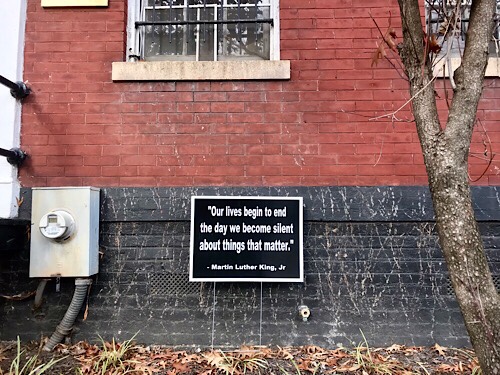
    We tend to think of giving our lives in terms of willingness to die, but is not any life lived in accordance with dharma a life dedicated to the service of what is greater, one in which we abandon gratification for aligning with a higher purpose?

    Peace and light, E — Posted with WordPress for BlackBerry.
Leave a Reply

Your email address will not be published. Required fields are marked *

This site uses Akismet to reduce spam. Learn how your comment data is processed.