Yesterday’s State of the Garden (Before Andrea)
Tonight in the moist tropical air of Andrea and her wake, the garden is outrageously blowsy. It will be a marvel when the sun heats it up again.


Tonight in the moist tropical air of Andrea and her wake, the garden is outrageously blowsy. It will be a marvel when the sun heats it up again.
For example, I am not concerned with the risk of being filled up by Satan (that’s Satan with a capital “S”) because of practicing yoga. But I am deeply concerned that the people quoted as making such warnings are seeking or are in positions of power. Thanks to my friend D. for sending me the link to this article.
What do we mean, exactly, when we say a thing is “by” someone? Yes, we are attributing the thing’s creation to that someone. But how is something just by us when it is based on all the input and teachings to which we have been exposed or immersed? How do we give credit when it is due? How do we honor and acknowledge what has influenced us? When is attribution called for?
The yoga sages speak of the parampara, the lineage of teachings. For some the lineage is just that: a linear chain passed on from one generation of teachings to the next, and the attribution is clear. Those in such lineages or who would lead one of their own making often teach that one should pick one path (one style of yoga/meditation) and stick with that form or teacher to succeed (with the mythic goal of enlightenment).
From my unattained perspective, I question who is to say how “enlightenment,” assuming it is indeed something that can be achieved, would or could or should be attained by anyone else? Practice tips for enhancing the experience of human embodiment (is that not the real path?) are nice, though.
I do not know the Elizabeth who drew on the sidewalk. She is quite possibly about the age I would have been when I first read (not saw the movie) Mary Poppins and dreamed of entering another world through a chalk drawing on the sidewalk.
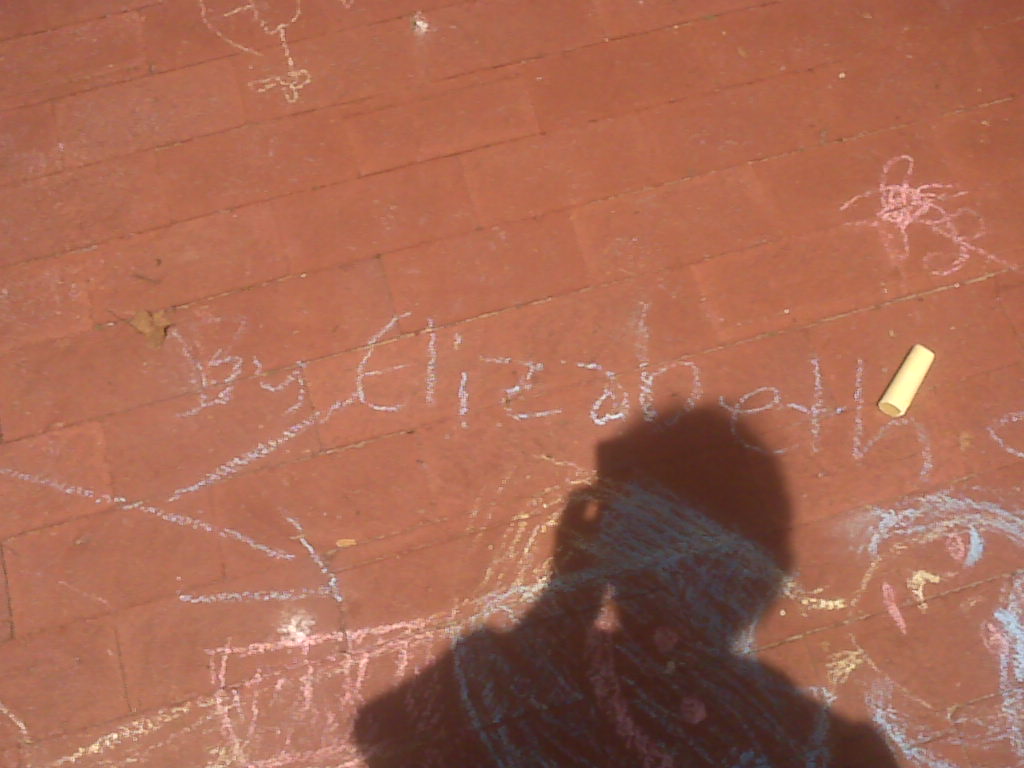
Peace and light, E — Posted with WordPress for BlackBerry.

Peace and light, E — Posted with WordPress for BlackBerry.
Dear Friends,
I hope you are thriving to the greatest extent possible under your current circumstances in this outrageous Spring and weathering (pun intended) the wild fluctuations between apparent late winter and seemingly already mid-summer. My garden has been uncertain at several moments, but partly due to careful attention at strategic points and partly out of love and luck, it is thriving–providing lots of herbs and greens and promising lots of tomatoes and peppers and beans.
I write this letter a bit later than might have been desirable, as the summer session at Willow Street has already started, and my partial sabbatical from yoga teaching evidently has begun. In practical terms of time and space this is the first time in almost eight years that I am not working weekends (first Saturdays and then Friday evenings) and commuting out to Takoma Park from Capitol Hill to teach.
It took much contemplation to come to this partial sabbatical. Being a part of the Willow Street Community has been and continues to be important to me, and I have learned an incredible amount from the opportunity Suzie Hurley, and Joe and Natalie Miller, gave me to share my enthusiasm for the practices and the teachings with the fabulous variety of people who come to Willow Street as students. It was an honor and a continuing source of inspiration and focus to be able to study with so many fine fellow teachers over the years. And change can be hard for me. It also is hard to let go of something that has been profoundly important.
For my optimal health and well being, though, there just was not enough time for me to work full time and go where my heart is currently leading and also continue to teach on Friday nights or Saturday mornings. I had to make a shift or start fraying around the edges, becoming less happy with everything. Better to make some space to breath and feel and think without pressure. Freeing my weekends fully will give me some of the space and time that I need at this crossroad in my life. I am moving, I hope, towards a phase where there is more emphasis on nurturing self and relationship more deeply and exploring other creative pursuits with more seriousness. To be able to work intelligently and with good will as a civil servant at this time and to continue to engage in our society that is in so much upheaval, leads me, for my abiding health and expansion, to the garden and the cat and my own practice and the growing and very special relationship that began on the trip to India (no value judgment implied by the order). It also will be lots easier for me to study; going to a weekend workshop will no longer require my getting a substitute to cover my absence–expect to see me as a fellow student at the Friday nights of weekend workshops at Willow Street. New ideas and opportunities for teaching will likely come, but not for the moment.
I continue to lead the all levels yoga practice at William Penn House on Tuesday nights where you will be warmly welcomed by the regulars whatever your age or ability level and will be sure to enjoy the fruits of my new and varied explorations in yoga and other practices, while still keeping to the fundamental structure of class influenced by Anusara methodology. Please join us. A portion of each student’s payment supports the work of William Penn House. While there is a suggested amount, if funds are a challenge, just pay what you can.
Feel free to e-mail me if you are a more experienced practitioner who is interested in the Wednesday night practice or if you are interested in arranging private sessions or semi-private practices with your own small group.
I look forward to seeing those of you who are local on a Tuesday night or at a workshop around town or in the neighborhood and also continuing to share photos and contemplations on this latest phase of my yogic (yes, I know that isn’t a real word) on the blog.
Peace and light,
Elizabeth


Peace and light, E — Posted with WordPress for BlackBerry.
I cannot tell you whether the food is tasty or healthy or authentic, but something felt good about this truck that was at Eastern Market today.
Please comment if you’ve tried it.

Peace and light, E — Posted with WordPress for BlackBerry.
Sprout brown lentils for 2-3 days and use while just showing sprouts.
Cook one or more types of whole grain rice (here a mixture of red and brown rice) (I like to use a rice cooker).
Let rice cool. Mix rice with lentils.
Add some oil to keep the rice a good texture. I used sesame oil. You could use the oil recommended for your Ayurvedic type if you are familiar with the recommended oil for your type. Though this does not really resemble traditional kitcheree, the basic/unprocessed elements of the dish –the mixture of rice and lentils and the spicing — are the same.
Add a mix of spices. Here, too, you could vary the spicing according to your dosha if that is something with which you have experience. I used turmeric, ginger, clove, black pepper stirred into the salad mixture and then minced some green coriander seeds from the garden to sprinkle on top. I think a squeeze of lemon, had I had it, would have added extra zest.
Serve the salad on delicate, freshly picked greens–spinach and baby chard would be good, though I used lettuce because it was what needed most to be harvested.


Peace and light, E — Posted with WordPress for BlackBerry.
Last week I took a lovely all-levels yoga class where the emphasis was on fully engaging in the practice rather than striving to achieve a particular outward notion of what the poses should look like.
Near the beginning of the class, but after the emphasis on not striving had already been discussed, the teacher said that the ideal form in uttanasana — standing forward fold — for classical hatha yoga is with the feet together. But, he said, however, he said, but not, the teacher explained, if your back is curved like a “c” in the pose, and your lumbar vertebrae are higher than your sacrum. In that case, you want to take your feet wider apart or you will strain or injure your low back.
As I was fully into the pose, I could see the rows of students behind me. At least two fellow students in my immediate line of sight, promptly put their feet together, even though they had tight hamstrings and bulging lumbar spines and were clearly pushing themselves hard to get their fingertips to the floor. As soon as the word “ideal” was uttered, they could not hear the caution or could or would not apply it to themselves.
The evident intent of the teacher in his exposition of the pose was to give an example where the “ideal” form is most certainly not ideal and will not further the reasons we practice asana. But for so many in this society, striving is such an ingrained way of being, that yoga class can become just another way to achieve.
It was useful for me to witness how carefully one must teach to high achievers this principle of the “ideal” being what suits and not what will win accolades. How do we teach (and learn) the practice of goalless goals, of enjoying working for fitness (of the mind, body, and emotions) without pushing and striving? I’m pretty sure that invoking the principle of actionless action from the Bhagavad Gita would not have made a difference here. It seems a shame to think that the only way to protect all the students’ backs is never to mention the classical form of the pose, and to have to tell all the students (especially in a big class) to have their feet apart (or some similar alignment rule)for protection of the few who do not (or are not yet ready) to hear the whole lesson.

Peace and light, E — Posted with WordPress for BlackBerry.