Similar Posts
What Grows in a Very Small Space (and living freely within limitations)
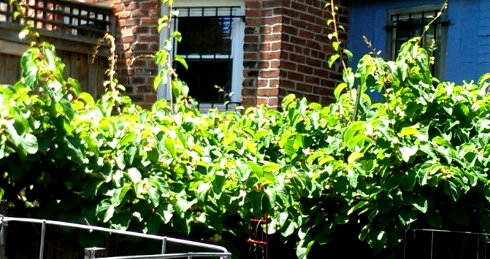
Sometimes when I am blogging about my garden — the joys I experience and its wonderful produce — I feel like I might be presumptuous. I am no Christoper Lloyd or Alice Waters. I just have a tiny space behind my urban, rowhouse that I have turned into a personal celebration.
A visitor from out of town graciously commented that in some ways the limits of my garden make it even more wonderful. In this sense, I know, perhaps best, from my garden the yoga teaching that ultimately to find freedom in this life we need to celebrate all we are within our limitations to find an inner space of unbounded, liberation.
(Shown here, cucumbers, mint, nasturtiums, peppers, greens, sage, savory, basil, okra, onions, more peppers, red and yellow cherry tomatoes (well picked), brandywine and roma tomatoes, eggplant (slow to start this year), echinacea, lavender, orchid.)


State of the Garden
One of the little orchids from Trader Joe’s had a baby orchid when I wasn’t looking. It’s hard to imagine that it’s almost time for the tropical plants to start coming inside.

Gardening When It’s Not Quite Time (and Sauca)
The first of Patanjali’s niyamas (part of the ethical precepts that are precursors to the practice of asana, pranayama, and meditation) is sauca — purity or cleanliness. The practice of sauca includes in it a literal exhortation to be physically clean. I think it also carries with it a sense of order, a cleaning out of physical, mental, and emotional clutter, so that we have more clarity. When we find more clarity, we can be more in the flow with the inexorable sequence of time and space.
Experiencing how we fit into the pulsation of time and space is one of the exquisite joys of gardening. This time of year, avid gardeners are eager to get int the garden, and it is tempting to get started to soon, to start new things without cleaning out the old. When we are more experienced (and know better the optimal sequencing of starting the garden with the shifting of the seasons), we also know that we might have gotten a few days in the 50s F, but it is still winter.
Emphasizing the practice of sauca now will serve the whole gardening season. When it is still cold, but the heart yearns for the garden, is the time to be planning, reorganizing, and cleaning to get ready for the days when it will stay warm enough for growing outside a cold frame or protected area. As I use a lot of containers, now is the time for me to see what containers need repairs, removal of perennials that did not make it through the winter, and new soil. It is the time to prune what is better pruned now than in the fall. This is not just trashing everything, but seeing what should be preserved, what should be repaired, what should be cleaned, and what should be discarded or given away. It is cleaning out what gets in the way of an optimal flow of energy to experience the greatest effulgence of nature. By practicing the cleaning and clearing out phase with intention and enthusiasm, I am present with the garden and also in sequence with the light and the temperature. In this way, just as I am when I practice these principles on the mat, I get the bliss of yoga.
How Do You React? (and Dharma)
How do you react when you see signs of neglect, disinterest, disregard for the health and well-being of the earth and other beings? Do you get stuck in a sense of helplessness or rage? Do you think we’re all screwed anyway and decide no effort to make things better is worth it? Are you moved to political action? Are you moved to take better care of self, family, and friends, even if you think you cannot make much of a greater impact beyond your intimate circle? Can you remain engaged and still find joy, whatever the apparent immediate results and how hard the battle seems to be?
The Bhagavad Gita, says that to live a life of yoga, we must do the last of these. The first teaching from the Bhagavad Gita on this point is that we must live in accordance with our dharma (duty). The second teaching, and more important for having peace of mind in a life of duty, is that of “actionless action.” The true yoga is to live a life of action in accordance with dharma, but without attachment to the outcome (i.e., live in an orderly way, accepting the tendency of the universe to be chaotic).
Dharma in the Bhagavad Gita, of course, contemplated rigid roles in terms of livelihood and place in society. In the paradigm of citizenship in a democracy that does not so narrowly circumscribe one’s livelihood or place in society, I wcould argue that it is all of our dharma to participate as a citizen, voting, speaking out for our beliefs, and otherwise using the freedom we have to live a life that best supports the twins of individual and common good, including not just human good, but the whole ecology in which we exist. The actionless action part is to keep seeking (without despairing) to make things more in alignment even if the forces against healing, nurture, and alignment seem to conspire against positive results that we will see or actualize ourselves.
Are you registered to vote? Have you watered your trees? Casey Trees reminds us that this week in DC is dry; trees need about 25 gallons of water or 1 1/2 inches.