| | |

Thoughts on Attribution and Lineage

What do we mean, exactly, when we say a thing is “by” someone? Yes, we are attributing the thing’s creation to that someone. But how is something just by us when it is based on all the input and teachings to which we have been exposed or immersed? How do we give credit when it is due? How do we honor and acknowledge what has influenced us? When is attribution called for?

The yoga sages speak of the parampara, the lineage of teachings. For some the lineage is just that: a linear chain passed on from one generation of teachings to the next, and the attribution is clear. Those in such lineages or who would lead one of their own making often teach that one should pick one path (one style of yoga/meditation) and stick with that form or teacher to succeed (with the mythic goal of enlightenment).

From my unattained perspective, I question who is to say how “enlightenment,” assuming it is indeed something that can be achieved, would or could or should be attained by anyone else? Practice tips for enhancing the experience of human embodiment (is that not the real path?) are nice, though.

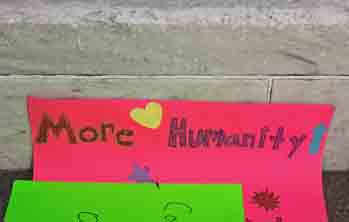
I do not know the Elizabeth who drew on the sidewalk. She is quite possibly about the age I would have been when I first read (not saw the movie) Mary Poppins and dreamed of entering another world through a chalk drawing on the sidewalk.

Peace and light, E — Posted with WordPress for BlackBerry.
Similar Posts

  • | | |

    Love Magic/Magic Love

    image

    I looked at these words hanging together and thought I wasn’t quite certain what was intended to be said.  Consider:
    Read from top to bottom or try it out from left to right.
    Put in a comma or an exclamation point.
    Just an period or perhaps two.  Omit punctuation entirely.
    Think of all the meanings of both words and mix them around with various punctuation marks.
    What about a question mark (or two)?
    Then stop all that and just let meaning come to you.

  • | |

    Snowdrops and Crocuses (and Spanda)

    Snowdrops have been showing up for more than a week, but crocuses?  They seem a little incongruous with the bitter winds and as much a reminder of global warming as of spring.  I feel a bit confused seeing them, though delighted.

    It has been a good winter.  I have learned to appreciate the cold and dark, which gives us time to enjoy the pleasures of home and introspection.  Now, I am looking forward to spring, the effusive colors, the warmth, the ability to get back out into the garden.

    This time of year, with the radical contrasts of cold winds and flowers does highlight the play of opposites, the very pulsation of existence — in yoga terms, the spanda.  This time in society seems to have a similar play of bitterness and sweetness.  Staying steady with our yoga practice and our community, we can delight in what we see and what we have, even as we may be worried and working for change.  That too, is part of the play (lila).  To invite in a steady warmth and support from our practice and our community, even as we see difficulties and challenges, want things to be different, and know that our work may not necessarily bring about the change we seek.

  • | | | |

    Balance of Stability and Freedom

    Last night, we were talking about the parameters of cultivating a steady and fruitful meditation practice, and Paul Muller-Ortega suggested that it was about the balance of stability and flexibility. He had learned the principle from a different source, but I have contemplated and explored the principle in depth from teachings I have received from John Friend.

    A critical aspect of the Anusara alignment principles is to find the perfect balance of stability and freedom. We need stability to stay fully and safely in each pose. We need freedom to achieve the fullest and most delightful expression of the pose.

    We find the stability both by making certain that we have established our foundation (which is an aspect of the first principle of opening to grace). By then using the three aspects of muscular energy–hugging the muscles to the bone, drawing into the midline, and drawing energy from the periphery to the focal point, we make possible an expansion of our edge, whatever that might be. Having a solid, aligned foundation and affirming our very core with these actions, gives us security and balance. We also want to reach out, to be playful, to expand to our fullest, which we do using the expansive, outreaching organic energy — from focal point to the periphery, from the midline to our outer edges, from the very marrow of our bones through bone, muscle, skin, and beyond.

    If we over-emphasize (including natural inclination) stability, then we can get stuck. If we just let ourselves be free, then we end up all over the place. When these elements are perfectly balanced, we can safely find our deepest freedom of expression.

    When I teach this principle as the focus of a class, I always invite my students to think of how important the balance of stability and freedom is for every aspect of our lives.

    The discussion last night put this principle in the context of the regularity and steadiness of our practice, with the recognition that to stick with our practice, we will sometimes need to vary the time or amount of our practice, or what elements are included in the practice.

    To get the fullest benefits of a practice (this applies to any practice and not just to meditation), we need to show up consistently and to practice in accordance with how we have been taught. To stay steady, though, we need to give ourselves the permission or freedom not to show up, or within appropriate parameters, to modify the practice when life gets in the way of what we think would be the ideal practice. If we think we have to do things at the exact time and place every day in a perfectly precise way, we become rigid. On the other hand, if we are loosey-goosey about it, then we do not have much of a practice and will not realize the benefits that we could get.

    Where in your practice or life would more stability and steadiness give a field for greater freedom and happiness? Where could you give yourself a little more flexibility so that you feel that steadiness brings the possibility of joy, rather than tying you down?

    Peace and light, E — Posted with WordPress for BlackBerry.

Leave a Reply

Your email address will not be published. Required fields are marked *

This site uses Akismet to reduce spam. Learn how your comment data is processed.