Author: Elizabeth

  • | | | |

    Reminder–No Class Tuesday July 2nd (and Svatantriya)–Web Version of E-Mailing

    Dear  Friends,

    Just a friendly reminder that there’s no practice at William Penn House or the house next week.  I’ll be off exercising the civil liberties currently available by traveling with my beloved to upstate New York to participate in tantric yoga philosophy camp (I know that’s not everyone’s idea of fun, but for those of us who love philosophy, it is quite wonderful to have found a group of people mostly outside of academia who truly relish such a conversation).  An afternoon and dinner in the City and a visit with my sister and brother-in-law who are only an hour out of the way will further emphasize just how much freedom I have to come and go and to gather in groups and talk and write.  For me to be going on such a vacation was partly good fortune and partly a lot of hard work and partly my balancing many conflicting desires, needs, aims, and possible outcomes, shaped by both the freedoms and strictures of this society.

    With regard to the strictures, I’ve seen and experienced just enough work-place harassment and discrimination and scholarship student financial struggle and their impact on my well-being to know that, as many challenges as I have faced, life can be far more burdened and limited by hardship and challenge.  I know from what was given to me and what was denied or only came after much hard work, how important it is that we make the safety nets of education, health care, housing, nourishing and tasty food, and a healthy ecology for all in our society.  I go on these trips to study philosophy or to practice yoga or to surround myself with beauty and flavor not ignorant of how much I have and how much it depended on scholarships and a decent public education and student loans and millions of women (and many men) before and with me seeking autonomy and meaningful choice as to how to live their lives and care for their bodies.

    I head out on vacation because I need both rest and inspiration, but I go knowing how much there is to be done at this, as Marge Piercy called it, “cruxtime.”  I go to study and talk, not just for anticipated pleasure, but also with the intention to open up new insight on how, since participation is unavoidable, to navigate more skillfully this volotile time in human history.

    I wish you a holiday week in which you are able recognize and experience your truest freedom–even if it is just the freedom of how to respond in the face of outrage or crisis or tragedy–and invite you to come join us for yoga some Tuesday night at William Penn House (click here for info) or the house practice on my return to nurture your body and join in community and conversation.

    Peace and light,

    Elizabeth


  • | |

    Yoga Ideas Best Put Aside

    I just received a yoga email advertising classes and workshops that quoted a well-respected teacher as saying not to  listen to your mind and to listen only to your heart.  I respectfully disagree.

    I do believe that if we listen (listening in the deepest and broadest sense)  only to our mind, we lose connection with body and emotion, which can lead to ill health and unhappiness.   I also believe that individual consciousness is more than mind and includes bodily and emotional awareness as well as brain function and that one of the salutary aspects of yoga practices is to expand our capacity to be aware beyond thought and mere processing of sense perception.

    But to listen only to our heart is to be empty-headed, to be without discrimination (viveka), and also presumes that we can process and act on what is in our heart of hearts without using our minds.  To dismiss our mind as somehow not being a source for deep listening also defies the tantric yoga notion that all is an essential part of being, of consciousness, of the source of inner bliss (Satcitananda–being, consciousness, bliss).  Why would we have minds if we weren’t meant to use them?

    Want to be a fully engaged yogi who lives in the world?  Go ahead:  cultivate, educate, enlighten, and use your mind.  Just do it with an open heart and ever expanding sensitivity and awareness of all your being and all that is around you!

    2013 06 22_0166

  • | | | |

    Yes, I Knew Him (and the Maha Mrityunjaya Mantra)

    When my students arrived at William Penn House last night for class, I said, “yes, I knew him; they are both my co-workers.”  I didn’t need to say anything else.  All of them read the Washington Post and know that I work for the Department of Labor in the area of pension benefits.  I said that I was shaken by the news, and I would offer the best practice I could.  At my invitation, we worked on grounding, being heavy in the best meaning of heavy so that we would feel the stability to rise and to stay graceful and open as we practiced some challenging standing poses and backbends, leading to a modified version of natarajasana (dancing in the cosmic fire).

    One co-worker is dead (either suicide or murder in his jail cell) after having severely injured another.  Yes, we all worked in the same office for three years when I first started at the Department in 1991 and episodically have worked on common projects for almost 22 years, most recently just three weeks ago. Had it been a fatal accident or a heart attack, a few dozen of us would have been at the funeral and spoken of what we liked about him.  It wouldn’t have been the horrified questioning ourselves and each other of what possibly could have gone so terribly, shockingly wrong.  The grieving and sense of loss are no less present and real, though, for the recoiling from his last acts and the salacious and rapacious local media coverage.

    Quaker practice has me holding those affected in the light–he and his family and she and hers, and our co-workers.  On hearing yesterday that he had died in jail, I was moved to chant the maha mrityunjaya mantra.  I was taught that chanting this mantra every day for 30 days can help a spirit cross-over.  What is spirit and to where it might be crossing was not really explained because how could it be?  But I do think chanting with such an intention can be a useful tool to help focus one’s own emotional process and healing in connection with a death.

    For some background on the mantra, you might want to start with this overview with useful links published by the Himalayan Institute (be advised that though citing to the YI because of the breadth of coverage, to get to the basic details, I needed to ignore the cheesy graphics and the use of the term “Lord” before Shiva in the linked article on what the author says are appropriate uses of the mantra).

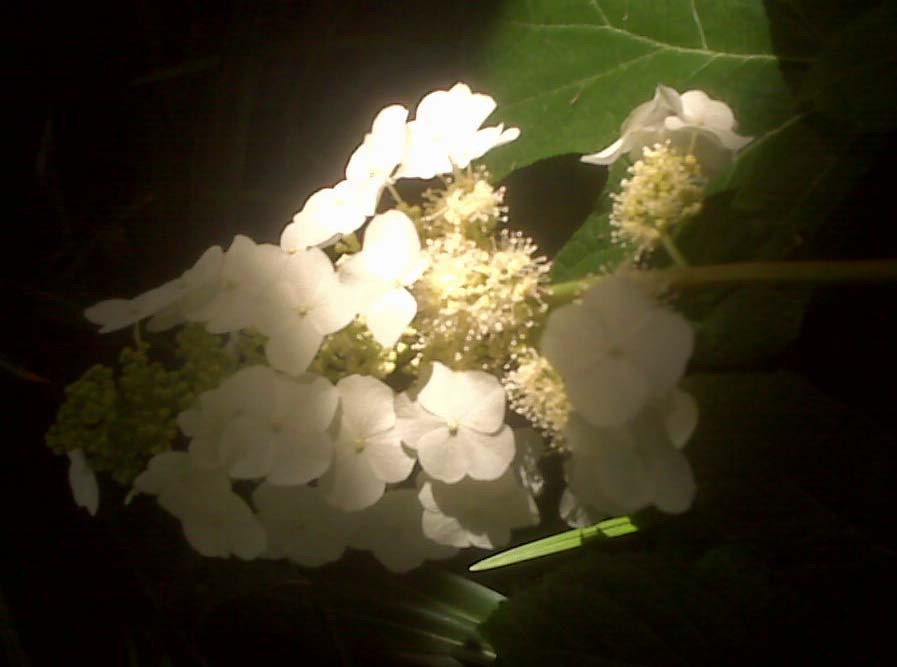
    oakleaf hydrangeaMy co-worker gave me this oakleaf hydrangea about 10-12 years ago; his brother had pulled an extra seedling that was an offshoot  from a larger plant in his yard.  It did not start thriving until two seasons ago when I moved it to a different corner of my front garden.