Similar Posts
How Do You React? (and Dharma)
How do you react when you see signs of neglect, disinterest, disregard for the health and well-being of the earth and other beings? Do you get stuck in a sense of helplessness or rage? Do you think we’re all screwed anyway and decide no effort to make things better is worth it? Are you moved to political action? Are you moved to take better care of self, family, and friends, even if you think you cannot make much of a greater impact beyond your intimate circle? Can you remain engaged and still find joy, whatever the apparent immediate results and how hard the battle seems to be?
The Bhagavad Gita, says that to live a life of yoga, we must do the last of these. The first teaching from the Bhagavad Gita on this point is that we must live in accordance with our dharma (duty). The second teaching, and more important for having peace of mind in a life of duty, is that of “actionless action.” The true yoga is to live a life of action in accordance with dharma, but without attachment to the outcome (i.e., live in an orderly way, accepting the tendency of the universe to be chaotic).
Dharma in the Bhagavad Gita, of course, contemplated rigid roles in terms of livelihood and place in society. In the paradigm of citizenship in a democracy that does not so narrowly circumscribe one’s livelihood or place in society, I wcould argue that it is all of our dharma to participate as a citizen, voting, speaking out for our beliefs, and otherwise using the freedom we have to live a life that best supports the twins of individual and common good, including not just human good, but the whole ecology in which we exist. The actionless action part is to keep seeking (without despairing) to make things more in alignment even if the forces against healing, nurture, and alignment seem to conspire against positive results that we will see or actualize ourselves.
Are you registered to vote? Have you watered your trees? Casey Trees reminds us that this week in DC is dry; trees need about 25 gallons of water or 1 1/2 inches.
Walking and Shopping in the Neighborhood (and brahmacharya)
Yesterday afternoon when I came home from teaching I wanted to be out for a walk in the neighborhood more than I wanted to be alone in the garden, but I also wanted to be serving the garden. I combined the two by walking the ten blocks to Gingko Gardens — our wonderful Capitol Hill nursery. It is a little more expensive than some of the nurseries out in the burbs, but I know the owner and have friends in common, I always bump into neighbors when I am shopping there, and they are experts in what grows and works in our little urban gardens. I was thrilled when they opened a number of years ago and want them to continue to thrive, so I make a point of shopping there. I bought some seeds and some planting medium for starting seeds indoors and ordered a few containers and organic potting soil for delivery.
In addition, after having done a bunch of research on rain barrels over the week, I also asked whether Gingko would deliver and install rain barrels from Aqua Barrel, which is located in Gaithersburg. Answer, “yes.” (For those of you in the suburbs, Amicus Green also carries and installs them). It took me a long time to assess what style barrel would work for me and where it should be placed. I was hoping to support a local manufacturer to cut down on wasteful transportation. I also know that given my circumstances it is critical that it be installed correctly with a good diverter system. It is good for me to do the research but then bring in a professional to make sure it is right. I made an appointment and am looking forward to being able to align a little better with nature (by using rain water run-off instead of scarce, potable water for the garden) and to support the neighborhood (by buying locally and hiring resident professionals). And I bumped into a fellow yogi and gardener while I was shopping; inspired by the chat, she, too, made an appointment to discuss rain barrel installation.
To me, this is one way of bringing yoga off the mat. One of the key principles in Patanjali’s yoga sutras is the practice of brahmacharya, which literally means aligning with Brahma. The classical translation is celibacy. Many modern translators substitute “moderation.” This way of living, is of course, moderate. It is living a western lifestyle on the grid, but choosing to consume in a way that supports friends, neighbors, and manufacturers who use recycled materials to create products that will help us all to be a little kinder to the environment, while nurturing my home and self.
A Hallway
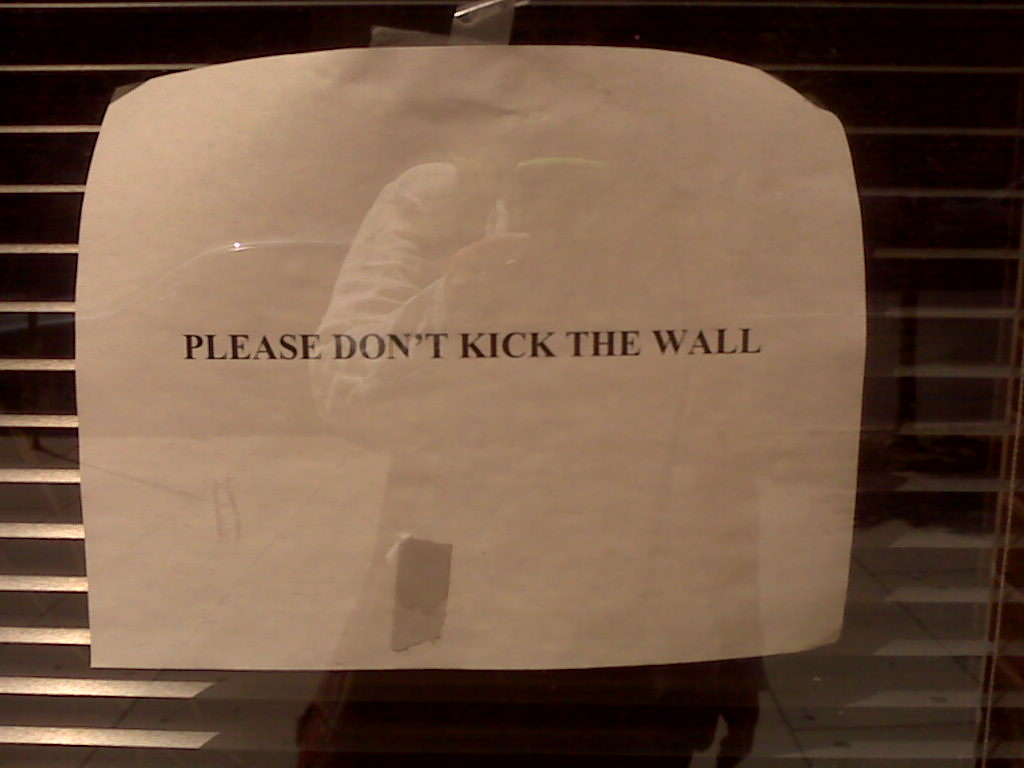
Sometimes, the healthiest way to address one’s environment is:
1. Accept what one cannot change;
2. Cultivate a sense of humor;
3. Know that going inside to witness the pure beauty of inner awareness is always available.- Asana, Pranayama, and Yoga Practice | Food for the Mind (Yoga Philosophy, etc) | Meditation | Photos
Gates and Gateways (and Ganesha’s Exhortation)
A gate might be an obstacle or it might be a way through or it might be that which is containing something that would otherwise be detrimental to our well-being. One of the key things that we do with the various yoga practices is explore how an apparent barrier is serving us or how a locked gate might turn our path in a more auspicious direction.
We will learn little and live less fully if we just lament the locked gate and unreasonably expect from the practices the removal of challenges or barriers. Ganesha–who is often invoked as the remover of obstacles–is less one who just opens all the gates for us than one who empowers us to discover gateways regardless of whether gates are meant to stay locked or whether they seem to block our path.