| |

Spiced Rice and Sprouted Lentil Salad with Chiffonade of Leaf Lettuce

Sprout brown lentils for 2-3 days and use while just showing sprouts.

Cook one or more types of whole grain rice (here a mixture of red and brown rice) (I like to use a rice cooker).

Let rice cool.  Mix rice with lentils.

Add some oil to keep the rice a good texture.  I used sesame oil.  You could use the oil recommended for your Ayurvedic type if you are familiar with the recommended oil for your type.  Though this does not really resemble traditional kitcheree, the basic/unprocessed elements of the dish –the mixture of rice and lentils and the spicing — are the same.

Add a mix of spices.  Here, too, you could vary the spicing according to your dosha if that is something with which you have experience.  I used turmeric, ginger, clove, black pepper stirred into the salad mixture and then minced some green coriander seeds from the garden to sprinkle on top.  I think a squeeze of lemon, had I had it, would have added extra zest.

Serve the salad on delicate, freshly picked greens–spinach and baby chard would be good, though I used lettuce because it was what needed most to be harvested.

sprouted kitcheree salad

Similar Posts

  • | |

    Knowing Your Garden (and svadyaya)

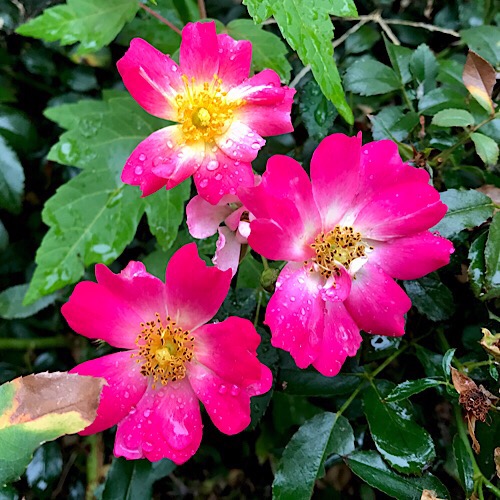
    This will be my 20th season in my garden.  I know that my back garden — where I grow my herbs, flowers, and vegetables —  is easily 4-5 weeks earlier than the gardens of my friends’ in Potomac and Silver Spring and the outer suburbs.  It is even almost that much earlier than my front garden.  I have a brilliantly sunny, south-facing, protected back garden with a brick patio that is against an unpainted brick house and a densely shaded, north-facing front garden.  Not only is the back garden sheltered from the wind by the house on one side and the fence on three sides, but the bricks retain enough heat to change the temperature by a a couple of degrees.  I have a special micro-climate.  My climbing rosebush (pictured in the header) is already in leaf.

    What does this mean?  While my friends in the suburbs or those with east/west facing houses are starting seedlings for kale and spinach indoors, I can put seeds into outdoor containers in the next week or two without compunction.  The seedlings I would need to start (if I don’t instead choose to purchase them from the organic farmers at the market) are peppers and tomatoes for planting in mid-April.  If I start with strong 8″-12″ plants in mid to late-April (depending on the 15-day forecast), I can have and have had for at least 10 of the past 20 years, cherry tomatoes in May and peppers in early June.  My greens, obviously, bolt earlier.  I’ve figured out that certain varieties of chard do better in these conditions, and that spinach and lettuce do better sheltered by the fence where they get afternoon shade, so that I can have them farther into the season.

    This kind of knowing by combining general book and teaching knowledge with personal observation of my little space, is much like the yoga practice of svadyaya (self-knowledge), which is the fourth niyama of Patanjali’s yoga sutras.  Svadyaya is literally study of the self through the scriptures.  Implicit in that is the guidance of a teacher or guru.  Ultimately, though, self-knowledge or awareness must be experiential.  We make the effort to study and we listen to our teacher, but then we practice.  We soften and open to who we (or our garden) truly are — another way of practicing and experiencing the Anusara principle of opening to grace — and then in the context of the teachings, accept who we are.  As gardeners, that means accepting what zone we are in, how much shade, water, space, and sun we have.  As yogins, it means accepting our strengths and our limitations.  We can shift our zone by treating certain plants as indoor/outdoor or as annuals rather than perennials; we can enhance our water flow by storing it in rain barrels, but that is merely expanding the edge rather than making a complete change.  We can expand the edge of our practice, but still need to accept the bodies with which we were born.

  • | | | | |

    A Flash of Abhuta

    I contemplate (practice bhavana on) the yoga principle abhuta (wonder) on a fairly consistent basis. When we can find wonder in sheer miraculous diversity of manifestation, we can enter a space of joy whence we can more likely respond in the highest.

    This afternoon, perhaps because I have so recently gone on a practice intensive, I experienced a spontaneous uprising of delighted wonder on receiving an email that would otherwise cause me some consternation and annoyance. Instead, my first reaction was, “My goodness! Another one just like the others, but still new and different! Amazing how that happens. And now I will have to respond.”

    I felt that way again as I joined the rush hour crowds on my way from work to go lead the restorative class at Takoma Park. (If you’re in town, drop-ins welcome. Thursdays at 8pm at Willow Street Takoma Park through the end of May).

    Peace and light, E — Posted with WordPress for BlackBerry.

  • | | | |

    A Happy Life is an Engaged Life (and Sadhana)

    I have spent most of my life practicing one thing or the other.  What attracts me about practicing in the sense of complete absorption that it brings.   For a time, the absorption can be enough.  Ultimately, though, the absorption should bring joy.  I do not really think that it matters what it is that one is practicing as long as steady engagement brings a sense of inner peace and bliss that enables one to be kinder and to offer service in some way.  I have quit some things along the way either because the practice did not bring enough joy or fulfillment or the practice was detrimental to my nature.

    I know yoga and meditation are the right for me at this point in my life because sadhana (practice) continues to brings me ever increasing delight.  I do not think of practice as work (though sometimes I need to use some self-discipline to remind myself to practice), but as an invitation to greater depth and understanding of not only the practice, but myself.

    I have friends for whom the right practice is not yoga, but something else — a visual art, music, law.  It is not what one does, but how one does it, and whether it brings a sense of fullness to life, a satisfaction with the engagement in the doing, rather than in what the doing achieves.

Leave a Reply

Your email address will not be published. Required fields are marked *

This site uses Akismet to reduce spam. Learn how your comment data is processed.