Asana, Pranayama, and Yoga Practice | Food for the Mind (Yoga Philosophy, etc) | Meditation | Photos
Para, Apara, Para Para?

Peace and light, E — Posted with WordPress for BlackBerry.
Peace and light, E — Posted with WordPress for BlackBerry.
This morning is the last Saturday in the foreseeable future when, even waking up before dawn, I have to cut short my morning practice to get on the metro to go teach. I have a strong memory of a relatively novice teacher telling me, before I started teaching, that she was going to stop teaching indefinitely because she needed more time for her own practice. At times over the years, when my other job was at its most demanding, I would think about that statement. Mostly, though, I have circumscribed other activities to fit in time for work, teaching, and a full practice.
It came time to admit, though, after nearly two years of steady study with 0Paul Muller-Ortega, which expanded my meditation practice from 25-30 minutes a day, in addition to asana practice and studying, to an hour a day plus additional practices and more studying, that there are not enough hours in a day for all I want to do.
I have been teaching on Saturday mornings for a number of years now. I love my Saturday morning students and have embraced the discipline of getting to class to teach.
The energies have shifted. I will still teach my noon class on Saturday and my weeknight classes, but I will have more time for a full practice and perhaps some extra garden time from this shift. I expect that this time to deeper into my own path will bring new energy and light to my teaching. I hope trust I will see my Saturday morning students at other classes and workshops, both when I am teaching and taking class together at Willow Street.


Peace and light, E — Posted with WordPress for BlackBerry.
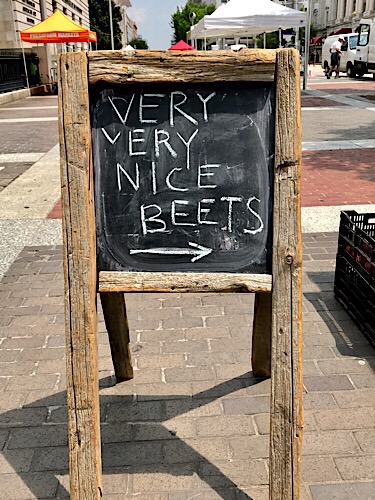
On my way back to the office after lunch with a friend. The beets weren’t yet on display–farmers were just starting to set up for the afternoon market in Penn Quarter–but there were some beautiful onions, tomatoes, and peaches.
The tantric yoga philosophy ascribes the characteristic of svatantriya or ultimate freedom to the energy that infuses all of us. We all want to be free, but when we get stuck in our embodiment, forgetting that we ourselves are manifestations of spirit, then we lose sight of our true freedom. To find our own freedom of spirit, we need to be disciplined, to practice, to study, to live in a way that brings us into better alignment with ourselves and world with which we are inextricably interconnected.
In this country, one of our principle ideals and buzz words in dialogue about how we should live is freedom. What can so often be forgotten in this dialogue, though, is that freedom is a contract. To be in a society where all have the opportunity to experience freedom, we need to agree, with discrimination (viveka) to certain limitations (for example, we agree to stop for red lights so that we can be free to drive and walk without a constant risk of being hit in crowded city).
Granted, I am grossly oversimplifying here, but part of the great losses of freedom we are currently experiencing is the abdication by individuals of the responsibility to shape the agreement to maximize our collective freedoms. Like the agreement with ourselves to practice steadily to experience inner freedom, we need to stay engaged, even when it seems impossible or deeply frustrating, in order not to lose sight of the ideal entirely. Here’s some information from FCNL on why it is important to lobby despite how fruitless an act it may appear to be.
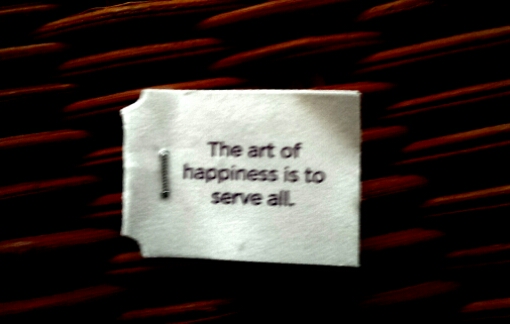
This morning, a friend suggested that if he took into account the needs of others when making plans, all he would be doing is serving others, and he would never get to do what he wants. “Why would I want to do that?” he asked.
I think that’s a common enough question in this society. By uncanny coincidence, the teabag I selected right after the question was posed suggested a possible answer.
As we are taught by the stories of the monkey deity Hanuman, whose main characteristic is a longing for devotion that he demonstrates (while still being utterly himself) through service (seva) cultivating mindful relationship is the highest service to our own self and not just to those with whom we are in relationship.
To take care of our selves can be done with consideration of others without sacrificing our own needs. The answer, I think, is in how we assess and balance our own needs. For me, when I consider the impact of my planning on others with whom I am in relationship as well as my own needs, for example, of freedom, autonomy, and personal delight, I am also considering my needs for companionship, mutuality, connection, and respect. If I completely privilege the former, I may be neglecting the latter and vice versa.