| | |

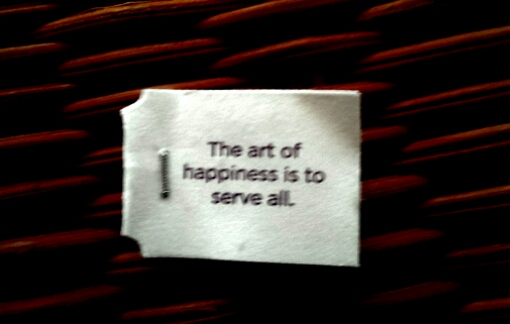
Message From a Teabag
image

This morning, a friend suggested that if he took into account the needs of others when making plans, all he would be doing is serving others, and he would never get to do what he wants.  “Why would  I want to do that?”  he asked. 

I think that’s a common enough question in this society.  By uncanny coincidence, the teabag I selected right after the question was posed suggested a possible answer.

As we are taught by the stories of the monkey deity Hanuman, whose main characteristic is a longing for devotion that he demonstrates (while still being utterly himself) through service (seva) cultivating mindful relationship is the highest service to our own self and not just to those with whom we are in relationship.

To take care of our selves can be done with consideration of others without sacrificing our own needs.  The answer, I think, is in how we assess and balance our own needs.  For me, when I consider the impact of my planning on others with whom I am in relationship as well as my own needs, for example, of freedom, autonomy, and personal delight, I am also considering my needs for companionship, mutuality, connection, and respect.  If I completely privilege the former, I may be neglecting the latter and vice versa.

Similar Posts

  • | | | |

    Each One, Reach One

    I went with a friend from volunteering at the youth garden yesterday morning to join with others to heighten awareness of the potential impact on the fabric of our fragile democracy of what the current Supreme Court decides in Moore v Harper, which was being argued.

    We got to talking to one of the fellow demonstrators. I had pictures of N (for more from N, see @blacklivesmattermemorialfence), from a previous demonstration relevant to voting rights earlier in the year. After we confirmed the connection, N asked me if I was a lawyer for the government; it turns out N also remembered that I had given directions and ended up walking a few blocks together to the gathering near the Capitol for the one year anniversary of the January 6th insurrection.

    We all talked about impact and whether it makes a difference if we only inspire a few people. I shared a story about one of the very few comments saying I had inspired being more politically active and outspoken in the yoga context. Maybe, I conjectured, it doesn’t matter if we only reach one person, because we don’t know who is that person and how they will be moved. N plans to make a t-shirt that says, “each one, reach one.”

    To whom will you reach out? What moves you?

  • | |

    Ether (the Mahabhuta akasha)

    Ether (akasha) is the fifth of the mahabhutas.  In science and perception, it is the space between the other elements, it is that in which the other elements reside.  It is to some degree, the critical element of how we are able to perceive the other elements.  I find focusing on the Anusara alignment principle of “open to grace” is the best way to experience the element of ether in myself.  By softening, opening, and inviting spaciousness, I can better experience the subtle elements and appreciate how it is that I experience them.

    The subtle elements or the panca tanmattras are smell (gandha), taste (rasa), form (rupa), touch (sparsa), and sound (sabda).  The subtle elements are not what we sense (which is composed of the mahabhutas) nor are the tanmattras our sense organs.  Rather the tanmattras are, as it were, the space in which perceptions arise, the ability to be perceived.

    The next sets of elements are the panca karmendriyas, the organs of locomotion, which correspond to how we physically move, digest, and change in the physical world, and the panca jnanendriyas, the organs of perception or cognition, which correspond to our sense organs themselves.  Our movement in and perception of the world bridges the physical elements, the perceptability of the physical world, and ourselves as physical beings, beings who move in the physical world, and beings who perceive the physical world.  All of this, I think of as needing space or residing in space.  As I consciously think of space giving a place for the world, my movement in it, and my perception of it, I become more conscious of consciousness.  The physical practice of “opening to grace” and experiencing the element akasha makes possible for me in my practice knowing or experiencing a greater consciousness.

    To start discovering your own understanding of akasha, try this meditation:  listen to the sounds beyond the room without trying to analyze or change them.  Appreciate how far in space your senses and consciousness can be.  Then bring your attention into the room and hear the sounds in the room.  Then open your ears to the sounds within you — your heart beat, your breath.  Then open to all the sounds (don’t try to change or analyze them), both those physically far away and those within your own body, and be aware of them as all residing within your own consciousness.  Appreciate that your consciousness is as spacious as the world around you and within you.  Rest in the space of consciousness.

    See whether spending a few minutes using this meditation technique helps you when your day has gotten too busy with work, errands, family or other demands.  I find it very helpful.

Leave a Reply

Your email address will not be published. Required fields are marked *

This site uses Akismet to reduce spam. Learn how your comment data is processed.