What An Exquisite Gift
To be able to see (and be grateful).

Peace and light, E — Posted with WordPress for BlackBerry.
To be able to see (and be grateful).
Peace and light, E — Posted with WordPress for BlackBerry.
Towards the end of a yoga session I start thinking about what would be a good theme for the next. I start by observing what is going on in the world — from the change of seasons, to whether it is rainy or drought, to what is going on in the political climate, noticing what is recurring in my own practice and the practices of my students, watching what is arising in my contemplations and meditations, and seeing what is resonating most in what I am learning from my own teachers. I will go into my library, reading and rereading things to see what resonates with what I am observing and experiencing. I also take into account the length of the session to be sure that it will fit well within the number of classes. Once I have set the session theme, I spend the week in which I will teach a particular principle, contemplating it, reading about it, practicing with it, and thinking about its relationship to my life off of the mat.
When I selected the tattvas this session it was for a whole array of reasons (some of which have been set out in previous posts). The order I picked to teach them, and which I chose to emphasize, were for what I thought would be the best way to share knowledge and experience and not for the outside calendar. It was then, by sheer serendipity that the themes fit as they did with the calendar:
Now this week, the last week of the session, parama shiva — the highest tattva. Shiva tattva is the most subjective principle and the most universal. It represents the essence of being (sat), consciousness (cit), and bliss (ananda). It is everywhere and nowhere, in all beings and not. It is whatever ever we think of as spirit or force or web of being or light or pulsation or divine — whatever we believe is the very essence of being. It is most interesting that by my series of contemplations and choices over the winter holidays, that I gave myself the homework assignment, as it were, to be specifically contemplating, practicing with, and studying the shiva tattva as I offer peace to Becky as she departs and seek my own peace in my grief over the loss of her physical presence.
In Paths to God, Ram Dass speaks of satgurus and upagurus. A satguru is the true teacher. The upaguru is anyone who teaches us something, which, when we are truly open to recognizing the good in all, is literally every one.
The satguru may refer to that within us that is the power, or the essential pulsation, or the light, or the illuminative wisdom, or the heart unbound by space and time that leads us to know the true Self. As such, the satguru unfolds the means to experience the love that the satguru is/experiences. The very rarest of individuals do not have to make any effort either through the various yoga practices (yama, niyama, asana, pranayama, pratyahara, etc.) or practices in another spiritual tradition to experience the fullness of consciousness unbound by self, or time, or space. The rest of us must engage in shifting our lives to align better with nature to experience the highest bliss of being. For this, we need teachers and we receive, if we are paying attention, teachings.
Sometimes a person will will recognize the satguru embodied in a particular human form, as Ram Dass has with Neem Karoli Baba. Sometimes, the teachers illuminating our journey are acharyas, great spiritual teachers who illuminate pathways and practices for finding the satguru within ourselves and in others. They are important teachers for many and a profound influence, but except to the extent that we are all the satguru, they are not “gurus,” nor do they hold themselves out as such. I think of my primary teachers–those I have studied with personally and a couple, like Ram Dass and J. Krishnamurti, whose writings have deeply shifted me–as acharyas. That they may have human foibles does not diminish the power of what I have learned from them and the joy I have experienced and shared from studying with them.
Other people we meet — all of them — are upagurus; we can learn from everyone and anyone. That is what Quakers are taught and seek to practice; that is what Ram Dass is offering for us to consider in both Paths to God and in more detail in Be Love Now. Sometimes we meet a stranger just for a moment, but the stranger in that moment exhibits such grace, that the stranger is one of our teachers for life. It is by being open and spacious that we get the opportunity to recognize those who have just one perfect teaching for us. When we are closed off, we can miss both teachers and teachings.
If we are open enough to seeing the light in everyone, we will also find that even those that trouble us can help us better respond in the highest. Those are the ones Ram Dass calls “teachings” instead of “teachers.” And those who will trouble us will come. We will meet someone and that person will push our buttons. Perhaps the person demonstrates too strongly some behavior or trait we don’t like in ourselves. What a great teaching that can be. When I see such a reflection of myself, I know that when I respond or act in similar ways, I am out of alignment, and it is a great motivator to release the behavior or trait.
Perhaps someone shows up to help us reenact an old emotional pattern that has not served. That someone is the laboratory upaguru who has arrived to give us the opportunity to discover whether this time around we are able better able to embody the principles that we are studying. In being faced with our old stuff, we are given an opportunity, by changing how we respond, to dissolve the old patterns (samskaras) that, if not dissolved by practice, commit us to perpetuate the suffering resulting from our past actions (karma).
Sometimes the upagurus come from the past. They are seeing you through the filter of their own past and have reappeared for something on their own journey. In such people, we perhaps get a teaching that reminds us why we are seeking to better align, why we have sought to shift and change old patterns. We might also meet in an upaguru who has been part of our past someone who has shifted and grown and inspires us to go further on the path, sharing it for a while. Those who are parts of our life for a long time, I think generally serve as both teachers and teachings, and we are the same for them.
With regard to everyone we meet, from an embodied satguru to the most troublesome, the more we are open, the more we hold all that we encounter in what John Friend calls “luminous spaciousness,” the more able we will be both to recognize the true teachers and to learn from the teachings.
I went to a Lenten service for ceasefire that was led in front of the White House today. First there was a Catholic Mass and then an ecumenical service.
I sometimes participate in religious rituals outside of my own, as a way of honoring our shared and diverse experience of being.
This is the first time I have gone to a Christian service on Ash Wednesday. No ashes for me. I was willing to, however, to participate in the invitation to participate in a call and response. The speaker listed the heinous atrocities that our tax dollars are funding, and the response was the acknowledgment that “I have blood on my hands.”
I’m still complicit even if I am letting those with power know that I do not agree, although that is better than being silent. One of the religious speakers suggested that repentance does not mean regret. It means acknowledgement and a change of behavior.

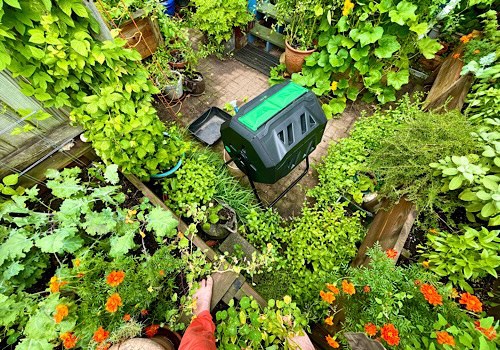
I practice the physical yoga postures to enhance and maintain the flexibility, agility, balance, and strength I need to get about my daily life, for example clambering about the vertical garden. Balance beam in high school was also helpful preparation.
When I paused to photograph this marker on a DC sidewalk yesterday, I wondered how many hundreds of people have walked past it–once or hundreds of times–without noticing it at all. I connected this sense of acute awareness with a conversation I had with Douglas Brooks in India, in which he said to me that he guaranteed that at that moment he was seeing more than I was seeing. He had experienced the place before, studied it extensively and intensively, and was still open to seeing. I did not take offense and none was meant. I am one who notices, but it is a given that study and experience, if one retains an openness to new understanding, maximizes the opportunity to witness.
Paul Muller-Ortega describes the expanding ability to see and understand in terms of the essential interrelationship between jnana and vijnana–book knowledge and experiential knowledge. One without the other does not permit for complete understanding. The two together, with ever-expanding and present openness is what leads to wisdom.
Thus, though I am one who tends to notice much of what is in my field of vision, I could not, on my first visit, possibly have seen as much in the immediate landscape as one who has devoted much of his life both to studying and experiencing it.

Peace and light, E — Posted with WordPress for BlackBerry.