Asana, Pranayama, and Yoga Practice | Food for the Mind (Yoga Philosophy, etc) | Meditation | Photos
Para, Apara, Para Para?
Peace and light, E — Posted with WordPress for BlackBerry.
Peace and light, E — Posted with WordPress for BlackBerry.
The two books I read while I was traveling to California (San Francisco for the delight of it and Lucerne Valley to study with Paul Muller-Ortega): Home of the Dancing Sivan, India in Mind.
The first I picked to bring because it was one on the bibliography Paul has given us to read that I had not yet read and was also something that I wanted to read in anticipation for my planned trip to to Chidambaram in December. By coincidence, while we were on this intensive, Paul showed us a video of a ceremony at Chidambaram, so I was glad to have read the book on the way there. The second, I picked up recently at the Bryn Mawr Lantern Bookshop, where I do regular volunteer work. India in Mind is an interesting collection–well-known Western voices writing about India, but collected by Pankaj Mishra, an Indian author who lives part of the time in London. Much in the collection I have read before, but the editing gives a very interesting perspective on how we in the West have related to and imagined India. More reading in preparation for my upcoming trip and for my continuing exploration of what has drawn me to the yoga over these many decades.
The five books I bought while in San Francisco (the first three from my every year or three pilgrimage to City Lights Bookstore; the last two from a used bookshop in Hayes Valley near Yoga Tree’s Hayes studio):
The Essential Tagore (a large and beautiful collection), Great Tales of Jewish Fantasy and the Occult (fantasy and magic from my ethnic heritage–why just concentrate on other cultures such as India?), White Hand Society (more on Allen Ginsberg and Timothy Leary, which ties in at a deep level to my Westerner’s understanding of Eastern mysticism); Wintering (I was captivated by Sylvia Plath in my teens and 20s; it looked like a nice book), The Violent Foam (wonderful and profoundly important poetry).
I went outside in the middle of the day to get supplies from the hardware store for plumbing repairs. An expert friend was teaching me how while doing the needed repairs.
This is one of the things I saw.
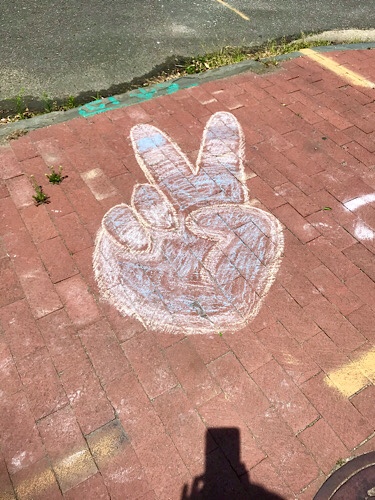
Once it was undeniable that I would be soaked from the knees down, I decided to revel in the symphony and smell of the much needed rain.
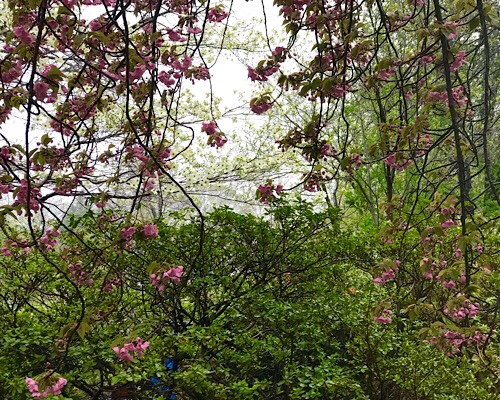
I was first taught that adhikara meant “studentship.” Although that is not a literal translation, adhikara implies a dedication and steadiness in the student that makes the student worthy of receiving the teachings (of yoga). As I was steadying myself during this momentous time and working in the garden, I was thinking about how the principle of adhikara applies to so many aspects of life, including gardening and being a citizen.
One of the literal translations for adhikara is “competence.” What is the competence one needs to have in order to participate in the study? As I harvested the last of the peppers and eggplants and pulled up the plants, making room to sow another round of greens (not too late in my sunny, protected yard in the city), and decided to leave the orchids out for another week, I thought about how I knew what to do when in my garden. By being present and observant for two decades in my yard alone, I have grown competent to know what will likely grow in my little patch of earth and for how long into the season, depending on the year’s weather. My initial competence, when I started this garden almost 20 years ago, was some basic training in other gardens, reading technical books, and enthusiasm. My consistent efforts to learn yielded results delightful to me from the beginning. As I have continued my studentship in the garden, my appreciation grows. The same is true for me also with cooking, relationships, and my participation in the community (not necessarily in that order).
The fundamental competence of a student is having the basic skills to participate at the level of the teachings. For a gardener, it is recognizing our climate, our space limitations, and our soil, and being open to learning what can be changed in a particular space and what must be accepted. For a citizen, it is knowing basic civics, what are the most relevant issues for us and society at large, and what we can change and what we must accept (I think knowing the subtle differences between what we can change and what we must accept is incredibly difficult). For yoga, it is much the same: we must know what are true limits and what are false ones and be consistently present, practice steadily, and be ever open, not only to studying, but to the fruits of study (expected or not).
I cannot change the weather, nor guarantee how other voters will vote, but I can continue to maintain the adhikara necessary to be a fully engaged student of this life on all days and not just the days it is fun or gratifying. The yoga, on a day like today, is to act fully, accepting, and perhaps even appreciating, the limits on what I can control.