It Happens Sometimes
Some mornings when I sit for meditation, the goddess incarnated as cat decides it is time for a twenty minute belly rub. Though I might do so meditatively and though her name is Uma, it is not quite meditating.

Some mornings when I sit for meditation, the goddess incarnated as cat decides it is time for a twenty minute belly rub. Though I might do so meditatively and though her name is Uma, it is not quite meditating.
A rather conservative co-worker, who was one of the people who would have to go grocery shopping last night lest the family be without perishable food for a few days, was talking to me about the impending snowstorm (including me advising him of the one forecast for next Tuesday/Wednesday). “It shows,” he said, “how easily our infrastructure and food supply can be disrupted.” I gave it a little pause, and then replied, “this is why I talk about gardening in our own yards and switching away from agribusiness to a more sustainable and self-sustaining way of living and seek to shift myself, though it is difficult.” He said, “hmmm,” letting the idea stick in his mind, but not wanting to carry the discussion further. I know him well enough to have dropped it for the time, but also know he will think about it and perhaps over the years, for his beloved daughters or out of perceived necessity, start making small shifts.
In yoga practice, the concept of suddha vidya — illuminative wisdom — is both revealed and practiced. When we start practicing or even before, we may have occasional and early insights into fundamental truths of being, but without steady practice and contemplation they will be fleeting and not shift our way of living. If we practice and study continuously, though, our insight will become steadier, more consistent, and will start to illuminate all states of our being on and off the mat. The more I practice, the more it is illuminated for me the connection of all beings and my need to live in a way that is more open, tolerant, loving, and aligned with the complex web of our interconnection. My co-worker’s insight might not have been “yoga,” but it was indeed a moment of illuminative wisdom in its recognition of a misalignment of society that tears at the fabric of our being.
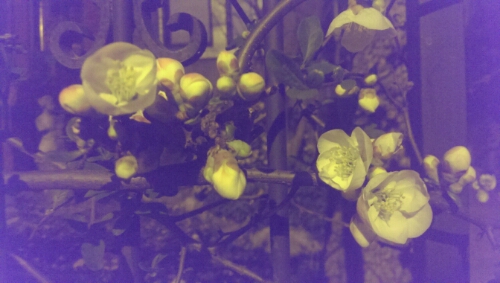
Quince on a neighbor’s fence
The other night after yoga class, a group of us went out to celebrate a friend’s 39th birthday. During the ambling course of the conversation, I said that I was turning 50 later this year. I added that I would grow my hair another couple of inches longer and lose three pounds, and 50 would be just fine (let’s leave aside for now all the societal conditioning that goes along with feeling that such an age marker wouldn’t feel too old as long as my hair was long and my body at a youthful weight).
“Who goes on a diet to lose three pounds?” asked one of my friends. I find that people sometimes look at me and are shocked that I pay attention to my weight. They have an idea that someone who stays slim is just lucky rather than consistently mindful. My grandmother who was 4’11” in her high-heeled slippers was the one who taught me to be mindful in this way. Once or twice a year, she would moderate her diet to lose the two pounds that crept on after one too many desserts over the course of a few months without any other change in her modest, healthful for those days diet.
Going on a diet to lose three pounds means never having to lose 10 or 20 pounds or more. It means returning to mindfully eating a little extra less for a couple of weeks after a couple of months of having eaten a little more than what is perfectly sustaining rather than having to go through a major lifestyle change. In my middle age, I pay attention to my diet not as much for how I look in my clothes and feel about my body, but more for whether what I am eating is healthy for me and the planet. One of the best and easiest ways to be at an optimal weight, feel healthier, and have less impact on the planet is simply to eat less (though this is a new announcement by the government, any one with even an ounce of common sense knew that, no matter how much exotic, novel, or challenging diets seemed more appealing).
Part of eating the right amount for your ideal fit with your body and its relationship to the planet and society is having food that is not necessary for a healthy body only on special occasions (which is different than rigidly forbidding it to yourself). In reviewing what is sustaining for me and the planet while still enjoying a delicious diet, I periodically take a look at what I am eating and think about what is really fulfilling. One of the things I enjoy, but have known really should be a treat is orange juice (which I stopped drinking on other than an occasional basis several months ago and truly have not missed).
If you are eating multiple servings of vegetables and a piece or two of fruit a day, orange juice processed, packaged, and shipped outside of a grower state provides little more benefit to your diet than does a can of soda. If you kept everything else in your diet consistent and aren’t already eating enough to be gaining weight, eliminating the unnecessary glass of juice would not only diminish your carbon footprint (and if it is not organic, your chemicals into the drinking water footprint as well as your carbon footprint), but you also would be eliminating the number of calories it takes to gain a pound over the course of a month. And if you live in one of those states covered in snow and ice and are yearning to eat something from the land of sunshine, eat an orange or some other tropical fruit–organic if you can get it — and skip the processing, the cooking (pasteurizing), and some of the packaging that goes into it being shipped to your grocery store as juice.
Did you notice the clouds, a blossom, something of joy while still recognizing and doing what you can with the world being as it is in these times?
Towards the end of a yoga session I start thinking about what would be a good theme for the next. I start by observing what is going on in the world — from the change of seasons, to whether it is rainy or drought, to what is going on in the political climate, noticing what is recurring in my own practice and the practices of my students, watching what is arising in my contemplations and meditations, and seeing what is resonating most in what I am learning from my own teachers. I will go into my library, reading and rereading things to see what resonates with what I am observing and experiencing. I also take into account the length of the session to be sure that it will fit well within the number of classes. Once I have set the session theme, I spend the week in which I will teach a particular principle, contemplating it, reading about it, practicing with it, and thinking about its relationship to my life off of the mat.
When I selected the tattvas this session it was for a whole array of reasons (some of which have been set out in previous posts). The order I picked to teach them, and which I chose to emphasize, were for what I thought would be the best way to share knowledge and experience and not for the outside calendar. It was then, by sheer serendipity that the themes fit as they did with the calendar:
Now this week, the last week of the session, parama shiva — the highest tattva. Shiva tattva is the most subjective principle and the most universal. It represents the essence of being (sat), consciousness (cit), and bliss (ananda). It is everywhere and nowhere, in all beings and not. It is whatever ever we think of as spirit or force or web of being or light or pulsation or divine — whatever we believe is the very essence of being. It is most interesting that by my series of contemplations and choices over the winter holidays, that I gave myself the homework assignment, as it were, to be specifically contemplating, practicing with, and studying the shiva tattva as I offer peace to Becky as she departs and seek my own peace in my grief over the loss of her physical presence.