Signs Around Town
Walking home after another 11-hour work day.
Walking home after another 11-hour work day.
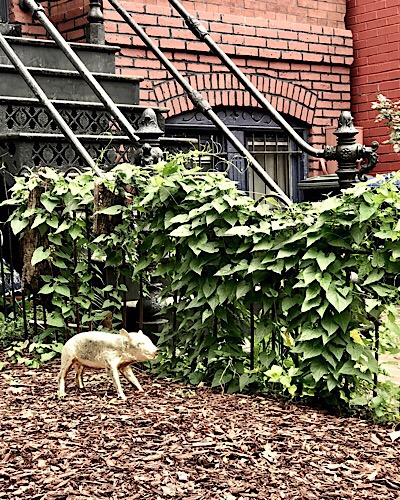
I think it highly unlikely that the neighbor who chose to decorate a front yard with a silver-painted pig and wood chips intended in any way to reference Vishnu in his incarnation as a boar. But as I’m caught up in learning about the animal chariots and incarnations of the 330 million these days, that is what came to mind for me.
There’s a story that Vishnu incarnated as a boar to kill a demon who could not be killed by man or god (similar to the story about Durga slaying Mahisha, the buffalo demon).
When in anthropomorphic form, Varaha is often seen with Bhudevi (Earth goddess) and sometimes also Lakshmi. There she is again–Lakshmi–calling to me to remind me to act from my abundance (from there comes my capacity to slay demons).
I have had a more stressful than usual couple of weeks at the office. While I was walking into the office, I was thinking about how the more deadlines I needed to meet and the more difficult interchanges I had to bring to the most optimal resolution, the harder it was also to have energy to give to those who are in far greater need, though I seek ways to be of service.
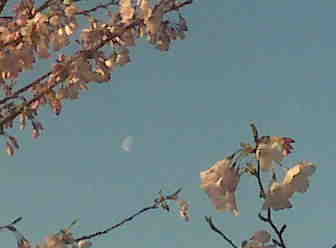
When I saw the oversized half moon dwarfed by the cherry blossoms, it helped put things in perspective. Nothing I do immediately impacts life or death. A hard week does not mean much in my life as a whole, my tribulations are only so much play in the midst of the outrageous ground of all human being, human being is only one small part of life on this planet in this galaxy in this universe, and who knows how vast is the realm of consciousness. I smiled at the moon and the blossoms and thought of their beauty throughout the day.
Peace and light, E — Posted with WordPress for BlackBerry.
The teachings can be found almost everywhere–as long as we are open to receiving them.