On This Boxing Day
On this Boxing Day, day after another Christmas with no tree on which to perch, the Christmas tree top angel, looking more like a fairy godmother, found a dance with Shiva Nataraja and his cohort.
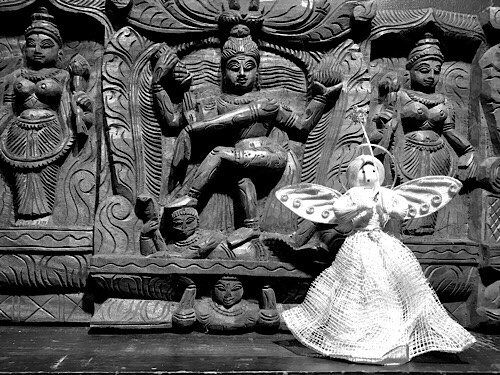
On this Boxing Day, day after another Christmas with no tree on which to perch, the Christmas tree top angel, looking more like a fairy godmother, found a dance with Shiva Nataraja and his cohort.
It is when we believe only one way is the way for all that we become subject to the perils of tyranny and divisiveness.
Nonetheless, as the yogic philosophers tend to teach, each individual is most likely to find depth of knowledge, experience, and conviction sticking to a single path.
Which way is this way?

Peace and light, E — Posted with WordPress for BlackBerry.
Looked at from one perspective, the yoga teachings say that outer peace will come from the cultivation of inner peace. I do think that it is hard to wage peace on a global level if one does not truly cultivate inner love and peace. Where I differ from some is that I do not believe it is sufficient to take care of your own inner peace without a care for how one fits into the global web.

Peace and light, E — Posted with WordPress for BlackBerry.
The dance of yoga is about motion in stillness and stillness in motion, and in not letting oneself be frozen. Stillness is the space between vibrations, instead of the shutting down or closing off vibration. To experience the space between the vibrations (spanda) when changing shapes (poses; going from one thing to the next), one must emerge into the shape and disssolve out of it, with the expanding delight of the coming and going more important than achieving some precise, required shape to demonstrate self-control and mastery (not unlike the teaching in the Siva Sutra that knowledge both binds and liberates).

On this day when billions contemplate an idea of resurrection, I find myself thinking that when too much energy is being consumed with continuous destruction, it is hard for resurrection or renewal or rebirth to manifest.
One of the offerings in John Friend’s Anusara Teacher Training Manual, is the “four gates of speech,” which I believe comes from Buddhist practice. The four gates are:
1. Is it truthful?
2. Is it necessary to say?
3. Is it the appropriate time?
4. Is it a kind thing to say?
It is easy to see this application in terms of speaking with others, though not always easy to practice, especially in a group setting where the culture is to condemn and criticize.
A more subtle practice of the four gates is how we talk to and about ourselves. I am someone who was raised to have a very strong internal judging voice. Although with the steady practice of yoga affirmation, my tendency for self-judgment has eased, the propensity reasserts itself when I am stressed. I have taken to asking myself, when I hear the judging voice, does it pass the four gates of speech? I find it a challenging practice, but a necessary one. When we honor ourselves (we can honor ourselves and our own light and still know there are ways we would benefit from expanding or shifting), we will more easily honor, recognize, and affirm the light in others.